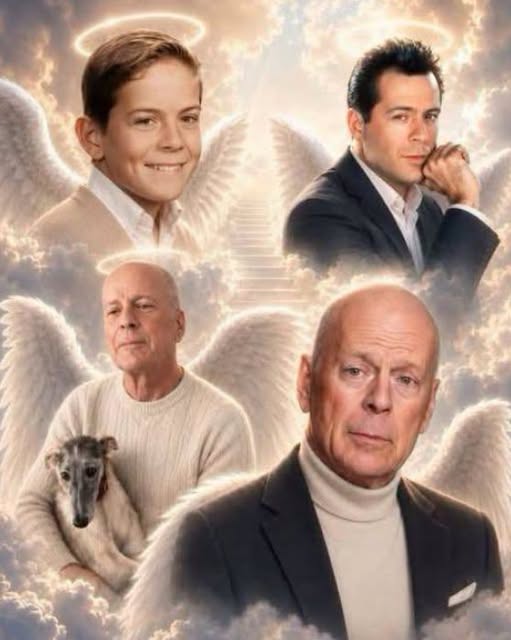
Farewell to a Legend: Remembering Bruce Willis and His Extraordinary Legacy
There are some actors who entertain us, and then there are actors who become part of our memories. Bruce Willis belongs to the second group. For decades, his face, voice, humor, toughness, and unmistakable screen presence helped define some of the most memorable moments in modern Hollywood. From action-packed blockbusters to heartfelt dramas and comedies, Willis built a career that reached generations of movie lovers around the world.
The phrase “farewell to a legend” can feel especially emotional when talking about Bruce Willis. However, it is important to separate emotional headlines and social-media rumors from confirmed facts. Bruce Willis is living with frontotemporal dementia, a condition his family publicly disclosed in 2023. His family has asked the public for compassion and privacy as they navigate this difficult chapter together. A farewell, therefore, does not have to mean a confirmed death. Sometimes, it can simply mean saying goodbye to the version of an artist we knew through decades of unforgettable performances.
Bruce Willis was born on March 19, 1955, in Idar-Oberstein, West Germany, and grew up in New Jersey. Before becoming one of Hollywood’s biggest stars, he worked a variety of jobs and pursued acting with determination. His breakthrough came with the television series Moonlighting, where he played David Addison opposite Cybill Shepherd. His charisma, comedic timing, and natural confidence quickly made him a recognizable television personality.
But it was Die Hard that transformed Willis into an international superstar.
Released in 1988, Die Hard introduced audiences to John McClane, a New York City police officer caught in an extraordinary hostage crisis inside a Los Angeles skyscraper. McClane was different from the nearly invincible action heroes audiences had become accustomed to seeing. He was vulnerable, sarcastic, frightened, injured, and exhausted. Yet he continued fighting because people needed him.
That combination of toughness and humanity became one of Willis’s greatest strengths.
John McClane became one of cinema’s most recognizable characters, and the success of Die Hard launched a major franchise. Willis would return to the role several times, helping establish a character whose humor and determination became an enduring part of popular culture.
But reducing Bruce Willis to Die Hard would overlook an enormous and diverse career.
He appeared in films such as Pulp Fiction, The Sixth Sense, Armageddon, The Fifth Element, 12 Monkeys, Unbreakable, Sin City, and many others. His performances ranged from action and science fiction to psychological thrillers, comedy, romance, and drama.
In Quentin Tarantino’s Pulp Fiction, Willis played Butch Coolidge, a boxer facing difficult choices and dangerous consequences. The role demonstrated that Willis could step outside the traditional action-hero image and become part of an unconventional ensemble filled with complex characters.
Then came The Sixth Sense, one of the defining supernatural thrillers of its era. Willis played Dr. Malcolm Crowe, a child psychologist trying to help a troubled young boy. His quieter performance showed another side of the actor, proving that he could create emotional impact without relying on explosions, gunfights, or one-liners.
His career was also filled with films that became cultural landmarks. Armageddon combined science fiction, disaster spectacle, humor, and emotional drama, while The Fifth Element allowed Willis to embrace a more playful and futuristic style.
One of the most remarkable things about Bruce Willis was his ability to make audiences believe in his characters. Whether he was playing a reluctant hero, a troubled professional, a mysterious stranger, or an ordinary man facing extraordinary circumstances, he often brought a sense of realism to larger-than-life stories.
His appeal was not simply physical toughness. It was his humanity.
Willis frequently portrayed characters who were imperfect. They made mistakes. They complained. They were afraid. They sometimes had no idea how they were going to survive the situation in front of them. Yet they kept moving forward.
That quality made his characters relatable.
For many fans, Bruce Willis was not just a movie star. He was part of their childhood, teenage years, family movie nights, and favorite memories. Someone may remember watching Die Hard for the first time with a parent. Another person may remember The Sixth Sense frightening them in a movie theater. Someone else may remember laughing at his performances in comedies or being amazed by the futuristic world of The Fifth Element.
These memories are part of his legacy.
In recent years, Willis’s life changed dramatically after his family announced his diagnosis of frontotemporal dementia, commonly known as FTD. The condition can affect communication, behavior, personality, and other cognitive abilities. His family has spoken openly about the challenges while also emphasizing the importance of awareness and support for others affected by dementia.
The public response has been filled with affection from fans, fellow performers, and colleagues.
There is something deeply human about seeing a legendary performer enter a stage of life where the spotlight is no longer important. The action hero who once raced through skyscrapers and battled impossible odds now represents something much quieter: the importance of family, dignity, love, and being surrounded by people who care.
His family has remained at the center of his life. Their support has reminded fans that behind every famous actor is a person with relationships, memories, joys, struggles, and a private life far more important than Hollywood fame.
This is why a farewell to Bruce Willis should not simply be a sad goodbye.
It should be a celebration.
We can celebrate the characters he gave us. We can celebrate the laughter, suspense, excitement, and emotion. We can remember the famous scenes and unforgettable lines without turning his personal health journey into sensational entertainment.
Most importantly, we can respect the wishes of his family.
The entertainment industry changes constantly. New stars appear, new movies dominate theaters, and new technologies transform filmmaking. Yet certain performers leave an imprint that does not disappear when their careers slow down.
Bruce Willis is one of those performers.
His legacy lives through the films people continue to watch. It lives through the characters that are still quoted. It lives through fans who introduce his movies to younger generations. And it lives through the simple feeling that comes when an old favorite film begins and that familiar voice appears on screen.
Legends are not remembered only because they were famous.
They are remembered because they made people feel something.
Bruce Willis made audiences laugh, cheer, worry, cry, and sometimes jump out of their seats. He played heroes who were beaten down but refused to surrender. In that sense, many of his characters reflected something universal about life: strength is not the absence of weakness. Strength is continuing despite it.
As fans look back at his career, perhaps the most meaningful tribute is not to focus on rumors or dramatic headlines. Instead, remember the work.
Remember John McClane crawling through the halls of Nakatomi Plaza.
Remember Butch Coolidge making impossible choices.
Remember Dr. Malcolm Crowe trying desperately to help a frightened child.
Remember Harry Stamper and the emotional journey of Armageddon.
Remember the countless other characters who helped make Bruce Willis one of the most recognizable performers of his generation.
And remember the person beyond the screen.
A career lasting decades is an extraordinary achievement. Millions of people around the world have been touched by Bruce Willis’s work, and that connection cannot simply disappear.
A farewell does not have to erase a legacy.
Sometimes, farewell means pausing to say, “Thank you.”
Thank you for the movies.
Thank you for the laughter.
Thank you for the unforgettable characters.
Thank you for the moments that became memories.
And thank you for reminding audiences that even the toughest heroes can be vulnerable, human, and imperfect.
Bruce Willis’s story is still more than a headline. It is the story of an actor who rose from humble beginnings, conquered television and Hollywood, became one of the defining action stars of his generation, and left behind a body of work that continues to entertain millions.
So rather than allowing an alarming “farewell” headline to become another unverified rumor, let us use the moment to celebrate an extraordinary career and show compassion toward Bruce Willis and his family.
The world may always know him as the man who ran through explosions, fought impossible enemies, delivered unforgettable one-liners, and somehow survived when everyone else thought the odds were hopeless.
But his greatest legacy may be simpler.
He made people remember.
And as long as audiences continue watching his films, laughing at his jokes, cheering for his characters, and sharing those movies with future generations, the legend of Bruce Willis will continue.
Some stars fade when the cameras stop rolling.
Others become part of cinema forever.
Bruce Willis is one of them.