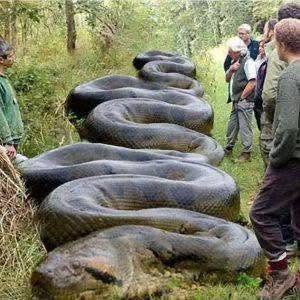
Hiker Encounters Massive Snake Camouflaged Along South Carolina Creek
A peaceful hike through a South Carolina park turned into an unforgettable wildlife encounter when a hiker spotted a large snake resting almost perfectly camouflaged along the edge of a creek.
At first glance, the animal could easily have been mistaken for part of the landscape. Its body blended into the vegetation and natural surroundings, making it difficult to notice until the hiker was close enough to realize that what appeared to be a root or branch was actually a living snake.
The encounter reportedly happened at Jeffries Creek Park in Florence, South Carolina. The hiker, Meredith Langley, later shared photographs and described what she had seen, hoping that other people enjoying the outdoors would understand the importance of paying attention to their surroundings.
According to reports about the encounter, the snake appeared to be approximately four to five feet long. For anyone who is not accustomed to seeing large snakes in the wild, that is certainly enough to produce a moment of surprise.
Imagine walking beside a peaceful creek, enjoying the sound of flowing water and the surrounding trees, when suddenly you realize that the “branch” beside the trail has eyes.
That was the kind of unexpected moment that made this encounter so memorable.
The snake reportedly remained calm and did not appear interested in attacking or chasing anyone. The hiker described it as watching quietly rather than behaving aggressively. She also emphasized an important principle of wildlife encounters: people are visitors in the animals’ environment.
That perspective is worth remembering.
When humans enter parks, forests, wetlands, and creek areas, they are entering places where wild animals already live. Snakes, birds, turtles, frogs, deer, insects, and countless other creatures are simply going about their daily lives.
A snake lying beside a creek is not necessarily looking for trouble. It may simply be resting, warming itself, searching for food, or moving between different parts of its habitat.
In this particular case, the snake’s appearance caused considerable discussion online. Some people who saw the photographs immediately wondered whether it was a cottonmouth, a venomous snake that occurs in parts of the southeastern United States.
The appearance of water snakes can sometimes make identification difficult for people who are unfamiliar with local species. Some harmless snakes can look surprisingly intimidating, especially when photographed from close range.
However, according to the report, Sean Foley, curator of herpetology at Riverbanks Zoo & Garden, identified the animal as a brown water snake, a nonvenomous species.
That identification changed the story considerably.
Rather than being a dangerous predator waiting to attack a passing hiker, the snake was apparently a harmless wild animal doing what snakes naturally do.
Brown water snakes are associated with aquatic environments and can be found around waterways. Their relationship with creeks and other bodies of water makes an encounter like this entirely understandable.
They are also capable of using defensive behaviors when they feel threatened.
According to the report, water snakes may flatten their heads and shake their tails when threatened, behaviors that can make them appear more intimidating. These actions are defensive rather than evidence that the animal is actively looking for a fight.
This is an important lesson for anyone who spends time outdoors.
Fear can cause people to make dangerous decisions. Someone who suddenly sees a large snake might instinctively try to get closer for a photograph, poke it with a stick, throw something at it, or attempt to move it.
Those are precisely the kinds of actions that should be avoided.
The safest response to a wild snake is usually to give it plenty of space.
If the animal is on or near a trail, hikers can calmly move away and allow it an opportunity to leave. There is generally no reason to approach a snake simply because it looks interesting.
Wildlife photography is another matter, but photographs should be taken from a safe distance. Modern phone cameras can capture surprisingly detailed images without requiring someone to stand directly beside an animal.
The encounter also demonstrates how effective natural camouflage can be.
Many snakes have coloring and patterns that allow them to blend into leaves, branches, mud, rocks, and vegetation. This is not an accident. Camouflage is an important survival strategy that can help animals avoid predators and approach prey without being noticed.
For hikers, that means looking carefully at the ground and surrounding vegetation is important, particularly near water.
Creeks and wetlands can provide ideal habitat for many animals. A person walking through these environments may encounter snakes, turtles, frogs, birds, insects, and other wildlife.
Most encounters are completely uneventful.
The animals usually want the same thing humans do: to continue on their way without being disturbed.
The story also highlights why accurate species identification matters.
A large snake can look frightening in a photograph, especially when the image is taken from an unusual angle. Online discussions can quickly turn an unidentified animal into a supposedly dangerous creature.
That is why people should be careful before labeling a snake as venomous.
Misidentification can create unnecessary fear and can also encourage people to harm animals that pose little threat.
In this case, the initial speculation about a cottonmouth was reportedly corrected by an expert who identified the snake as a brown water snake.
That small detail changes the entire meaning of the encounter.
Instead of a story about a dangerous monster lurking beside a trail, it becomes a fascinating example of ordinary wildlife being discovered by an observant hiker.
For the hiker and her children, the experience also became an opportunity to demonstrate respect for nature.
That message may be the most valuable part of the story.
Wild animals do not need to be feared simply because they are unfamiliar. At the same time, respect does not mean forgetting that they are wild. The best approach is a combination of curiosity and caution.
Watch from a distance.
Do not corner the animal.
Do not attempt to touch it.
Keep children and pets away.
And give the animal a clear opportunity to move away.
These simple habits can make outdoor experiences safer for both people and wildlife.
The South Carolina snake encounter may have lasted only a few minutes, but the photographs and story quickly captured people’s attention. Some viewers were amazed by the snake’s size, while others were surprised by how effectively it disappeared into its surroundings.
It is easy to understand why.
There is something fascinating about discovering an animal that was hiding in plain sight.
A creek that looks completely ordinary can contain an entire ecosystem. Beneath the surface and among the vegetation are animals living lives that hikers may never notice.
That is part of the magic of exploring nature.
Every trail has surprises.
Every creek has its own wildlife.
And sometimes, one of those surprises is a four- or five-foot snake quietly resting beside the water.
The lesson from this encounter is not that hikers should be terrified of snakes. Instead, it is that they should become more observant and respectful when exploring natural areas.
The next time you walk beside a creek, look carefully at the vegetation. Listen to the sounds around you. Pay attention to where you step. And if you happen to discover a snake hiding among the leaves, remember that you are seeing a wild creature in its natural home.
Take a moment to appreciate the encounter from a safe distance.
Then let the snake continue on its way.
After all, the most memorable wildlife experiences are often the ones we never expected to have.