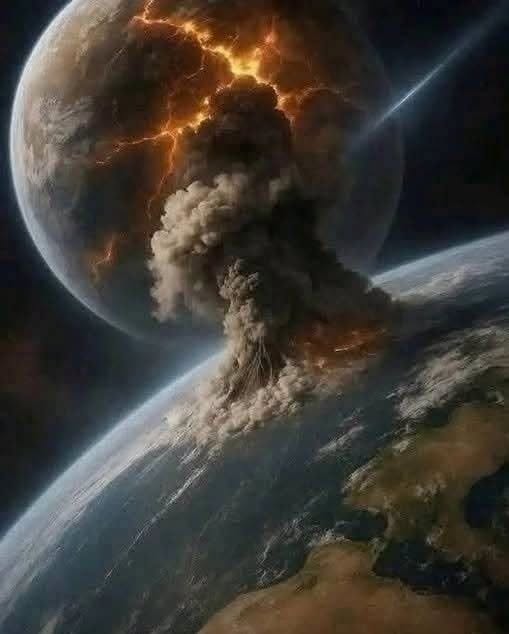
BREAKING NEWS: NASA Confirms Earth Is Entering a New Era in 2026 — What Scientists Are Watching Closely
For weeks, a dramatic headline has been spreading across social media: “NASA confirms that in 2026, Earth will begin to…” The unfinished sentence has been enough to trigger thousands of comments, shares, and anxious questions.
Will Earth suddenly become uninhabitable? Could the planet lose its gravity? Is a massive asteroid approaching? Could the Sun cause an unprecedented disaster?
The reality is far less mysterious—but still fascinating.
NASA has not announced that Earth will suddenly end, lose its gravity, become permanently dark, or become uninhabitable in 2026. In fact, NASA’s own scientific information shows that many of the most frightening claims circulating online are misleading or completely unsupported. Similar viral claims have previously alleged that Earth would lose gravity for several seconds, forcing NASA to publicly reject the story.
But there are genuine changes happening on our planet, and scientists are watching them carefully.
Earth Is Changing
From space, Earth can appear perfectly stable—a blue sphere floating peacefully against a black background. But beneath that familiar appearance, enormous changes are taking place.
NASA satellites have spent decades measuring Earth’s atmosphere, oceans, ice sheets, land surfaces and temperature. NASA’s Earth science program monitors several major areas, including sea-level rise, air quality, wildfires, greenhouse gases, agriculture and changes in Earth’s climate.
According to NASA, Earth’s average surface temperature has risen by roughly 1 degree Celsius, or about 2 degrees Fahrenheit, since the late 19th century. The oceans have also absorbed much of the additional heat trapped in the climate system. Meanwhile, Greenland and Antarctica have been losing enormous amounts of ice.
These changes are not something that suddenly begins on one particular day in 2026. They are part of long-term processes that scientists have been measuring for decades.
And that distinction is important.
What Happens in 2026?
The year 2026 itself is not a magical deadline for Earth.
There is no scientific evidence that humanity will suddenly wake up one morning to a completely different planet.
Instead, 2026 represents another year in an ongoing period of intense scientific observation.
Scientists will continue measuring temperatures, ocean conditions, atmospheric gases, ice loss and changes in Earth’s surface. Each new year provides additional data that can help researchers understand how rapidly our planet is changing.
One particularly interesting area is Earth’s rotation and movement.
NASA-funded research has found that changes involving groundwater, melting ice sheets, glaciers and sea-level changes can influence the movement of Earth’s spin axis. Researchers found that these factors explained a large portion of recurring changes in polar motion during the period they studied.
That does not mean Earth is about to stop spinning.
It means our planet is a dynamic system, and even changes in where water is stored can have measurable effects on how Earth moves.
What About Asteroids?
Whenever headlines mention NASA and the future of Earth, asteroid fears quickly appear.
NASA does track potentially hazardous asteroids and comets. Its planetary-defense programs continuously monitor objects that pass relatively close to Earth and calculate their future trajectories.
But the scientific picture is reassuring.
NASA says it is highly unlikely that an asteroid large enough to cause widespread damage will strike Earth during the next century or more, based on current knowledge of the near-Earth asteroid population.
That doesn’t mean scientists stop looking.
Quite the opposite.
The reason NASA continues searching for asteroids is simple: finding an object early gives scientists much more time to calculate its orbit and determine whether it represents a genuine threat.
A recent example showed why continuous monitoring matters. NASA’s planetary-defense work has demonstrated how new observations can dramatically change the calculated risk of an asteroid. In the case of asteroid 2024 YR4, additional observations eventually reduced the impact probability to well under 1%, and the object was no longer considered a potential Earth impactor.
The Real Story May Be More Interesting
While viral posts focus on apocalyptic predictions, NASA is actually looking much farther into the future.
Scientists know that Earth will not remain exactly as it is forever.
The Sun itself is slowly changing. Billions of years from now, its evolution will dramatically transform the solar system. Scientific models indicate that Earth will eventually become hostile to complex life long before the Sun reaches its later red-giant phase.
But those timescales are measured in billions of years, not months.
So when a social-media post claims that NASA has discovered that Earth will suddenly become uninhabitable in 2026, readers should immediately ask an important question:
Where is the original NASA announcement?
If there is no NASA publication, scientific paper, mission statement or official agency announcement supporting the claim, the headline should be treated with extreme caution.
A New Window Into the Universe
Interestingly, 2026 really is an extraordinary year for space science.
NASA and its partners continue operating some of humanity’s most powerful observatories and spacecraft. The James Webb Space Telescope is studying the universe across enormous distances, investigating everything from early galaxies to the formation of planetary systems.
NASA’s growing fleet of missions is also expanding humanity’s ability to study planets, asteroids, stars and distant galaxies.
The Nancy Grace Roman Space Telescope is another major part of that effort. Its mission is designed to investigate dark energy, dark matter and exoplanets while creating enormous astronomical surveys. Recent reporting says the telescope launched in August 2026 and will complement observations made by instruments such as Webb and Hubble.
So perhaps the real “beginning” of 2026 is not the beginning of Earth’s destruction.
It is the beginning of another chapter in humanity’s ability to observe our planet and the universe around it.
Don’t Let Fear Replace Science
The internet moves faster than scientific research.
A dramatic sentence can be shared millions of times before anyone checks whether it is true. Adding the words “NASA confirms” can make a claim appear authoritative even when NASA never made such a statement.
That is why readers should be careful with headlines promising catastrophe.
Earth is changing. Climate change is real. Ice is disappearing. Oceans are warming. Scientists are monitoring asteroids. Earth’s rotation and movement can change in subtle ways.
But none of those facts means NASA has predicted the destruction of Earth in 2026.
The real story is both less frightening and more important.
Our planet is a complex system, and scientists are watching it more closely than ever before.
Every satellite image, temperature measurement, ocean observation and astronomical discovery gives humanity another piece of the puzzle.
And perhaps that is the most important message behind the viral headline:
2026 is not necessarily the year Earth ends. It is another year in which humanity gets a clearer look at what is happening to the only planet we call home.
The future remains uncertain—but science gives us something more valuable than frightening predictions.
It gives us evidence.
And evidence is where the real story begins.