Baby Born While an IUD Was Still in Place: The Medical Story Behind the Headline
A headline claiming that a baby was born while an IUD was still in place can sound almost unbelievable. For many people, the first reaction is confusion: How could someone become pregnant with an intrauterine device? And what happens to the baby if the device remains in the uterus?
Although intrauterine devices are among the most effective forms of reversible contraception, no contraceptive method is 100 percent effective. Pregnancy with an IUD in place is uncommon, but it can happen. When it does, doctors take the situation seriously because the pregnancy has a higher risk of certain complications.
An IUD, sometimes casually called an intrauterine contraceptive device, is a small device placed inside the uterus to prevent pregnancy. There are two major types: copper IUDs and hormonal IUDs. Both are highly effective, but they work in different ways.
A copper IUD releases copper ions that interfere with sperm movement and fertilization. Hormonal IUDs release a small amount of levonorgestrel, which thickens cervical mucus and makes it more difficult for sperm to reach an egg. Hormonal IUDs also change the uterine lining and can suppress ovulation in some users.
Because these devices are extremely effective, pregnancy while one is correctly positioned is rare. But “rare” does not mean impossible.
What happens if pregnancy occurs?
If someone with an IUD discovers that they are pregnant, medical evaluation is important.
One of the first concerns is determining where the pregnancy is located.
This matters because an IUD pregnancy has an increased concern for ectopic pregnancy. An ectopic pregnancy occurs when a fertilized egg implants outside the main cavity of the uterus, most commonly in a fallopian tube. An ectopic pregnancy cannot develop normally and can become a medical emergency.
Doctors may use pregnancy testing, ultrasound, blood tests, and other examinations to determine the location and condition of the pregnancy.
If the pregnancy is confirmed to be inside the uterus, doctors then assess the position of the IUD and whether its strings can be safely accessed.
Can the IUD be removed?
In many cases, if an IUD pregnancy occurs and the device can be safely removed, healthcare professionals recommend removing it as early as possible.
However, this is not something a pregnant person should attempt to do themselves.
Removing an IUD requires medical evaluation because the device is located inside the uterus. A healthcare professional must consider the position of the device, the stage of pregnancy, and the potential risks involved.
If the IUD strings are visible and removal is considered appropriate, a clinician may be able to remove the device carefully.
If the strings cannot be seen, additional evaluation may be necessary.
The decision is individualized because attempting to remove a device incorrectly can cause injury.
What if the IUD remains?
If the IUD cannot be safely removed, the pregnancy may continue under close medical supervision.
Having an IUD remain in place during pregnancy is associated with increased risks, including miscarriage, infection, premature delivery, and other pregnancy complications.
That does not mean that every pregnancy involving an IUD will have a tragic outcome.
Some pregnancies do continue successfully.
However, doctors generally consider these pregnancies higher risk and may monitor the mother and developing baby more closely.
This is one reason sensational headlines can be misleading. A headline may make it sound as though the device physically surrounds or directly harms the baby throughout pregnancy. In reality, the exact situation depends on the location of the IUD, the pregnancy, and how the uterus changes during gestation.
What does “born with an IUD” really mean?
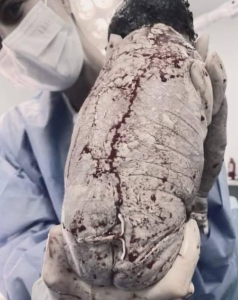
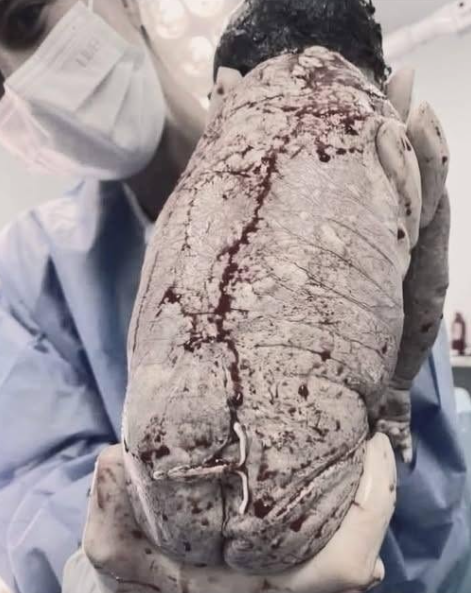
Social-media headlines sometimes use phrases such as “baby born holding an IUD” or “baby born with an IUD.”
These descriptions can be dramatic, but they may simplify what actually happened.
In some documented cases, the IUD was discovered near the baby at delivery or became visible after birth. Photographs can then spread rapidly online.
However, an image alone does not tell the entire medical story.
It does not necessarily mean that the IUD was physically attached to the baby or that the baby developed around the device.
The exact circumstances must be established through medical records and professional reporting.
This distinction is important because viral posts frequently turn unusual medical events into exaggerated stories designed to generate clicks.
Can an IUD harm a developing baby?
An IUD is designed to prevent pregnancy, not to remain inside the uterus during pregnancy.
When pregnancy occurs with an IUD still present, the primary concern is the increased risk of complications associated with the pregnancy and the device.
The situation is therefore monitored carefully by healthcare professionals.
People should not interpret an unusual birth story online as evidence that IUDs are generally dangerous. For people who are appropriate candidates, IUDs are widely used and considered highly effective forms of contraception.
The unusual nature of these cases is precisely why they attract so much attention.
Why do IUD pregnancies happen?
There are several possible explanations.
Sometimes an IUD may be expelled from the uterus without the person realizing it. This can reduce contraceptive protection.
An IUD can also occasionally move from its intended position, particularly around the time it is inserted or afterward.
Insertion itself is a medical procedure, and correct placement is important for effectiveness.
Because of this, healthcare providers may recommend checking the IUD periodically according to the instructions provided for that particular device.
If someone cannot feel the strings when they normally could, feels that the strings have changed significantly, experiences unusual pain or bleeding, or suspects that the device has moved or fallen out, they should contact a healthcare professional.
What should someone do after a positive pregnancy test?
A person who has an IUD and receives a positive pregnancy test should contact their healthcare provider promptly.
They should not attempt to pull the device out themselves.
Medical professionals can determine whether the pregnancy is inside the uterus, locate the IUD, and decide what steps are safest.
Urgent medical attention is especially important if pregnancy is accompanied by severe abdominal or pelvic pain, shoulder pain, fainting, dizziness, heavy bleeding, or weakness, because these symptoms can occur with serious complications such as ectopic pregnancy.
The human side of these stories
Behind every unusual medical headline is a real family.
When a baby is born under unexpected circumstances, parents may experience a mixture of fear, relief, confusion, and joy. A dramatic photograph can become an internet sensation, but the family involved may have lived through months of uncertainty before that moment.
That is why these stories deserve compassion rather than sensationalism.
A remarkable birth can certainly be shared as an educational story, but medical details should be accurate and respectful.
A reminder about viral medical headlines
The phrase “baby born with an IUD” is extremely effective at attracting attention because it sounds impossible.
But readers should always ask what the headline actually means.
Was the IUD still inside the uterus?
Was it discovered during delivery?
Was it removed during pregnancy?
Was the photograph from the same case?
Was the story confirmed by a medical professional?
Without those details, a viral headline may leave readers with an inaccurate understanding of what happened.
The bigger lesson
IUDs are highly effective contraception, but no contraceptive method eliminates pregnancy risk completely.
When pregnancy occurs with an IUD in place, doctors carefully evaluate the pregnancy and the device because certain complications become more likely. Early medical assessment is important, particularly to determine whether the pregnancy is ectopic and whether the IUD can safely be removed.
Most importantly, people should never attempt to remove an IUD themselves after discovering a pregnancy.
The internet may turn an unusual birth into a shocking headline, but the real story is more medically complex—and often more fascinating—than a few words can explain.
A baby born after an IUD pregnancy is not proof that contraception “doesn’t work.” Rather, it is an example of how even highly effective medical technologies can have rare exceptions.
The safest response to a surprising medical story is not panic.
It is curiosity, accurate information, and professional medical advice.