“13 Minutes Ago”: Viral Claim Says Russian Su-57 Destroyed U.S. Aircraft Carrier Carrying 700 Tanks
.
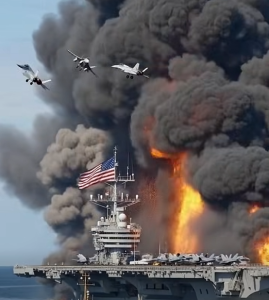
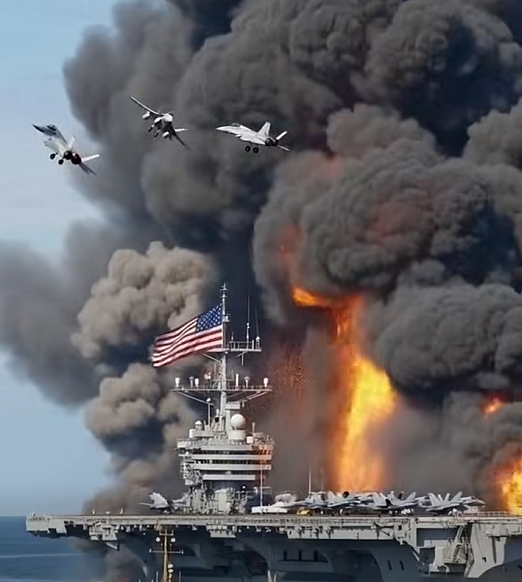
A dramatic headline circulating online claims that “13 minutes ago, a Russian Su-57 pilot destroyed a U.S. aircraft carrier carrying 700 tanks.”
The wording immediately sounds like a major military emergency.
A Russian fifth-generation fighter.
A U.S. aircraft carrier.
Hundreds of tanks.
And an alleged destruction occurring only minutes ago.
But there is a critical problem with the story: the claim has not been established by credible evidence, and the description of an American aircraft carrier carrying 700 tanks does not fit the normal role and configuration of a U.S. carrier.
That means readers should be extremely careful before sharing the headline as breaking news.
What Is the Su-57?
The Su-57 is Russia’s advanced multirole fighter aircraft, developed by Sukhoi.
It is designed for missions including air combat and strikes against ground and maritime targets. Russia has presented the aircraft as a fifth-generation fighter, emphasizing characteristics such as reduced radar visibility, advanced avionics, and the ability to employ a variety of weapons.
Because of its sophisticated design and Russia’s ongoing military operations, the Su-57 frequently appears in online military videos and sensational headlines.
However, the existence of the aircraft does not establish every claim made about it.
A photograph of a Su-57, a military exercise, or footage from a completely different event can easily be reused online and presented as evidence of a new attack.
The Aircraft-Carrier Claim Raises Questions
The most unusual part of the viral headline is the statement that the American aircraft carrier was carrying 700 tanks.
A U.S. aircraft carrier is primarily designed to operate aircraft.
Its enormous internal spaces support aviation operations, fuel, weapons, maintenance, crew accommodations, and other functions necessary to operate a carrier air wing.
It is not a conventional tank transport.
Large numbers of armored vehicles would ordinarily be transported using specialized cargo or amphibious vessels rather than an aircraft carrier.
This doesn’t mean armored vehicles can never be transported aboard ships associated with military operations. It means that the specific description of a U.S. aircraft carrier carrying 700 tanks should immediately cause readers to question the source.
Why Such Headlines Become Viral
Military headlines are particularly effective at attracting attention because they combine danger, technology, national power, and uncertainty.
A headline saying:
“Russian fighter destroys American carrier”
already has enormous emotional impact.
Adding:
“carrying 700 tanks”
makes the story sound even more extraordinary.
Adding:
“13 minutes ago”
creates urgency.
Readers may believe they have discovered information before major television networks or newspapers have reported it.
That sense of being among the first to know can encourage people to click and share immediately.
But urgency is not evidence.
What Would Happen If a U.S. Aircraft Carrier Were Actually Destroyed?
The destruction of a U.S. aircraft carrier by a foreign military would represent an extraordinarily significant military event.
An American carrier is not simply another naval vessel.
It is the center of a large carrier strike group involving multiple ships, aircraft, and personnel.
A genuine confirmed sinking or destruction of such a vessel would therefore be expected to generate substantial reporting from numerous independent sources.
Official military statements would be particularly important.
Satellite imagery, maritime tracking information, photographs, video evidence, statements from personnel, and reporting from established news organizations could also become relevant.
One anonymous social-media post would not be sufficient to establish such an event.
Why Independent Confirmation Matters
Modern military operations can be difficult to verify immediately.
Governments sometimes delay announcements.
Military forces may restrict operational information.
Images can be classified.
Communications can be disrupted.
For those reasons, legitimate breaking-news reporting may sometimes begin with incomplete information.
But there is an important difference between saying:
“There are unconfirmed reports of an attack.”
and saying:
“A Russian pilot destroyed a U.S. aircraft carrier.”
The first acknowledges uncertainty.
The second presents the event as established fact.
Responsible reporting should preserve that distinction.
The Problem With Old Military Footage
Another reason military stories can become confusing is the widespread availability of dramatic archival footage.
A video showing missiles launching, aircraft flying, explosions at sea, or ships burning can look convincing even when it has nothing to do with the event described in the caption.
Some clips originate from military exercises.
Others come from video games, simulations, movies, previous wars, or unrelated incidents.
Once the original context is removed, viewers may assume the footage represents the latest event.
This is why the date and original source of military footage matter.
Could a Su-57 Attack Naval Targets?
In general terms, the Su-57 is designed as a multirole combat aircraft and has been associated with the use of air-launched weapons.
That means discussions about the aircraft potentially engaging targets at sea are not inherently impossible.
But capability is different from occurrence.
A fighter being capable of carrying weapons does not prove that it attacked a particular ship.
Likewise, the existence of tensions between Russia and the United States does not establish that a direct attack has occurred.
Evidence is required for each individual claim.
A Major Military Escalation Would Matter Globally
If a Russian aircraft had actually destroyed a U.S. aircraft carrier, the implications would extend far beyond the ship itself.
Such an event could dramatically affect relations between Washington and Moscow.
Military commanders would need to assess what happened, determine responsibility, protect personnel, and consider the broader security situation.
Allied governments would likely monitor developments closely.
Financial markets could react to expectations surrounding geopolitical risk.
News organizations around the world would devote extensive coverage to the incident.
That is precisely why extraordinary military claims require extraordinary verification.
Be Careful With the Phrase “13 Minutes Ago”
One of the biggest warning signs in viral news is the use of constantly changing timestamps.
A post may say “13 minutes ago,” while another version says “20 minutes ago” or “just five minutes ago.”
The goal is often to make old or unverified material appear newly discovered.
Readers should look for the actual publication date and time from the original source rather than trusting the timestamp in a repost.
If the original article cannot be located, that is another reason for caution.
What We Can Say Right Now
The viral claim that a Russian Su-57 pilot destroyed a U.S. aircraft carrier carrying 700 tanks should not be treated as confirmed based solely on the headline.
The claim contains details that require independent verification, particularly the identity and location of the alleged carrier, the supposed attack, the aircraft involved, casualties, and the unusual assertion about 700 tanks.
Until reliable sources confirm those details, the responsible description is:
An unverified viral military claim—not established breaking news.
That distinction may sound small, but it is extremely important.
In today’s information environment, sensational military stories can spread across Facebook, TikTok, X, YouTube, and other platforms within minutes.
Once thousands of people repeat a claim, it can become difficult to separate the original information from speculation.
The Lesson for Social-Media Readers
When you see a headline claiming that a major military event happened “13 minutes ago,” take a moment before sharing.
Ask:
Who reported it?
Is there an official statement?
Are multiple independent news organizations reporting the same event?
Can the location be independently verified?
Is the video actually from the claimed event?
Does the description make sense from a military and logistical perspective?
And most importantly:
Is the story confirmed, or is it simply being presented as confirmed?
The difference between those two things is enormous.
For now, the dramatic claim about a Russian Su-57 destroying a U.S. aircraft carrier carrying 700 tanks should be treated with skepticism until credible evidence emerges.
A headline can be frightening.
A video can look convincing.
A social-media post can have millions of views.
But none of those things, by themselves, establish that a major military event actually happened.
When the stakes are this high, verification matters more than virality.