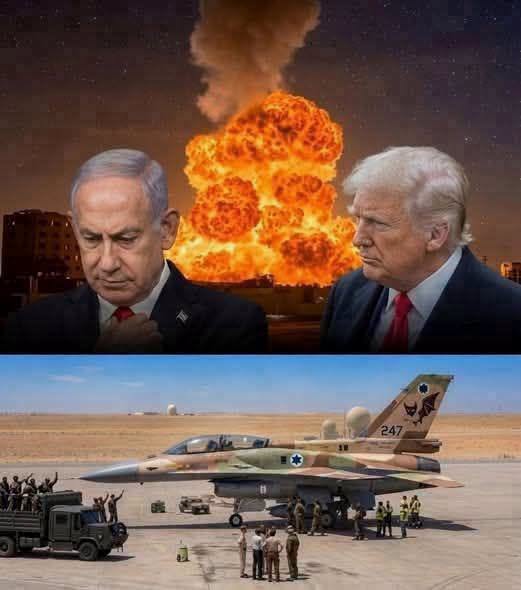
BREAKING: Israel Faces Another Tense Moment as Regional Crisis Intensifies
September 19, 2026 — Middle East
A new wave of tension is unfolding across the Middle East as Israel remains on heightened alert amid continuing regional instability. Reports emerging today are drawing attention to military preparations, security concerns, and developments involving Iran and other actors in the region.
However, despite dramatic headlines circulating online claiming that “Israel has just finished” a major operation, the exact claim behind those posts has not been independently confirmed by reliable sources at the time of writing.
That distinction matters.
In a rapidly changing conflict, social-media posts can spread much faster than official statements or independently verified reporting. A headline claiming that a major military operation has been completed may appear convincing, but without confirmation from credible news organizations or official authorities, readers should treat such claims cautiously.
What is confirmed is that the region remains highly tense.
According to the Times of Israel’s latest reporting, the Israel Defense Forces have increased readiness on multiple fronts ahead of Yom Kippur, with Israel’s Air Force and Navy also placed on heightened readiness.
The heightened posture comes at a sensitive moment.
Israel continues to face security challenges connected to the broader regional conflict, while developments involving Iran, Gaza, Lebanon, and Yemen continue to create uncertainty.
One of the latest developments came from Iran itself.
Iranian authorities announced Saturday that they had executed Hossein Pedaran, whom the judiciary accused of spying for Israel’s Mossad intelligence agency. According to Reuters, Iranian authorities said Pedaran had provided information concerning missile sites in Isfahan province. His death sentence was reportedly upheld by Iran’s Supreme Court before the execution was carried out.
The announcement adds another layer to already intense tensions between Tehran and Jerusalem.
Iran has repeatedly accused Israel of intelligence operations inside the country, while Israel has long maintained extensive security and intelligence capabilities across the region. Details surrounding individual espionage cases can be difficult to independently verify because governments often release limited information and because intelligence operations are inherently secretive.
Meanwhile, developments involving the wider regional conflict continue to unfold.
Reports from Saudi Arabia indicated that emergency alerts were issued after authorities warned of a hostile aerial threat, with an explosion heard in Riyadh. Officials had not immediately reported casualties or confirmed the source of the threat in the reporting available today.
The situation demonstrates how events far beyond Israel’s borders can quickly affect the wider security environment.
The Red Sea, Persian Gulf, Strait of Hormuz, Lebanon, Gaza, and Yemen have all become interconnected parts of the region’s security picture.
Earlier reporting also indicated continuing tensions around the Strait of Hormuz, one of the world’s most important maritime routes. Iran has asserted greater control over the waterway during the current confrontation, while attacks and threats involving shipping have raised concerns about international commerce and energy supplies.
For ordinary people living across the region, the consequences of these developments are much more immediate than the headlines suggest.
Military alerts can mean uncertainty for families.
Air-raid warnings can interrupt daily life.
Road closures and security restrictions can affect transportation.
And continuing violence can leave communities wondering what will happen next.
That is why claims of a major military operation being “finished” should be approached carefully.
If Israel has completed a specific operation, the most important questions are: What operation? Where did it occur? When did it begin? What was its stated objective? Was the operation acknowledged by Israel’s military? Were casualties reported? And have independent sources confirmed the details?
Those questions help separate verified information from speculation.
The current environment is particularly vulnerable to misinformation because dramatic developments can occur quickly and videos, photographs, and old footage can be reposted as if they were new.
A video showing explosions may be genuine but from an earlier date.
A photograph of military aircraft may be authentic but unrelated to the event being discussed.
And a headline may combine several separate developments into one sensational claim.
For readers following the situation, the safest approach is to look for confirmation from multiple reputable sources and to check the publication time carefully.
Today’s developments also come as Israeli politics remain significant. The Times of Israel reported that Israeli Prime Minister Benjamin Netanyahu is expected to travel to the United States in connection with the upcoming United Nations General Assembly, while a U.S. official said President Donald Trump was unlikely to meet Netanyahu at the UN because of scheduling difficulties.
Diplomatic developments are important because military tensions are occurring alongside international efforts to influence the direction of the conflict.
At the same time, Israel’s military posture remains a major focus.
The reported decision to strengthen forces on multiple fronts ahead of Yom Kippur illustrates how seriously Israeli authorities are treating the possibility of renewed threats.
For Israelis, Palestinians, Iranians, Lebanese civilians, and others across the region, another escalation could have serious consequences.
The humanitarian impact is also impossible to separate from the military story.
Recent reporting from Gaza described the collapse of a building damaged by previous Israeli strikes, killing at least 21 people, including 11 children, according to the Associated Press.
Such incidents demonstrate that military operations and their aftermath can continue affecting civilians long after the initial strikes have ended.
This is why every new report about military action receives intense attention.
People want to know whether another escalation is beginning.
They want to know whether missiles will be launched.
They want to know whether borders will close.
They want to know whether diplomatic channels can prevent another round of fighting.
And most importantly, families want to know whether they are safe.
For now, the central fact is that the region remains highly unstable.
There is no reliable confirmation supporting the broad social-media claim that “Israel has just finished” an unspecified operation. What can be established from current reporting is that Israel has increased military readiness, Iran has announced an execution in a case involving alleged espionage for Israel, and security concerns are continuing across the wider Middle East.
The situation could change quickly.
New statements from Israeli authorities, Iran, the United States, or other governments could provide additional information in the hours ahead.
Until then, readers should be cautious about viral posts claiming that a major event has already occurred when the details have not been independently confirmed.
In a region where events can change within minutes, accuracy matters more than a dramatic headline.
And sometimes the most important part of breaking news is not what a viral post claims—but what reliable evidence can actually confirm.