Tehran Claims Direct Strike on USS Abraham Lincoln as Regional Conflict Reaches Breaking Point
A dramatic new claim from Tehran has added another layer of tension to the already dangerous confrontation between Iran and the United States.
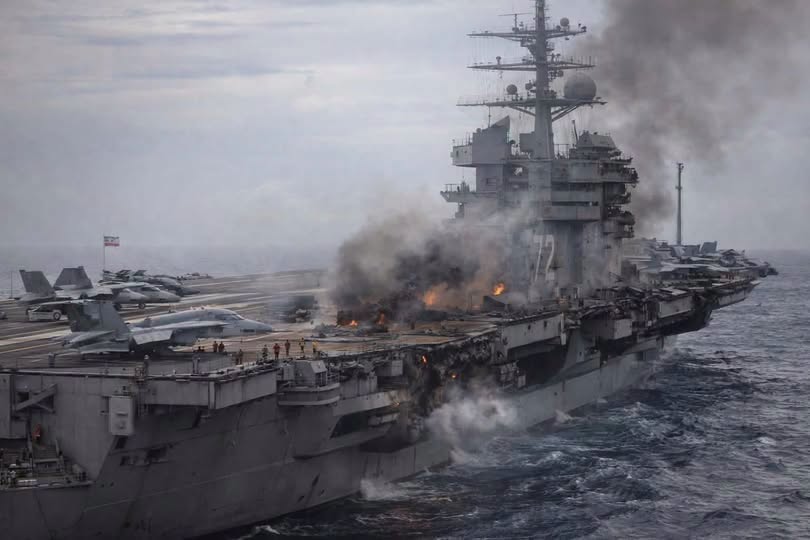
Iranian sources have claimed that Iranian forces successfully targeted the USS Abraham Lincoln, one of the U.S. Navy’s most powerful aircraft carriers, during the ongoing conflict. The claim has rapidly attracted attention because an attack on a carrier of this importance would represent a major escalation.
However, there is an important distinction between what Tehran claims and what has been independently confirmed.
At present, available reporting does not independently establish that the USS Abraham Lincoln was successfully struck. Fact-checking reports say Iranian authorities claimed attacks against the carrier, while U.S. sources have disputed the assertion.
That uncertainty is particularly important during wartime, when governments on opposing sides often release dramatically different accounts of the same events.
Why the USS Abraham Lincoln Matters
The USS Abraham Lincoln is not an ordinary naval vessel.
It is a nuclear-powered Nimitz-class aircraft carrier capable of carrying thousands of sailors and Marines and operating a large air wing. During its extraordinarily long deployment, the carrier supported U.S. military operations connected to the conflict with Iran.
Recent reporting shows just how extensive that deployment became.
The Lincoln spent months operating in and around the Middle East before eventually moving toward the Indo-Pacific. In August, U.S. Naval Institute reporting said the carrier had spent almost seven months in the Middle East supporting U.S. operations against Iran.
By September, the carrier had made stops in Thailand and Guam as it continued its journey home.
USNI News reported on September 19 that the Lincoln had reached Guam after 302 days of deployment, making the mission one of the longest carrier deployments of the post-Cold War period.
That history makes any claim involving the ship especially significant.
Tehran’s Claim
Iranian authorities have portrayed the alleged attack as evidence that U.S. military forces remain vulnerable despite their enormous technological and military advantages.
According to fact-checking reports, Iranian officials and state-linked outlets claimed that Iranian weapons were used against the carrier.
But public evidence supporting the claim has not established that the Lincoln itself was hit.
This distinction matters.
In modern warfare, governments can make claims within minutes of an alleged attack. Independent confirmation may take much longer.
Satellite imagery, naval tracking information, military statements, photographs, videos, and reports from independent journalists can all help establish what actually happened.
Until such evidence is available, the claim should be treated as an allegation rather than a confirmed fact.
The U.S. Response
The United States has disputed the idea that the Abraham Lincoln was successfully struck.
That creates two very different narratives.
Iran says its forces demonstrated the ability to threaten a major U.S. carrier.
The United States has rejected the claim that the carrier was hit.
The difference between these accounts illustrates one of the biggest challenges of following modern conflicts: information itself has become part of the battlefield.
Governments want their populations, allies, and adversaries to believe particular versions of events.
A successful attack against an American aircraft carrier would have enormous symbolic importance. Conversely, proving that such an attack failed would reinforce the perception that U.S. naval defenses can protect one of America’s most valuable military assets.
A Long and Difficult Deployment
Regardless of the disputed strike claim, the Abraham Lincoln has already experienced an extraordinary deployment.
The carrier spent months at sea while supporting combat operations.
Reports have also described difficult conditions aboard the ship, including supply challenges and concerns raised by some sailors and their families.
The Associated Press reported that approximately 5,000 personnel were aboard the carrier when it arrived in Thailand in September following a prolonged period at sea.
Reuters likewise reported that the carrier had participated in naval blockade and combat operations during the conflict with Iran before making its five-day visit to Thailand.
After leaving Thailand, the carrier continued toward Guam.
The Navy later described the Guam stop as a logistics visit where the crew could receive stores, mail, and equipment.
These details show that the carrier’s story is much bigger than one disputed battlefield claim.
Why a Carrier Attack Would Be So Significant
Aircraft carriers represent enormous concentrations of military capability.
A carrier strike group combines the carrier itself with aircraft, destroyers, cruisers, logistics vessels, and other supporting assets.
The purpose is not simply to put one enormous ship in the water.
The entire formation is designed to operate as a network.
Aircraft can conduct missions.
Destroyers can provide air and missile defense.
Other ships can provide additional weapons and surveillance capabilities.
Supply vessels keep the force operating far from home.
That means attacking a carrier is extremely difficult.
It also explains why claims about successful strikes against carriers receive so much attention.
If a carrier were genuinely damaged or disabled by an enemy attack, the military and strategic consequences could be significant.
But the absence of reliable confirmation is equally important.
The Information War
Perhaps the most interesting part of this story is not only what happened physically—but what people believe happened.
During conflicts, dramatic videos often spread across social media within minutes.
Some may show genuine attacks.
Others may show unrelated events from previous years.
Some can be digitally manipulated or generated with artificial intelligence.
AFP previously investigated viral footage falsely presented as showing an Iranian attack on the USS Abraham Lincoln and found that the video was actually old and contained signs of manipulation.
That is a powerful reminder for anyone following breaking military news online.
A dramatic photograph is not automatically proof.
A video is not automatically proof.
A social-media post is not automatically proof.
And a government statement—whether from Tehran or Washington—still needs to be understood in the context of competing wartime narratives.
Could the Conflict Escalate Further?
The larger confrontation remains extremely serious.
The Abraham Lincoln has already been involved in U.S. military operations connected to the conflict with Iran, while other American naval forces remain active in the region.
The United States has also moved additional carrier forces into the Middle East.
In August, the USS George Washington arrived in the Arabian Sea to replace the Lincoln as the latter began its journey away from the region.
This demonstrates that the carrier dispute is occurring within a much larger military confrontation.
The question is therefore not simply whether one missile or drone hit one ship.
The broader question is how far the conflict will expand, how long military operations will continue, and whether diplomatic efforts can eventually reduce the fighting.
What Happens Next?
For now, the most responsible approach is to separate confirmed information from claims.
Confirmed: The USS Abraham Lincoln participated in U.S. military operations connected to the Iran conflict.
Confirmed: The carrier spent an exceptionally long period deployed and at sea.
Confirmed: The ship eventually left the Middle East and made port visits in Thailand and Guam.
Claimed by Iran: Iranian forces successfully attacked the Abraham Lincoln.
Not independently established: That the carrier was actually struck and damaged by Iranian weapons.
That final distinction is critical.
As more information becomes available, satellite imagery, official military assessments, independent reporting, and other evidence may provide a clearer picture.
Until then, headlines claiming that the Abraham Lincoln was definitely destroyed, severely damaged, or directly hit should be treated cautiously.
A Dangerous Moment
There is no question that the U.S.–Iran confrontation has created one of the most dangerous security situations in the region.
The presence of powerful military forces, missile systems, drones, aircraft, naval vessels, and thousands of personnel means that even a limited incident could potentially trigger a much wider response.
That is why every major claim deserves careful examination.
For the sailors aboard the Abraham Lincoln, however, the story is more personal than the headlines suggest.
They have spent months away from home, operating under demanding conditions and uncertainty.
For their families, every report about an alleged attack can create fear and anxiety.
And for people around the world watching the conflict unfold, the central question remains the same:
What actually happened?
The answer should come from verified evidence—not simply from the loudest headline.
🌍⚓ Tehran has made a serious claim. Washington disputes it. Independent confirmation remains essential.
As the conflict continues, the world will be watching closely.