The skies over Iran have become the central battlefield in one of the most intense military campaigns of the modern era. In recent days, the United States Air Force and the Israeli Air Force have launched a sustained series of high-volume airstrikes targeting Iranian military infrastructure, missile sites, air defenses, and command centers. Military analysts say the operation represents one of the largest coordinated air campaigns in decades, demonstrating the combined technological and operational dominance of two of the most powerful air forces in the world.
The campaign began in late February when the United States and Israel initiated a coordinated strike operation against targets across Iran following escalating tensions and the collapse of diplomatic negotiations over Iran’s nuclear program and regional military activities. The operation—referred to in some reports as Operation Lion’s Roar—involved hundreds of aircraft, precision-guided weapons, cyber operations, and intelligence support.
Establishing Control of the Skies
From the first hours of the campaign, the priority of U.S. and Israeli planners was to establish air superiority over Iranian territory. Achieving this objective required neutralizing Iran’s radar systems, missile defenses, and air bases.
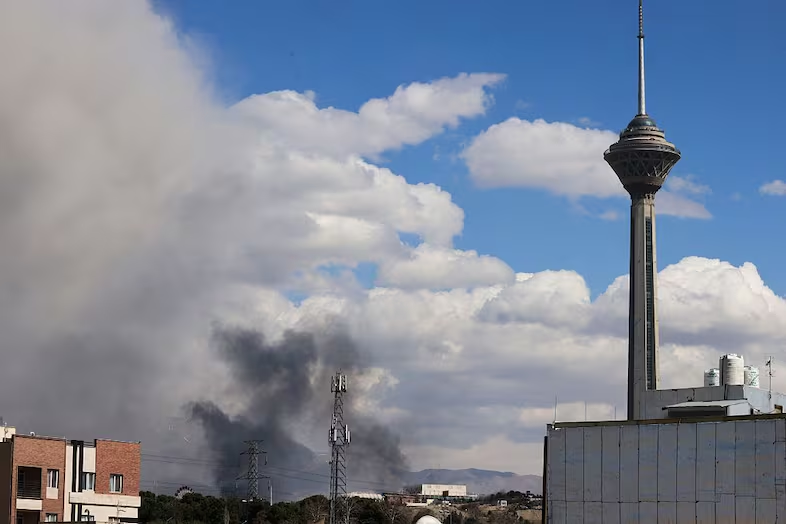
Within days, combined strikes targeted Iranian air defense networks, destroying radar systems and damaging several key airbases. Analysts monitoring the conflict reported that the campaign had already degraded much of Iran’s ability to contest the skies, enabling U.S. and Israeli aircraft to operate more freely over parts of the country.
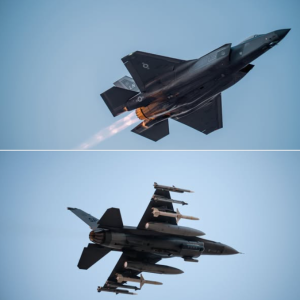
This phase of the operation involved a complex mix of aircraft and weapons systems. Stealth fighters such as the Lockheed Martin F‑22 Raptor and the Lockheed Martin F‑35 Lightning II were deployed alongside older but still formidable strike aircraft like the F-15 and F-16. The stealth capabilities of these jets allowed them to penetrate defended airspace and target key installations with precision.
The deployment of the F-22 to the region was especially notable, as the aircraft is designed specifically to dominate contested airspace. According to defense sources, the fighters were forward-deployed along with tanker aircraft and surveillance platforms to support sustained operations over Iranian territory.
Massive Scale of the Air Campaign
The scale of the operation has been extraordinary. Israeli defense officials reported that thousands of bombs and missiles have already been dropped in the opening phase of the conflict, striking military bases, missile launchers, and command facilities.
In addition, analysts estimate that more than 2,000 targets have been struck since the campaign began, illustrating the intensity of the bombardment and the breadth of its objectives.
Many of these targets include:
-
Ballistic missile launchers
-
Revolutionary Guard bases
-
Radar and air defense systems
-
Weapons factories and logistics depots
-
Military command centers
By attacking these systems simultaneously, coalition planners sought to paralyze Iran’s ability to coordinate air defense and retaliatory operations.
Advanced Technology in the War
The campaign has also showcased the latest generation of military technology.
Space-based surveillance systems, including satellites operated by the U.S. military, have provided real-time tracking of missile launches and military movements. Cyber operations have reportedly disrupted Iranian radar networks and communications, making it more difficult for Iranian forces to coordinate their defenses.
Laser weapons and missile interception systems have also been deployed to counter Iranian drones and missiles during the conflict. In some cases, these systems were able to intercept incoming threats before they could reach their targets.
Meanwhile, aerial refueling tankers—such as the KC-135 and KC-46—have played a critical role in sustaining long-range air operations. These aircraft allow fighter jets to remain in the air for extended periods, dramatically increasing the reach and persistence of the air campaign.
Iran’s Response
Despite suffering significant losses, Iran has attempted to retaliate through missile attacks and proxy operations. Iranian forces have launched missiles toward regional targets and threatened further escalation.
However, analysts note that Iran’s air force faces a major technological disadvantage compared to the United States and Israel. Many Iranian aircraft are older models from the 1970s and 1980s, including aging fighters such as the F-4 and MiG-29, which struggle to compete with modern stealth fighters and advanced electronic warfare systems.
In one notable incident during the conflict, an Israeli F-35 shot down an Iranian aircraft over Tehran—reportedly marking the first air-to-air kill by the F-35 in combat.
Risks and Complications
Despite the overwhelming airpower advantage, the campaign has not been without challenges. Modern warfare involving multiple countries and large numbers of aircraft carries significant risks.
For example, a friendly-fire incident occurred early in the conflict when Kuwaiti air defenses mistakenly shot down three U.S. fighter jets during the chaos of regional air operations. Fortunately, all six aircrew members were able to eject safely and were recovered.
Such incidents highlight the complexity of operating large multinational air campaigns in crowded and contested airspace.
Strategic Goals
The broader strategic goals of the campaign appear to include:
-
Destroying Iran’s missile infrastructure
-
Disrupting nuclear-related facilities
-
Weakening the command structure of the Iranian military
-
Limiting Iran’s ability to threaten regional allies
Some strikes have reportedly targeted key nuclear-related facilities, including sites associated with uranium enrichment and weapons research.
Global Implications
The air campaign over Iran is not just a regional conflict—it carries global consequences. Energy markets, shipping routes, and diplomatic relations across the Middle East have already been affected.
Iran has threatened to disrupt shipping through the Strait of Hormuz, a narrow waterway through which roughly one-fifth of the world’s oil supply passes. Any disruption there could send shockwaves through the global economy.
Meanwhile, international leaders are urging caution to prevent the conflict from expanding into a broader regional war involving additional countries.
The Power of Air Dominance
The current conflict illustrates a core principle of modern warfare: control of the skies often determines the outcome on the ground.
With the combined capabilities of the United States and Israel—stealth aircraft, precision weapons, intelligence networks, and cyber warfare—the coalition has demonstrated a level of air dominance rarely seen in modern conflict.
Whether that dominance ultimately leads to a decisive strategic outcome remains uncertain. Wars rarely follow predictable paths, and Iran still retains asymmetric tools such as missile strikes, proxy militias, and cyber attacks.
But for now, one reality is clear: the skies over Iran have become the stage for a powerful demonstration of modern air warfare—where technology, strategy, and overwhelming force converge in a high-stakes struggle that could reshape the balance of power in the Middle East.