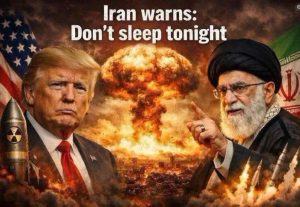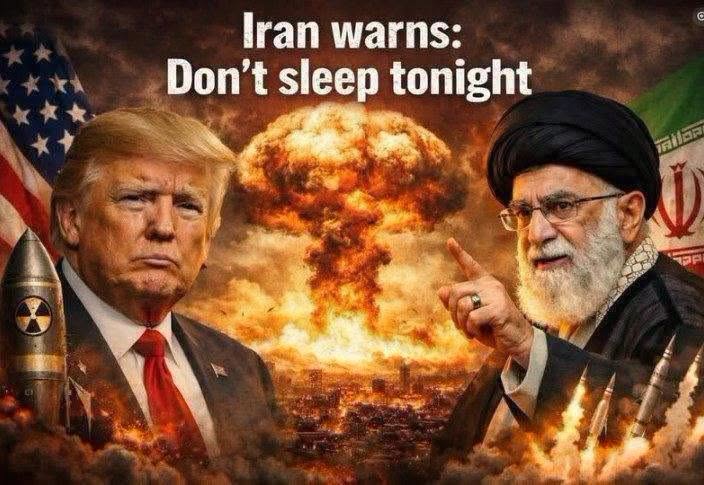
BREAKING NEWS: Iran Warns, “Don’t Sleep Tonight” — What Is Really Happening?
A dramatic message is spreading rapidly across social media: “BREAKING NEWS: Iran warns: Don’t sleep tonight…” The headline has triggered concern and speculation about what could happen next in the already tense Middle East.
But behind the viral wording is a much more complicated situation. As of September 30, 2026, the United States and Iran remain locked in a prolonged conflict, while diplomatic efforts are continuing through intermediaries. Iran has issued strong warnings about regional security, the Strait of Hormuz, and the consequences of continued military pressure.
That does not, however, mean that a specific attack tonight has been confirmed.
A Region Already on Edge
The latest developments come after months of military confrontation involving Iran, the United States, Israel and other regional actors. The Strait of Hormuz has become one of the most important flashpoints because it is a critical route for global energy shipments.
Iranian officials have repeatedly warned that their country will defend what it considers its security interests. Iranian Army spokesman Brig. Gen. Amir Akrami-Nia recently described what he called a new “Iranian order” in the Strait of Hormuz and said Iranian forces would prevent adversaries from using the waterway as they had in the past.
Such statements have naturally raised concerns among governments, businesses and ordinary people throughout the region.
Yet strong rhetoric should not automatically be interpreted as confirmation that a major attack is scheduled for a particular night.
Diplomatic Talks Are Still Taking Place
One of the most important details sometimes missing from viral social-media posts is that military threats and diplomacy are occurring simultaneously.
Iran has proposed a seven-day ceasefire arrangement involving the phased reopening of the Strait of Hormuz. The proposal was communicated through Qatari intermediaries, with Tehran seeking conditions related to sanctions, blockades and other issues.
On September 30, Iranian officials confirmed that Tehran had received an official U.S. response to its latest proposal. The contents of that response had not been publicly disclosed at the time of reporting.
That means the situation remains fluid.
A diplomatic response does not guarantee peace, but it does show that negotiations remain part of the picture alongside military pressure.
Why the Strait of Hormuz Matters
For people outside the region, the name “Strait of Hormuz” may sound like a distant geographical reference. In reality, events there can affect countries around the world.
The narrow waterway connects the Persian Gulf with the Gulf of Oman and the Arabian Sea. Large quantities of energy products normally pass through the area.
Because of the ongoing conflict, commercial shipping has faced serious disruption. A maritime security agency recently reported that a vessel was struck by a suspected projectile while transiting the Strait, causing a fire that was later extinguished. The crew was reported safe.
Any further escalation could therefore have consequences far beyond Iran and its immediate neighbors.
Oil prices, shipping costs, insurance rates and transportation expenses can all be affected when a major international shipping route becomes dangerous.
Iran Has Continued Issuing Strong Warnings
Iranian officials have made several statements threatening consequences if their country’s security interests are not protected.
Iranian parliament speaker Mohammad Bagher Ghalibaf said that if Iran could not safely sell its oil, other regional infrastructure would also face danger. Iranian Revolutionary Guard officials have also spoken about developing and upgrading weapons for national defense.
These statements are part of a broader campaign of deterrence and political messaging.
They should be taken seriously, but they should also be understood in context.
A warning from a government is not the same thing as an announcement that an attack will definitely happen at a particular time.
Why “Don’t Sleep Tonight” Is Going Viral
Social media thrives on urgency.
A headline such as “Don’t Sleep Tonight” immediately creates fear and curiosity. People want to know what happened, what might happen next and whether they should be worried.
But dramatic wording can sometimes travel much faster than the facts behind it.
A social-media post may combine a genuine statement from an official with exaggerated language added by another account. A warning issued days earlier can also be presented as though it were made moments ago.
That is why readers should check the date, source and exact wording before sharing such claims.
At the moment, available reporting confirms serious tensions and military threats, but it does not establish that Iran has officially announced a specific major attack scheduled for tonight.
The Human Cost Behind the Headlines
Beyond missiles, military aircraft, ships and political statements are millions of ordinary people.
Families in the Middle East have already experienced fear, displacement, economic pressure and uncertainty. Workers worry about transportation. Parents worry about their children. Businesses worry about whether they can operate normally.
When tensions rise, even people far from the battlefield can feel the consequences.
Fuel prices can change. Flights can be canceled. Shipping routes can be altered. Markets can become unstable.
The consequences of conflict therefore extend far beyond military targets.
The World Is Watching Closely
Governments around the world are closely monitoring developments.
The United States and Iran remain deeply divided, while regional countries are trying to protect their own security and economic interests. Meanwhile, international mediators continue attempting to keep diplomatic channels open.
There have also been security concerns outside the immediate battlefield.
British authorities, for example, are investigating a suspected plot near RAF Fairford, a base used by U.S. forces in the conflict. Five men were arrested and later released on bail while the investigation continued. Iranian authorities have denied involvement.
These developments demonstrate just how complicated the current security environment has become.
What Happens Next?
There are several possible developments that observers will be watching.
The first is diplomacy. If the United States and Iran can find common ground, a ceasefire or partial de-escalation could reduce immediate risks.
The second is the Strait of Hormuz. Any changes in shipping access could have major economic consequences.
The third is military activity. Continued strikes, threats or attacks could create another cycle of escalation.
The fourth is the response of regional allies and armed groups. Any expansion of the conflict could make an already complicated situation even harder to control.
For now, uncertainty remains.
Don’t Let Fear Replace Facts
The phrase “Don’t sleep tonight” is powerful, but people should not allow a viral headline to create unnecessary panic.
The confirmed reality is serious enough without exaggeration: the U.S.-Iran conflict remains active, the Strait of Hormuz remains a major point of tension, Iran has issued strong warnings, and diplomatic efforts have not yet produced a final settlement.
At the same time, there is an important difference between “tensions are extremely high” and “a specific attack is confirmed for tonight.”
Those are not the same statement.
As the world waits for further developments, the most responsible approach is to follow credible reporting, verify dramatic claims before sharing them, and pay attention to official safety instructions if you are in an affected area.
The next hours and days could be important. But until authorities or multiple credible sources confirm a specific event, viral claims about what will happen “tonight” should be treated with caution.
Stay informed. Stay calm. And always check the facts before sharing breaking-news headlines.