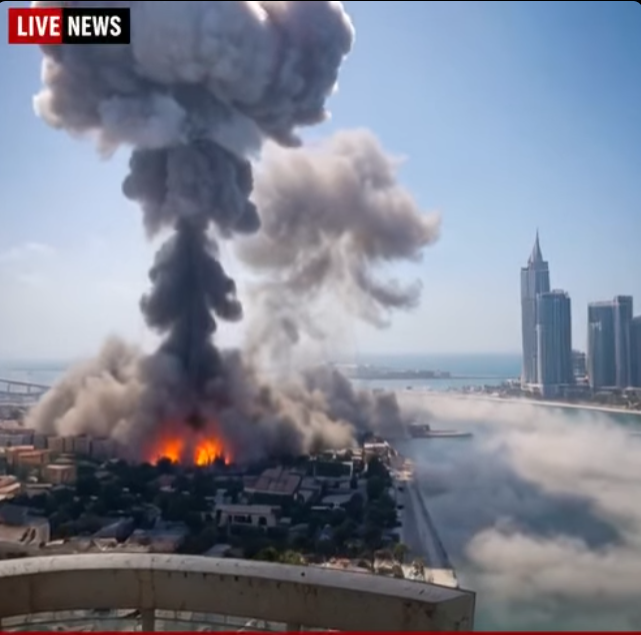
BREAKING NEWS: 4 Countries Join Forces to Atta… See More
A dramatic headline is spreading rapidly across social media:
“BREAKING NEWS: 4 countries join forces to atta… See more.”
The words immediately raise an alarming question: Have four countries really joined forces for a major military operation?
The situation in the Middle East is already extremely tense, with Iran, the United States, Israel and several regional governments involved in an increasingly complicated security crisis. Recent developments have included missile and drone attacks, heightened air defenses, disruptions to shipping and intense diplomatic efforts.
But there is an important distinction between the dramatic headline circulating online and what has actually been confirmed.
At the time of writing, reliable reporting does not establish that four countries have formally announced a new joint offensive to attack another country.
What is confirmed is that several nations are coordinating their security responses as the regional conflict continues.
A Region Under Extraordinary Pressure
The Persian Gulf has become one of the most closely watched areas in the world.
Military installations, shipping routes and energy infrastructure have all been affected by the wider conflict.
Iran has continued to confront the United States and its regional partners, while Gulf governments have been forced to consider how they can protect their territory from possible missile and drone attacks.
The United States has also been changing its military posture in the region.
On September 30, U.S. forces completed their withdrawal from Iraq under a previously agreed plan, a development that has been described by Iranian officials and their allies as an important strategic moment.
At the same time, Washington and Tehran continue to communicate indirectly through mediators.
Four Countries and the Viral Claim
The headline appears to refer to Bahrain, Qatar, Kuwait and the United Arab Emirates, four Gulf countries that host or have hosted significant U.S. military facilities.
Reports circulating online describe Iranian attacks involving locations associated with American forces in those countries and defensive responses by the host governments.
However, saying that these four countries have “joined forces to attack” would go beyond what has been established.
There is a major difference between countries activating air-defense systems and countries forming a military coalition to launch an offensive.
The distinction matters.
Defensive cooperation can involve radar systems, missile interceptors, intelligence sharing, emergency warnings and coordination with allied forces.
That does not automatically mean the countries have agreed to launch attacks of their own.
Why the Situation Is So Dangerous
The geography of the Persian Gulf makes the current crisis especially significant.
Several major American military facilities are located in countries surrounding the Gulf. If fighting expands, those installations can become targets.
At the same time, the Gulf contains critical energy infrastructure and sits next to some of the world’s most important shipping routes.
Any prolonged disruption could affect countries far beyond the Middle East.
Oil prices, shipping insurance, transportation costs and energy supplies can all be influenced by instability in the region.
That means a military escalation is not simply a regional story.
It can quickly become a global economic issue.
The Strait of Hormuz
One of the biggest concerns is the Strait of Hormuz.
Iran has repeatedly linked negotiations and regional security to the strategic waterway.
According to Reuters, Iran has received a U.S. response to its latest proposal involving a possible ceasefire and the reopening of the Strait of Hormuz. The two sides remain divided over how any agreement would be implemented.
CBS News likewise reported that Iranian officials said Washington had responded to Tehran’s seven-day ceasefire proposal and that the Iranian government was considering the response.
These developments show that diplomacy continues even while military tensions remain high.
The Possibility of a Wider Conflict
The greatest fear among many observers is that a limited confrontation could develop into something much larger.
Once several governments become involved, controlling escalation becomes more difficult.
A missile strike can lead to retaliation.
Retaliation can trigger another response.
An attack on military personnel can create political pressure for further action.
And when multiple countries have troops, bases or strategic interests in the same region, the potential consequences become even more complicated.
This is why governments throughout the region are closely monitoring developments.
Saudi Arabia, Turkey and Pakistan
Another important development involves a different regional security arrangement.
The Associated Press reports that Saudi Arabia, Turkey and Pakistan signed the Mecca Joint Defense Agreement in August. Pakistan’s defense minister has recently pledged to defend Saudi Arabia against Iran-backed Houthi attacks, while also saying Pakistan continues to maintain diplomatic channels with Iran.
This is significant because it demonstrates how regional security relationships are changing.
But it is still important not to confuse this agreement with the viral claim that four countries have suddenly joined forces for a new attack.
The actual situation is more complicated.
Different countries are developing different partnerships, defensive arrangements and diplomatic positions.
Diplomacy Has Not Disappeared
Despite the military confrontation, negotiations remain possible.
Iran has communicated with the United States through intermediaries, including Qatar.
The latest discussions reportedly concern a possible ceasefire and conditions surrounding the Strait of Hormuz.
This means that the region is experiencing two seemingly contradictory developments at the same time:
Military pressure is increasing in some areas, while diplomatic efforts continue in others.
That is common during international crises.
Governments may prepare for the possibility of further conflict while simultaneously trying to negotiate an agreement that could prevent it.
Why Social Media Makes the Situation More Confusing
Breaking-news headlines are often designed to create an immediate emotional response.
Words such as:
BREAKING
URGENT
ATTACK
FOUR COUNTRIES
and
SEE MORE
naturally make people want to click.
But the first sentence of a viral post may not tell the complete story.
A headline might describe defensive cooperation as an “alliance.”
An old event may be presented as though it happened today.
A prediction may be written as though it were a confirmed announcement.
And a statement from one official may be presented as the position of an entire country.
This is why readers should look for the original reporting before sharing dramatic claims.
The Human Cost
Behind every military headline are ordinary people.
Families living near military bases may hear sirens or explosions.
Workers may be unable to travel normally.
Airlines may change routes.
Businesses may face disruptions.
Parents may worry about their children.
And communities already affected by war may face another period of uncertainty.
For civilians, political statements and military strategy can have very real consequences.
That is why responsible reporting matters so much during a crisis.
What We Know Right Now
The confirmed picture is serious.
Iran and the United States remain involved in a major confrontation.
Gulf states are facing significant security pressures.
Military installations across the region remain important strategic targets.
Saudi Arabia, Turkey and Pakistan have established a new defense arrangement.
And diplomatic channels between Iran and the United States remain active.
But the specific viral statement that “four countries have joined forces to attack” should not be presented as a confirmed fact without stronger evidence.
The reality is more complicated than the headline suggests.
What Happens Next?
The next few days could be closely watched.
Diplomats will continue discussing possible arrangements.
Military forces will remain alert.
Regional governments will monitor threats.
Energy markets will watch developments around the Gulf.
And millions of people will wait for clearer information.
The key question is whether diplomacy can slow the escalation before additional countries become directly involved.
At the same time, governments will likely continue preparing for the possibility that negotiations fail.
Final Thoughts
The headline “BREAKING NEWS: 4 countries join forces to attack…” is certainly attention-grabbing.
But readers should separate the confirmed facts from the dramatic wording.
The Middle East is already experiencing a serious and rapidly changing security crisis. Countries are coordinating defenses, military alliances are evolving, and negotiations are continuing.
That is significant enough without adding claims that have not been independently verified.
For anyone following the story, the best approach is simple:
Check the source. Check the date. Look for confirmation from multiple credible news organizations. And don’t mistake a dramatic social-media headline for an official announcement.
The situation remains fluid, and new developments could emerge quickly.
Stay informed, stay alert, and wait for verified information before sharing breaking-news claims.