American Airlines Flight 191: The Tragedy at Chicago O’Hare
On May 25, 1979, a routine afternoon departure from Chicago O’Hare International Airport became one of the darkest moments in American aviation history.
American Airlines Flight 191, a McDonnell Douglas DC-10-10, was preparing to depart Chicago for Los Angeles. On board were 271 people—passengers and crew members beginning what was supposed to be an ordinary journey across the United States.
Instead, only moments after takeoff, a catastrophic mechanical failure changed everything.
The disaster ultimately claimed the lives of everyone aboard the aircraft and two people on the ground, for a total of 273 fatalities. The accident shocked the country and led to an extensive investigation that uncovered serious problems involving aircraft maintenance, procedures, communication, and safety oversight.
A Routine Flight Turns Into a Disaster
Flight 191 began its takeoff from Runway 32R at approximately 3:04 p.m. Central time. The weather was clear, with visibility reported at about 15 miles.
At first, everything appeared normal.
But during the takeoff rotation, something went terribly wrong.
The aircraft’s left engine and pylon assembly separated from the left wing. Approximately three feet of the wing’s leading edge also separated with the engine and pylon. The components fell onto the runway while the aircraft continued into the air.
The pilots were confronted with an extraordinary emergency just seconds after becoming airborne.
The aircraft continued climbing, reaching approximately 300 to 325 feet above the ground. But the separation of the engine and pylon had caused extensive damage to critical aircraft systems.
Among the consequences was damage to hydraulic lines and the loss of electrical power from the engine’s generator. Several instruments and warning systems were also affected.
The crew had very little altitude and almost no time to understand what had happened.
The Critical Seconds
The aircraft’s left-wing leading-edge slats played an important role in allowing the wing to produce sufficient lift at relatively low speeds.
Because of the damage caused by the engine and pylon separation, the left-wing slats retracted.
That created a dangerous aerodynamic imbalance.
The left wing could no longer produce the lift expected at the aircraft’s takeoff speed. As the aircraft continued climbing, the left wing entered an aerodynamic stall while the right wing continued producing lift.
The result was a rapidly developing roll to the left.
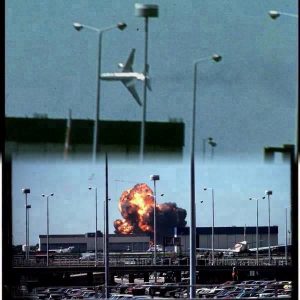
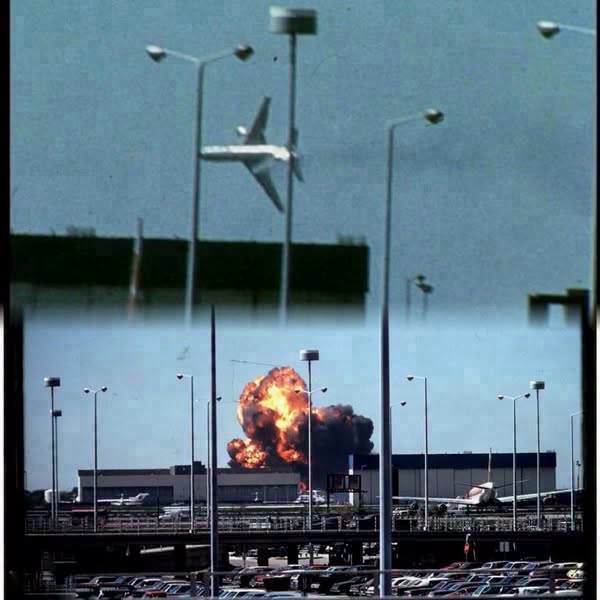
According to the Federal Aviation Administration’s account, the aircraft climbed to approximately 300 feet with its wings initially level before beginning a left roll. The bank angle increased dramatically, and the nose eventually pitched downward.
The crew had only seconds to react.
The aircraft eventually rolled past a 90-degree bank angle before descending toward the ground.
There was no realistic opportunity for the pilots to regain control at such a low altitude.
The Crash Near O’Hare
Flight 191 crashed into an open field approximately 4,600 feet northwest of the departure end of Runway 32R.
The aircraft struck the ground and was destroyed in the resulting impact and fire. Wreckage spread into an adjacent trailer park area.
The tragedy was not limited to the people aboard the aircraft. Two people on the ground also lost their lives, while two others suffered injuries. A mobile home, vehicles, and an old aircraft hangar were among the property damaged or destroyed.
The crash scene was devastating.
Emergency crews faced an enormous and difficult operation as they responded to the wreckage and fire. The scale of the disaster quickly became apparent.
For families waiting for loved ones to arrive in California, the news was devastating.
People who had boarded the aircraft expecting a normal cross-country journey would never reach their destination.
What Caused Flight 191 to Fail?
The investigation conducted by the National Transportation Safety Board eventually determined that the accident was not simply the result of an engine failure.
Investigators found that the engine and pylon separation resulted from damage associated with improper maintenance procedures.
The NTSB determined that maintenance practices had damaged the pylon structure, ultimately leading to its separation at a critical moment during takeoff.
Once the engine and pylon separated, several systems were affected.
Hydraulic lines were damaged.
Electrical power from the engine’s generator was lost.
Important instruments and warning systems became unavailable.
Most critically, the configuration of the left wing changed in a way that produced an asymmetric stall.
The NTSB described the probable cause as the asymmetric stall and resulting roll caused by the uncommanded retraction of the left-wing outboard leading-edge slats, following maintenance-induced damage that led to separation of the engine and pylon assembly.
Maintenance Errors and a Chain of Events
One of the most important lessons from Flight 191 was that catastrophic accidents rarely result from a single isolated problem.
Instead, multiple weaknesses can combine.
In this case, investigators identified vulnerabilities in the aircraft’s pylon attachment design and the leading-edge slat system. They also identified deficiencies involving FAA surveillance and reporting systems, as well as problems with communication among the airline, manufacturer, and regulators.
That meant the disaster was not simply a story about one broken component.
It was a story about how maintenance procedures, aircraft design, organizational communication, regulatory oversight, and emergency response can intersect.
A seemingly manageable maintenance issue can become catastrophic when it occurs at exactly the wrong moment.
The DC-10 and Aviation Safety
Flight 191 occurred during a period when the McDonnell Douglas DC-10 was already receiving considerable attention from aviation authorities and the public because of previous accidents and safety concerns.
The Chicago disaster intensified scrutiny of the aircraft and its maintenance practices.
The FAA’s historical records describe the Flight 191 accident as a major event that exposed problems involving the engine and pylon separation and the resulting damage to aircraft control systems.
Investigators studied the aircraft’s design, maintenance practices, emergency procedures, and regulatory oversight.
The tragedy became an important case study in aviation safety.
Remembering the Victims
Behind every statistic were individual human beings.
The number 273 can sound like a distant historical figure, but each person represented a family, a friendship, a career, a childhood, or a future that suddenly ended.
Some passengers were traveling for business.
Others were traveling for personal reasons.
Some may have been heading toward vacations or family reunions.
The crew members were doing what they had done many times before: preparing to operate a commercial flight safely.
None of them could have known that the aircraft would experience a catastrophic failure only moments after leaving the runway.
For the families, the accident was not simply a historical event. It was a permanent loss.
A Lasting Lesson
The Flight 191 investigation produced numerous safety recommendations. The NTSB identified not only the immediate mechanical and aerodynamic causes but also broader organizational and regulatory factors that contributed to the accident.
The tragedy demonstrated why aviation safety depends on more than pilots.
Aircraft must be properly designed.
Maintenance must be performed according to approved procedures.
Airlines must communicate safety information effectively.
Manufacturers must respond to known problems.
Regulators must monitor the industry and act when risks emerge.
And procedures must account for the realities pilots may face during emergencies.
Every part of the system matters.
Why Flight 191 Is Still Remembered
More than four decades later, American Airlines Flight 191 remains an important part of aviation history.
The accident is remembered not because of sensational details, but because it revealed how a sequence of technical and organizational failures could turn an ordinary takeoff into a catastrophe within seconds.
It also became a lesson in how investigations can transform tragedy into improvements in transportation safety.
The people aboard Flight 191 never reached Los Angeles.
Their lives ended near Chicago O’Hare on May 25, 1979.
But the investigation that followed helped aviation authorities better understand the dangers associated with maintenance-induced structural damage, asymmetric wing configurations, warning-system failures, and emergency procedures.
A Moment to Remember
When discussing disasters such as Flight 191, it is easy to focus on numbers.
271 people aboard.
Two people on the ground.
273 lives lost.
But behind those numbers were people whose families and communities were forever changed.
The story of American Airlines Flight 191 is therefore more than the story of an aircraft crash.
It is a story about lives lost, families grieving, investigators searching for answers, and an aviation industry learning difficult lessons from tragedy.
The accident remains a solemn reminder that aviation safety is built through thousands of procedures, inspections, decisions, and safeguards working together.
And when those safeguards fail, the consequences can be devastating.
Today, Flight 191 is remembered as one of the defining aviation disasters in American history—not simply for the scale of the loss, but for the safety lessons that emerged from the investigation.
The victims deserve to be remembered with dignity, and the lessons of May 25, 1979, continue to serve as a reminder of why careful maintenance, effective communication, strong oversight, and constant attention to safety matter every time an aircraft leaves the ground.