Ohio Air Show Crash Shows the Risks of Wing Walking
The image of an aircraft performing breathtaking maneuvers above an air-show crowd can be unforgettable. But behind the excitement and spectacle is a dangerous profession that demands extraordinary precision, discipline, and experience.
That reality became painfully clear on June 22, 2013, when a vintage biplane crashed during the Vectren Dayton Air Show near Dayton, Ohio, killing pilot Charlie Schwenker and professional wing walker Jane Wicker. The aircraft crashed at Dayton International Airport while performing in front of thousands of spectators.
The tragedy brought renewed attention to one of aviation’s most unusual performance traditions: wing walking.
Wing walking involves a performer moving around the exterior of an aircraft while it is airborne. Depending on the routine, the performer may stand, sit, climb, or hang from parts of the airplane while the aircraft performs carefully choreographed maneuvers.
From the ground, the performance can look almost effortless.
In reality, it is anything but.
The Dayton Tragedy
Jane Wicker was an experienced wing walker who had been involved in the profession since 1990. She was also an accomplished pilot and the owner-operator of Jane Wicker Airshows. Charlie Schwenker was the pilot flying the aircraft during the Dayton performance.
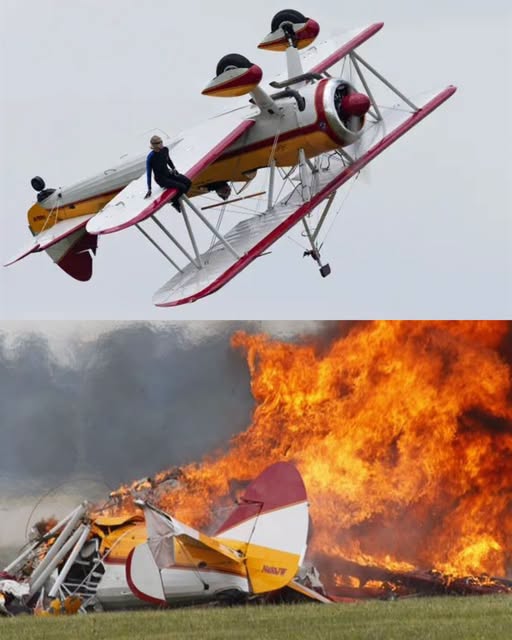
During the performance, Wicker was positioned on the aircraft as it performed an inverted maneuver at low altitude.
Video recorded by spectators captured the final moments of the flight. The airplane rolled and then descended rapidly before striking the ground and catching fire.
Both Wicker and Schwenker died in the crash.
No spectators on the ground were reported killed or injured in the accident. The air show was stopped for the remainder of the day and later resumed with a moment of silence honoring the victims.
At first, investigators did not know exactly what had caused the airplane to crash.
The National Transportation Safety Board launched an investigation, examining video recordings, photographs, aircraft information, witness accounts, and the sequence of the maneuver.
The eventual findings provided a much clearer picture.
What the Investigation Found
The NTSB determined that the probable cause was controlled flight into terrain.
According to the investigation, the aircraft was operating at low altitude and low airspeed during a modified air-show maneuver. Those conditions contributed to the accident.
The aircraft had slowed significantly during the maneuver, and investigators determined that the modified routine placed the airplane in a dangerous position.
The finding is important because it shows that an air-show accident does not necessarily require an engine failure or dramatic mechanical malfunction.
A sequence of aerodynamic and operational factors can create a situation in which there is simply not enough altitude or airspeed available to recover.
At air-show altitudes, there may be very little room for error.
Why Wing Walking Is So Difficult
Wing walking has roots going back to the barnstorming era of the 1920s, when pilots and performers traveled from town to town demonstrating the possibilities of aviation.
The tradition became less common during the middle of the 20th century but later returned as part of specialized air-show performances.
Only a small number of people have traditionally performed wing-walking acts in the United States.
The physical demands are substantial.
A wing walker must deal with powerful airflow, vibration, aircraft movement, noise, altitude, temperature, and the constant need to maintain position.
Even a simple movement becomes difficult when an aircraft is traveling at high speed.
One experienced wing walker described the sensation as being similar to running a marathon in a hurricane.
That description helps explain why the profession requires extensive preparation.
Performers cannot simply climb onto an airplane and begin performing.
Training generally begins on the ground. Trainees learn how to move around the aircraft while it is stationary, then progress to situations involving engine vibration and taxiing before eventually moving into airborne training.
One air-show professional interviewed after the Dayton crash said trainees could spend about a year developing the skills necessary to perform safely.
The Importance of Airspeed and Altitude
The Dayton accident also illustrates two basic principles of aviation: airspeed and altitude are precious resources.
An airplane needs sufficient airspeed to maintain controlled flight. When speed decreases during certain maneuvers, the aircraft can approach aerodynamic limits.
Altitude, meanwhile, provides time and space to correct a problem.
At a high altitude, a pilot may have several seconds—or much longer—to respond to an unexpected situation.
At air-show altitude, that margin can disappear almost instantly.
This is particularly significant when an aircraft is performing aerobatic maneuvers.
A pilot must maintain precise control while simultaneously considering position, speed, altitude, orientation, the performance area, and the presence of a performer outside the cockpit.
The margin for error can therefore be extremely small.
A Dangerous Profession With a Long History
Wing walking is often associated with the golden age of aviation, when barnstormers performed spectacular stunts for crowds that had rarely, if ever, seen an airplane up close.
Those early performers helped create the culture of aviation entertainment that continues today.
But the spectacle has always involved risk.
The profession requires performers to trust their equipment, training, pilots, procedures, and one another.
The FAA has explained that performers involved in these acts spend extensive time practicing away from crowds and developing procedures intended to reduce risk. At the same time, officials acknowledge that when something does go wrong, the consequences can be severe.
The rarity of serious accidents can sometimes make the performances appear safer than they actually are.
For the performer standing on a wing, however, the environment is anything but ordinary.
Remembering Jane Wicker
For those who knew Jane Wicker, wing walking was more than a job.
She was passionate about aviation and described the feeling of being in the sky as a unique sense of freedom.
Her career demonstrated the dedication required to become a professional performer.
She had years of experience and was also a trained pilot.
That is an important reminder that experience does not eliminate risk.
Instead, experience helps professionals recognize, manage, and prepare for risk—but aviation can never make every danger disappear.
The same is true for the pilot.
Charlie Schwenker was an experienced air-show pilot, and the accident was not the result of a lack of appreciation for aviation’s dangers.
It was a tragic example of how quickly circumstances can become unrecoverable during a low-altitude maneuver.
Why the Accident Still Matters
More than a decade after the Dayton crash, the event remains a powerful reminder of the responsibility involved in air-show performances.
Modern air shows rely on detailed planning, experienced pilots, rehearsed routines, designated performance areas, emergency procedures, and regulatory oversight.
Yet no safety system can completely eliminate the risks associated with flying aircraft at low altitude while performing aerobatic maneuvers.
The Dayton crash also demonstrates why investigators examine accidents so carefully.
Their goal is not simply to explain what happened.
The findings can help identify contributing factors and potentially prevent similar accidents in the future.
In the Ohio case, the investigation’s conclusion about controlled flight into terrain, combined with the effects of low altitude, low airspeed, and a modified maneuver, provides important lessons about maintaining adequate margins during air-show operations.
A Spectacle That Demands Respect
For spectators, wing walking can look almost magical.
A person appears to stand on an airplane as it moves through the sky, sometimes upside down, sometimes banking or performing other dramatic maneuvers.
But the closer one looks, the clearer the reality becomes.
Every movement has consequences.
Every maneuver must be carefully planned.
Every second matters.
And when an aircraft is operating close to the ground, even a small deviation can become a life-threatening emergency.
The story of Jane Wicker and Charlie Schwenker is therefore not simply a story about an air-show accident.
It is also a story about the dedication of aviation professionals, the history of wing walking, the importance of training, and the unforgiving nature of flight.
Their deaths serve as a lasting reminder that spectacular performances in the sky come with real risks that audiences may never see from the ground.
Air shows are designed to inspire wonder.
But behind every breathtaking maneuver are people working within extremely demanding conditions—and the Dayton tragedy showed just how narrow the line can sometimes be between an unforgettable performance and disaster.