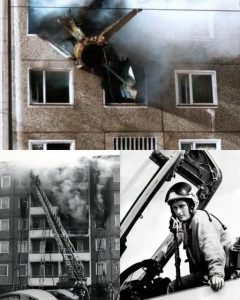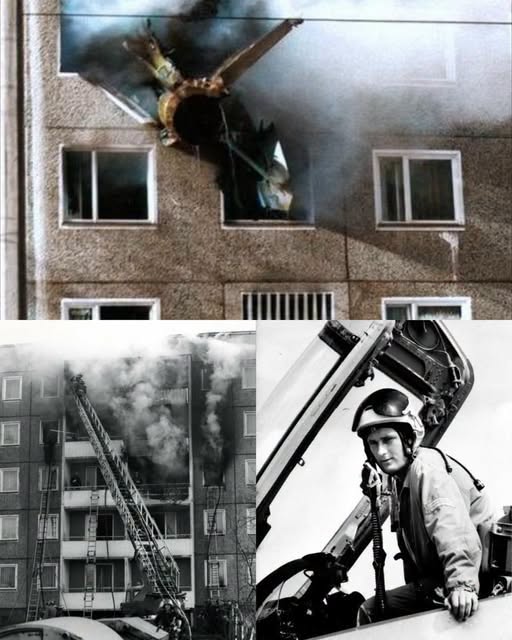
The 1975 MiG-21 Disaster That Sent a Fighter Crashing Into an East German Apartment Block
On a winter day in 1975, residents of an East German city witnessed a terrifying aviation disaster when a military fighter aircraft plunged into a residential building.
The aircraft was a Soviet-designed MiG-21, one of the most recognizable fighter jets of the Cold War.
For military planners, the MiG-21 represented speed, simplicity, and the ability to operate at high performance. For ordinary civilians living beneath its flight path, however, the presence of military aircraft overhead was a reminder of the enormous tensions that divided Europe during the Cold War.
The 1975 crash became one of those rare accidents in which military aviation and civilian life collided with devastating consequences.
The MiG-21 and the Cold War
The MiG-21 was developed in the Soviet Union during the 1950s and became one of the most widely produced supersonic fighter aircraft in history.
Its compact design and delta wing gave it a distinctive appearance.
The aircraft was capable of supersonic speeds and was operated by air forces across the Soviet Union and its allies.
East Germany, officially the German Democratic Republic, was one of the Warsaw Pact states aligned with Moscow.
Its military forces operated aircraft supplied by the Soviet Union, including MiG-21 fighters.
During the Cold War, military aviation was a routine part of life across East Germany.
Training flights were conducted regularly, and pilots practiced interception, navigation, formation flying, and other missions.
But military training was never completely free of danger.
A Routine Flight Turns Into Disaster
The flight that ended in tragedy was not expected to become a historic accident.
The aircraft was being operated as part of a military training environment.
But something went wrong.
The fighter lost the ability to remain safely on its intended flight path and descended toward a populated area.
Unlike a civilian airliner, a fighter aircraft can move extremely quickly and can cover significant distances in seconds.
When a problem occurs at low altitude, a pilot may have almost no time to respond.
The result can be catastrophic.
In this case, the aircraft ultimately struck a residential apartment block.
The impact transformed what had begun as a military flight into a civilian disaster.
A Fighter Against a Building
A MiG-21 was a relatively small aircraft compared with a commercial airliner, but its speed and fuel load meant that a crash could generate tremendous destructive energy.
When the aircraft struck the building, the consequences were immediate.
Fire, debris, and structural damage spread through the affected area.
People who had been going about their ordinary daily lives suddenly found themselves confronted by an aviation emergency.
Emergency services had to respond rapidly.
Firefighters and rescue personnel entered a scene that would have been extremely difficult to manage.
The disaster also raised an obvious question:
How could a military fighter end up striking a residential building?
Investigating a Cold War Accident
Investigating a military aviation accident during the Cold War was different from investigating an ordinary civilian crash.
Military aircraft were connected to national security.
Information about their missions, equipment, procedures, and capabilities could be restricted.
Accident investigators therefore had to work within a military environment.
Wreckage could provide important clues.
Investigators could examine the engine, flight controls, instruments, and other components.
They could also analyze the aircraft’s planned route and determine whether the pilot had encountered a technical or operational problem.
Witness accounts were another important source of evidence.
People on the ground might have seen the aircraft’s position, heard unusual engine sounds, or observed smoke or other indications of trouble before the impact.
The Human Cost
Behind every aviation accident are people.
The pilot in the cockpit was facing an emergency that developed rapidly.
The residents of the apartment building had no control over what was happening above them.
That contrast is one of the most painful aspects of military aviation accidents in populated areas.
Pilots accept significant risks as part of their profession.
Civilians living nearby generally do not.
When an aircraft crashes into a residential building, an accident that began in the military sphere suddenly becomes a tragedy affecting families who had nothing to do with the flight.
The loss of life and destruction of homes can leave a lasting impact on a community.
Life Behind the Iron Curtain
The accident also needs to be understood within the larger setting of 1970s East Germany.
The country was behind the Iron Curtain and was part of the Soviet-led Warsaw Pact.
Military readiness was considered essential by the East German government and its allies.
The skies over East Germany therefore contained significant military activity.
Residents were accustomed to seeing aircraft and hearing military exercises.
Yet familiarity should never be mistaken for safety.
Every aircraft represented a complex machine operating in an environment where small failures could have serious consequences.
Why the MiG-21 Was So Widely Used
The MiG-21 became famous partly because it was relatively simple compared with some later-generation fighters.
Its design emphasized speed, maneuverability, and ease of production.
That made it attractive to many countries.
More than 10,000 examples were produced in various versions, making the aircraft one of the most numerous supersonic fighters ever built.
Its enormous production run also meant that accidents occurred across many countries and over many decades.
The MiG-21 was an important Cold War aircraft, but it was still a machine with mechanical limitations and demanding flight characteristics.
The Danger of Low Altitude
One of the central lessons of accidents involving military aircraft is the importance of altitude.
At cruising altitude, a pilot may have time to diagnose a problem and attempt an emergency procedure.
Close to the ground, the situation is completely different.
There may be only seconds between recognizing a problem and reaching the surface.
A fighter traveling at high speed can cross a large area before a pilot has enough time to change course.
This is particularly important when training flights occur near populated areas.
Military aviation authorities must balance realistic training with the need to reduce risks to civilians.
A Reminder of the Cold War’s Hidden Risks
The Cold War is often remembered through images of nuclear weapons, missile launches, political speeches, and military confrontations.
But ordinary people also experienced the era through less dramatic events.
They heard military aircraft overhead.
They lived near bases.
They watched exercises.
And occasionally, they experienced the consequences when something went wrong.
The 1975 MiG-21 accident belongs to that less visible history.
It demonstrates how the Cold War could affect everyday civilian life even when no war was taking place.
Remembering the Victims
With historical aviation disasters, there is a temptation to focus primarily on the aircraft.
The MiG-21’s design, speed, engine, and military role are fascinating subjects.
But the most important part of the story is the human cost.
The apartment building was not simply a structure.
It was someone’s home.
People had families, possessions, routines, and plans for the future.
An aircraft falling from the sky could destroy all of that in moments.
Remembering the accident therefore means remembering the people affected by it rather than treating the event merely as an interesting chapter in aviation history.
What the Disaster Can Teach Us
Military aviation has changed enormously since 1975.
Aircraft now have more sophisticated navigation systems, sensors, communications equipment, and safety procedures.
Yet the fundamental risks remain.
Aircraft are heavy, fast machines.
They require highly trained crews and carefully controlled operating environments.
When something goes wrong, there may be little time to recover.
The history of military aviation accidents therefore continues to provide valuable lessons for modern operators.
Every investigation has the potential to reveal weaknesses in training, maintenance, procedures, or emergency planning.
Those lessons can help prevent future tragedies.
A Forgotten Chapter of Cold War History
Today, the Cold War can feel distant.
The Berlin Wall is gone.
East and West Germany have been reunited.
The Warsaw Pact no longer exists.
And many of the military aircraft that once dominated European skies have become museum exhibits.
But accidents such as the 1975 MiG-21 disaster remind us that the Cold War was lived by millions of ordinary people.
For the residents of the affected East German community, the crash was not history.
It was a sudden and frightening event that changed lives.
The story of the MiG-21 that ended up striking an apartment building is therefore more than an aviation tale.
It is a reminder of the risks created when powerful military machines operate close to civilian communities.
It is also a reminder that behind every aircraft accident are people—pilots, residents, rescuers, investigators, and families whose lives can be changed in an instant.
Decades later, the aircraft may be gone and the political world that produced it may have disappeared.
But the human story remains.
And that is why Cold War aviation disasters deserve to be remembered—not simply as dramatic moments involving machines, but as events that affected real people living through one of the most tense periods in modern history.