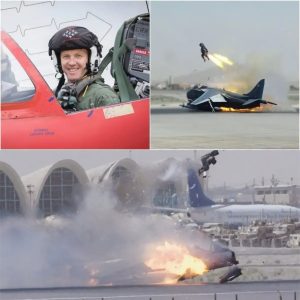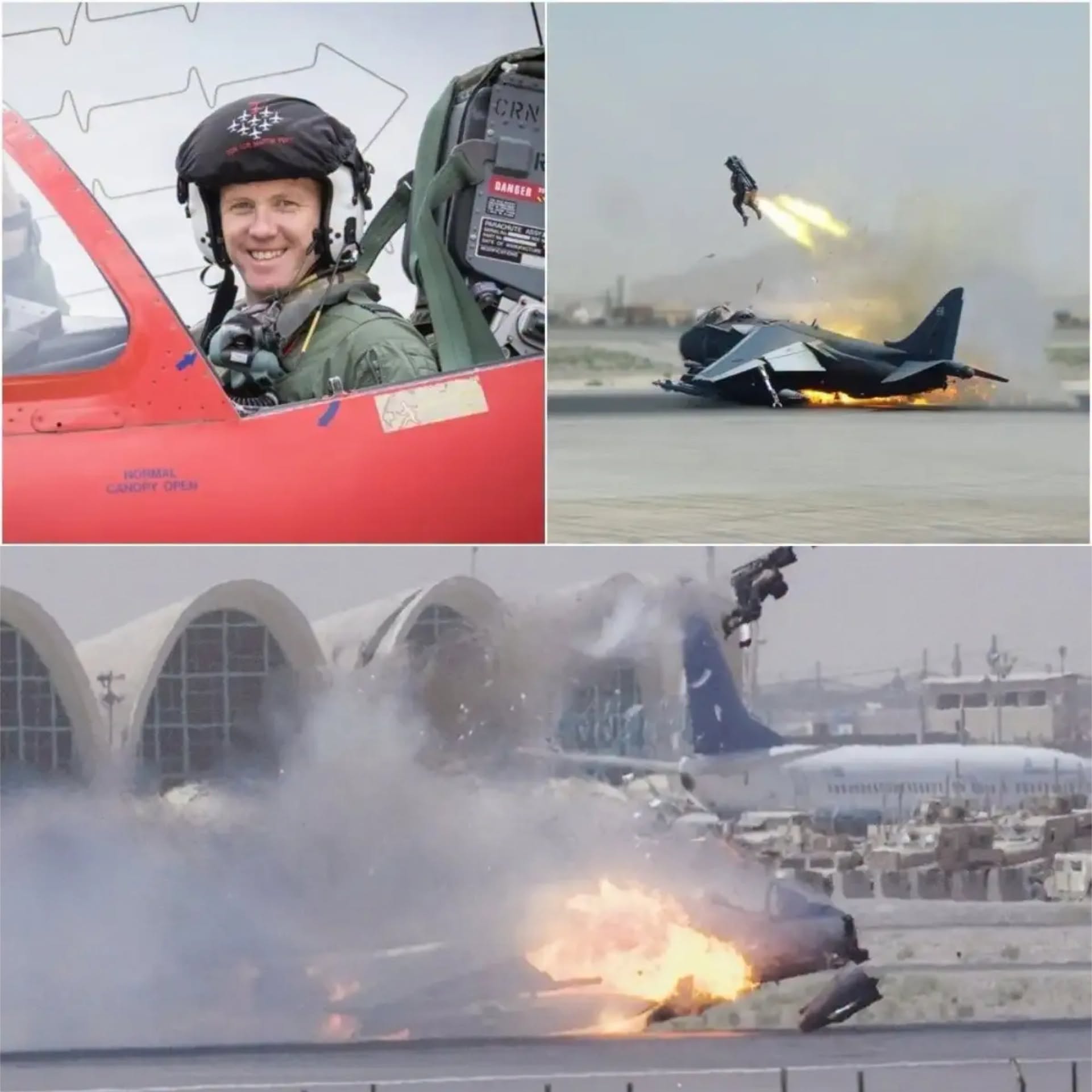
Red Arrows Leader Remembers the Moment He Ejected After a Crash Landing in a Harrier
For a military pilot, few moments are as intense—or as difficult to forget—as the instant an aircraft stops behaving the way it should. Decisions that normally take minutes must suddenly be made in seconds. Training takes over, instincts become critical, and the difference between a controlled landing and disaster can depend on a single decision.
For one former leader of the Royal Air Force Red Arrows, that moment came during a flight in a Harrier jump jet.
The Harrier was unlike almost any other combat aircraft. Famous for its ability to take off and land vertically or with very little runway, it gave pilots extraordinary flexibility. But its unique capabilities also came with demanding handling characteristics, particularly during low-speed operations and landing.
The incident became a defining chapter in the pilot’s career—not simply because an aircraft was lost, but because he had to make the most difficult decision a pilot can make: abandoning the aircraft and trusting his ejection seat to carry him away from danger.
A Pilot at the Top of His Profession
Flying with the Red Arrows is widely regarded as one of the most prestigious assignments in the Royal Air Force. The team is known around the world for precision flying, close formations and spectacular displays that demonstrate the skill and discipline of military aviation.
The pilots who join the team are already highly experienced. They have spent years flying fast jets, learning how to manage complex aircraft while operating under enormous pressure.
Leadership within the Red Arrows demands even more.
The team leader is responsible not only for his own aircraft but also for maintaining awareness of the other aircraft around him. Every maneuver is carefully practiced, and every movement has to be precise.
That background makes a serious accident particularly striking.
A pilot with extensive experience can still find himself in a situation where there is no safe way to recover the aircraft.
The Harrier
The Hawker Siddeley Harrier became one of Britain’s most recognizable military aircraft.
Its most famous feature was its ability to perform vertical and short takeoffs and landings. Instead of relying entirely on forward speed and conventional wings to generate lift, the aircraft could redirect engine thrust downward.
This capability transformed the way the aircraft could operate.
But vertical and short-field operations required exceptional concentration. The pilot had to carefully manage power, attitude, speed and the aircraft’s relationship with the ground.
A mistake or unexpected problem during the final stages of landing could leave almost no time for correction.
For the pilot involved in the accident, the situation developed rapidly.
When the Landing Went Wrong
Crash landings are among the most dangerous events a military pilot can experience.
During a normal landing, a pilot expects to have several options. If something goes wrong, the aircraft can potentially climb away, circle for another attempt or divert to another runway.
At very low altitude, however, those options disappear quickly.
The Harrier was descending toward the ground when the situation became critical. The pilot had to recognize that the aircraft could no longer be safely recovered.
At that point, the priority changed.
The mission no longer mattered.
The aircraft no longer mattered.
Survival mattered.
The pilot’s training took over as he prepared to eject.
The Ejection
Ejecting from a military aircraft is not like simply jumping out of a plane.
The process is violent, extremely fast and physically demanding.
An ejection seat must propel the pilot clear of the aircraft before the aircraft reaches the ground or breaks apart. Depending on the aircraft and seat, explosive charges and rocket systems can be involved in launching the seat away from the cockpit.
For the pilot, the sequence happens in seconds.
There is little time to think.
Pull the handle.
Brace.
Leave the aircraft.
Trust the equipment.
Trust the training.
Trust the parachute.
The pilot later remembered the moment of ejection as one of the most dramatic experiences of his life.
The aircraft he had spent years learning to fly was suddenly no longer something he could save.
He had to leave it behind.
The Seconds After Ejection
Once outside the aircraft, the pilot’s situation was still dangerous.
An ejection does not instantly mean safety.
The pilot must separate from the seat, deploy the parachute and prepare for landing. Depending on altitude and speed, all of this can happen extraordinarily quickly.
There may also be debris, fire, fuel or other hazards.
Yet once the parachute is open, the situation changes dramatically.
The roar and violence of the aircraft’s final moments give way to something almost surreal: silence.
The pilot is suddenly suspended beneath a parachute, looking down at the ground.
For someone who has just escaped a potentially fatal accident, those moments can be difficult to describe.
There is relief—but also shock.
There may be the realization that an aircraft has just been lost.
And there is the knowledge that only seconds earlier, the outcome could have been very different.
The Human Side of an Aviation Accident
Military aviation stories are often remembered through aircraft specifications, photographs and dramatic footage.
But behind every accident is a person.
The pilot has a family.
There are colleagues waiting on the ground.
There are friends who know exactly how dangerous military flying can be.
And there is often a community of fellow pilots who understand better than anyone else what the survivor has experienced.
For a Red Arrows leader, the psychological impact of such an event could be especially significant.
The Red Arrows operate at extremely close distances, sometimes with only a few metres separating aircraft during complex formations. Their performances are based on trust, discipline and repetition.
Every pilot understands that aviation contains risks.
But knowing the risk intellectually is very different from experiencing a life-threatening emergency firsthand.
Lessons From the Crash
Every serious aviation accident becomes an opportunity to learn.
Investigators examine the aircraft, weather, maintenance records, pilot actions and countless other factors.
The objective is not simply to explain what happened.
The deeper goal is preventing the next accident.
Military aviation has developed an extraordinary safety culture partly because pilots and engineers are willing to study mistakes and failures in painful detail.
A surviving pilot’s testimony can be particularly valuable.
The person sitting in the cockpit can describe what the aircraft felt like, what warnings appeared, what decisions were possible and how quickly the situation changed.
Those details can help shape future training and procedures.
A Memory That Never Really Disappears
Pilots who survive serious accidents often say that certain moments remain permanently clear in their memories.
The sound of an engine.
The movement of the aircraft.
The sudden realization that something is wrong.
The decision to eject.
Then the parachute opening.
These memories can remain vivid for decades.
For the former Red Arrows leader, the Harrier accident became more than a story about a damaged aircraft. It became a reminder of the responsibility carried by every military pilot.
Flying fast jets requires confidence, but confidence must be balanced by judgment.
A pilot must know not only how to control an aircraft but also when the aircraft can no longer be controlled safely.
That distinction can save a life.
The Legacy
The Harrier’s story remains an important part of British aviation history. It represented technological innovation and gave the Royal Air Force capabilities that few other aircraft could match.
The men and women who flew it accepted enormous responsibilities.
Some experienced emergencies.
Some survived accidents.
And some did not return home.
The story of the Red Arrows leader who was forced to eject after a Harrier crash landing is ultimately a story about survival, professionalism and the importance of making the right decision under extreme pressure.
For the pilot, ejecting meant accepting that the aircraft could not be saved.
But walking away from the accident meant something far more important had been saved: a life.
Years later, the memory of those few seconds remains powerful. It illustrates one of the fundamental truths of military aviation: even the most highly trained pilot can encounter a situation beyond his control.
What matters then is recognizing the danger, trusting one’s training and acting decisively.
The Harrier may have been lost, but its pilot survived to tell the story.
And that story continues to offer a powerful reminder of the courage, skill and split-second judgment required every time a military pilot takes to the sky.