The Night Short Stirling W7630 Was Shot Down While Heading for Düsseldorf
On the night of 10–11 September 1942, the skies over occupied Europe became the setting for another dangerous mission of the Second World War. Among the British aircraft taking part was Short Stirling W7630, a four-engine heavy bomber of RAF Bomber Command. Its destination was Düsseldorf, an important industrial city in western Germany that had become a target during Britain’s growing strategic bombing campaign.
For the crew aboard W7630, the mission began like many others: with preparations on the ground, a briefing, checks of the aircraft and engines, and the knowledge that once they took off, their safety would depend on training, teamwork and luck.
The Short Stirling was one of Britain’s first four-engine heavy bombers to enter operational service. Large and imposing, it was powered by four engines and designed to carry a substantial bomb load over long distances. By 1942, RAF crews were being sent deep into enemy territory on increasingly dangerous night operations.
The advantage of night bombing was obvious. Darkness made it harder for German fighters to locate British bombers, but it also created enormous challenges. Crews had to navigate across unfamiliar territory with limited visibility while facing searchlights, anti-aircraft guns and enemy night fighters.
For the men aboard W7630, the mission to Düsseldorf would become a fight for survival.
Düsseldorf was an important industrial and transportation center in western Germany. Its factories, railways and infrastructure made it a significant target for Allied bombing. But reaching the city meant crossing heavily defended territory.
German air defenses had developed rapidly by this stage of the war.
As British bombers approached their targets, they could encounter anti-aircraft artillery—known as flak—firing shells into the night sky. Searchlights could sweep across the darkness, attempting to illuminate aircraft and provide aiming points for the guns.
Above and around the bombers were also German night fighters.
These aircraft operated specifically to intercept bombers after dark. Their pilots relied on ground-controlled information, visual observation and increasingly sophisticated methods to locate their targets.
The combination was deadly.
According to the account of W7630’s final mission, the Stirling was first hit by German anti-aircraft fire while heading toward Düsseldorf.
For a bomber crew flying at night, being struck by flak was an extremely serious event. A heavy bomber could absorb considerable damage, but it was not invulnerable. An exploding anti-aircraft shell could damage engines, control surfaces, fuel systems or the aircraft’s structure.
Even if the aircraft remained airborne, the damage could make it slower and more vulnerable.
That appears to have been what happened to W7630.
After surviving the initial attack by anti-aircraft guns, the bomber was subsequently intercepted by a German night fighter.
The crew now faced a different kind of danger.
Unlike flak, which came from the ground, a night fighter could maneuver through the darkness and attack the bomber directly. A fighter pilot might approach from below or behind, attempting to remain difficult to detect before opening fire.
For the bomber crew, warning time could be extremely limited.
At night, the darkness surrounding the aircraft could make it nearly impossible to see an approaching fighter until the attack had already begun.
The Stirling’s defensive armament gave its gunners a chance to fight back, but a four-engine bomber was still at a disadvantage when attacked by a maneuverable fighter.
The German aircraft attacked.
W7630 was hit and shot down.
In a matter of minutes, the crew’s mission had changed from reaching the target to simply trying to survive.
The fate of an individual bomber crew could depend on countless factors: the severity of the damage, the altitude of the aircraft, the location of the attack and whether crew members had enough time to escape.
Some bomber crews were able to bail out and become prisoners of war. Others were killed when their aircraft broke apart or crashed.
For those left behind on the ground, the disappearance of a bomber could initially be accompanied by uncertainty.
Was the aircraft delayed?
Had it been forced to land?
Had the crew survived?
In wartime, families could be left waiting for answers for weeks or months.
The loss of W7630 was therefore more than the destruction of an aircraft. It represented the loss and disruption of human lives.
The men aboard the Stirling had families, friends and fellow airmen waiting for their return. They had trained together, shared meals, prepared for missions and developed the trust that was essential inside a bomber crew.
A heavy bomber was not operated by one person alone.
The pilot depended on the navigator to find the route. Wireless operators maintained communications. Engineers monitored the aircraft’s engines and mechanical systems. Gunners watched the skies for enemy aircraft. Other crew members had their own responsibilities, all working together inside a large machine flying through hostile darkness.
That teamwork was one of the defining features of Bomber Command operations.
The mission against Düsseldorf also illustrates the extraordinary danger faced by RAF crews during the early years of Britain’s strategic bombing offensive.
By 1942, the technology and tactics of night bombing were still developing. Crews were learning how to navigate more accurately, avoid enemy defenses and coordinate large formations.
Germany, meanwhile, was developing its own defenses.
The result was an increasingly dangerous contest between bomber crews and the German night-fighter and anti-aircraft networks.
Every mission was a calculated risk.
Aircraft could disappear without warning.
The story of W7630 also reminds us that wartime losses were not limited to the dramatic battles that appear most often in history books. Many aircraft were lost during individual missions, sometimes in isolated areas far from the main battlefield.
A single bomber going down could become one small entry in the enormous wartime records of the RAF.
Yet behind that entry were real people.
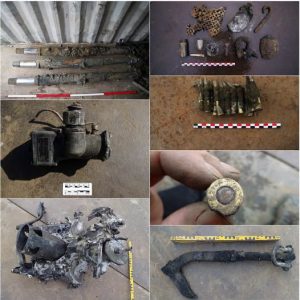
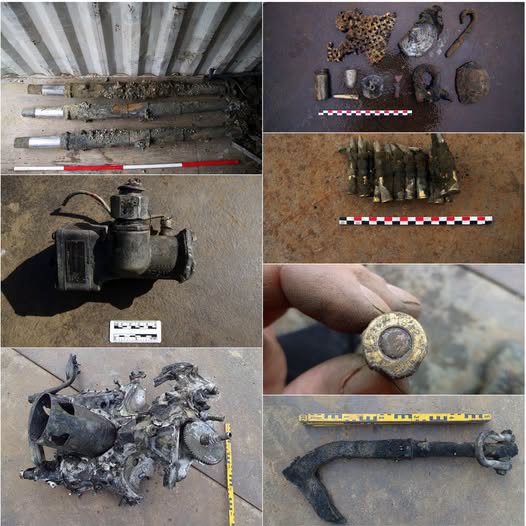
Today, historians and researchers continue to reconstruct these missions through operational records, crash reports, German records, eyewitness testimony, recovered aircraft components and information preserved by local communities.
When the details of a particular aircraft can be established, the story becomes much more personal.
The aircraft’s identification can connect it to a specific squadron, a specific mission and, most importantly, a specific group of airmen.
Short Stirling W7630’s final flight therefore represents a small but significant chapter in the wider history of Bomber Command.
It was a night when technology, courage and danger collided above Europe.
The crew began their journey as part of a large wartime operation, heading toward Düsseldorf under cover of darkness. Somewhere along the route, German anti-aircraft defenses found them. The aircraft survived that first encounter, but the danger had not passed.
A German night fighter found the damaged bomber.
The final attack brought the mission to an end.
More than eighty years later, stories like this remain important because they put human faces behind the statistics of World War II.
The war involved millions of people and countless aircraft, ships and vehicles. It is easy to look at the numbers and forget the individuals.
But every aircraft lost represented a crew.
Every crew represented families.
And every family carried the consequences of that loss.
Short Stirling W7630 may now be remembered primarily through the records of its final mission, but those records preserve something valuable: evidence that these men were there, that they took to the skies, and that their mission formed part of the enormous struggle that shaped modern history.
On the night of 10–11 September 1942, W7630 disappeared into the darkness over Europe.
Its mission ended before the crew could safely return home.
But the story of that aircraft and the men who flew in it continues to remind us of the extraordinary risks faced by RAF Bomber Command crews—and of the human cost hidden behind every wartime mission.