MID-AIR COLLISION IN 1978: The Terrifying Disaster That Shook San Diego and Changed Aviation History
On the morning of September 25, 1978, a routine flight over San Diego, California, turned into one of the most devastating aviation disasters in American history. A passenger jet and a small private aircraft collided in mid-air, sending both planes crashing into a residential neighborhood below.
The tragedy claimed 144 lives, including people aboard both aircraft and seven people on the ground. Homes were destroyed, fires erupted, and an entire community was left struggling to understand how such a catastrophe could happen on an otherwise clear morning. The accident became a turning point in aviation safety and remains a sobering reminder of the importance of communication, coordination, and technology in the skies. <Cite refs={[“turn370602search0″,”turn370602search2”]}/>
A Routine Morning Becomes a Nightmare
On that Monday morning, Pacific Southwest Airlines Flight 182 was approaching San Diego’s Lindbergh Field, now known as San Diego International Airport.
The aircraft was a Boeing 727 carrying passengers and crew on a scheduled journey from Sacramento, with a stop in Los Angeles before continuing to San Diego.
At approximately the same time, a small Cessna 172 was flying nearby. Its occupants, pilot David Lee Boswell and flight instructor Martin Kazy, were conducting a flying lesson.
Both aircraft were operating in the busy airspace around San Diego, where commercial passenger flights and smaller training aircraft shared the skies.
Initially, the situation appeared ordinary. The weather was clear, and visibility was good. Yet the two aircraft were moving along flight paths that would eventually bring them dangerously close together.
Neither the passengers aboard the Boeing 727 nor the people living beneath its flight path could have imagined the disaster that was about to unfold. <Cite refs={[“turn370602search2″,”turn370602search4”]}/>
Confusion in the Sky
As Flight 182 approached the airport, air traffic controllers were communicating with the aircraft and the Cessna.
The commercial jet’s flight crew had spotted the smaller aircraft and reported seeing it. Controllers then relied on visual separation procedures, under which pilots were responsible for maintaining separation from another aircraft they could see.
The critical problem was that visual contact was not maintained as required.
The Boeing 727’s crew eventually lost sight of the Cessna but did not properly communicate that change to air traffic control. This left controllers operating with an incomplete understanding of the situation.
Meanwhile, the aircraft continued along intersecting flight paths.
The accident investigation later identified failures in the flight crew’s compliance with visual-separation instructions as the primary cause. Air traffic control procedures that permitted visual separation when radar separation could have been used also contributed to the tragedy.
It was not simply a matter of two airplanes occupying the same sky. It was a chain of communication and procedural failures that allowed a dangerous situation to develop without being corrected in time. <Cite refs={[“turn370602search0″,”turn370602search5”]}/>
The Moment of Impact
At approximately 9:02 a.m., the Boeing 727 and the Cessna collided in mid-air northeast of the airport.
The impact was catastrophic.
The smaller aircraft struck the passenger jet, and both airplanes lost control. The Boeing 727, carrying dozens of families, travelers, and airline employees, plunged toward the ground.
The aircraft crashed into the North Park neighborhood of San Diego, where residential streets and family homes lay beneath its flight path.
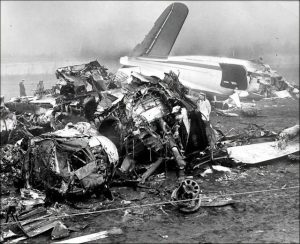
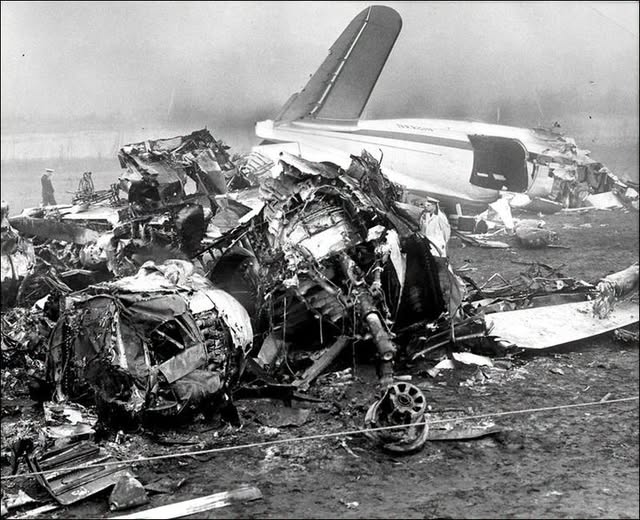
The wreckage and resulting fires caused extensive destruction. Twenty-two dwellings were damaged or destroyed, and people on the ground were caught in the disaster.
Emergency responders rushed toward the crash site, confronting burning wreckage, damaged buildings, and a scene that would remain etched in the community’s memory.
All 135 people aboard the Boeing 727 and Cessna were killed. Seven people on the ground also lost their lives, bringing the confirmed death toll to 144. Nine other people on the ground were injured. <Cite refs={[“turn370602search0″,”turn370602search4”]}/>
A Community in Shock
For residents of North Park, the morning became a nightmare that arrived without warning.
People who had been preparing for work, caring for their families, or beginning their daily routines suddenly found themselves facing a major emergency.
Firefighters, police officers, medical personnel, and other emergency workers responded to the scene. Their efforts focused on fighting fires, helping the injured, securing damaged areas, and dealing with the aftermath of the collision.
The disaster was particularly heartbreaking because it affected not only those who had boarded an airplane that morning but also people who had simply been at home.
Families lost loved ones. Residents lost homes and possessions. Neighbors faced the difficult task of rebuilding their lives while coping with the shock of what had happened.
The tragedy demonstrated that aviation accidents can have consequences far beyond an airport or an aircraft. When a plane crashes into a populated area, an entire community can become part of the disaster.
Investigators Search for Answers
Following the collision, investigators worked to reconstruct the final minutes of both flights.
They examined aircraft wreckage, flight records, communications between pilots and controllers, and other evidence to understand how the collision had occurred.
The National Transportation Safety Board ultimately concluded that Flight 182’s crew had failed to follow the requirements associated with maintaining visual separation, including informing the controller when the Cessna was no longer in sight.
The investigation also highlighted weaknesses in the air traffic control procedures being used at the time.
The findings helped demonstrate why aviation safety cannot depend solely on pilots seeing other aircraft through cockpit windows.
Human vision can be limited by aircraft structure, viewing angles, workload, and the difficulty of tracking a moving object against a complex background. Even experienced pilots can lose sight of another aircraft, especially when multiple tasks demand their attention.
Reliable communication, effective radar procedures, and technological safeguards are therefore essential layers of protection. <Cite refs={[“turn370602search0″,”turn370602search5”]}/>
How the Disaster Changed Aviation Safety
The San Diego collision became an important lesson for the aviation industry.
In the years that followed, the need for stronger protection against mid-air collisions helped drive improvements in air traffic management and the development of airborne collision-avoidance technology.
Modern Traffic Alert and Collision Avoidance Systems, commonly known as TCAS, can warn flight crews when another aircraft presents a potential collision threat. Depending on the circumstances, the system can provide instructions intended to help pilots avoid a dangerous encounter.
These systems do not eliminate every aviation risk, and safe operations still depend on trained crews, effective procedures, reliable equipment, and coordination between aircraft and controllers.
Nevertheless, collision-avoidance technology provides an additional layer of protection that earlier generations of pilots did not have.
The tragedy also reinforced an enduring principle: when safety procedures require a pilot to report that visual contact has been lost, that information must reach air traffic control immediately. Small communication failures can have enormous consequences when aircraft are operating close together.
The lessons learned from accidents such as Flight 182 have helped shape the safety practices used in modern aviation. <Cite refs={[“turn370602search0″,”turn370602search1”]}/>
Remembering the 144 Victims
Decades have passed since that terrible morning, but the loss remains part of San Diego’s history.
The 144 people who died were more than a number in an accident report. They were individuals with families, friendships, plans, and futures that were tragically cut short.
The people aboard Flight 182 were traveling to their destinations. The occupants of the Cessna were participating in a flying lesson. Those on the ground were going about their ordinary lives.
Their stories remind us that aviation safety is not merely a technical subject. It is a responsibility involving every person and system that helps aircraft travel safely.
Remembering this tragedy means honoring the victims while continuing to learn from the failures that led to their deaths.
A Lasting Warning From History
The 1978 San Diego mid-air collision remains one of the clearest examples of how several seemingly manageable problems can combine into an irreversible catastrophe.
A loss of visual contact, a failure to communicate, and procedures that left too much responsibility on human observation all played roles in the disaster.
Today, commercial aviation benefits from decades of safety improvements, advanced navigation systems, and better collision-warning technology. Yet the fundamental lesson remains unchanged: safety depends on recognizing risks early, communicating clearly, and never assuming that another person or system has a situation under control without confirmation.
The tragedy of September 25, 1978, should never be forgotten. Its victims deserve to be remembered, its survivors and affected community deserve respect, and the lessons learned must continue to protect lives in the skies.
Historical accuracy note: Although some online headlines describe this event as killing 153 people, the official accident record confirms 144 fatalities. The collision involved Pacific Southwest Airlines Flight 182, a Boeing 727, and a Cessna 172 in San Diego, California. <Cite refs={[“turn370602search0″,”turn370602search2”]}/>