Navy Jet Crash in Hertford – February 21, 1957: The Tragic Day a Fighter Nearly Struck a High School
On the morning of February 21, 1957, the quiet community of Hertford, North Carolina, experienced a terrifying aviation disaster that would remain unforgettable for generations. A U.S. Navy fighter jet crashed near Perquimans County High School, killing two men, injuring another, and destroying a school bus garage. What made the accident especially frightening was how close the aircraft came to a building filled with students and teachers.
It was a day that began like any other school day. Students arrived for classes, teachers prepared their lessons, and school employees went about their normal duties. Nobody could have imagined that a military jet, traveling at high speed and reportedly on fire, would soon descend toward the school grounds.
The disaster became a story of sudden tragedy, extraordinary luck, and the courageous response of a community determined to help those in danger.
A Routine Training Flight Turns Into a Disaster
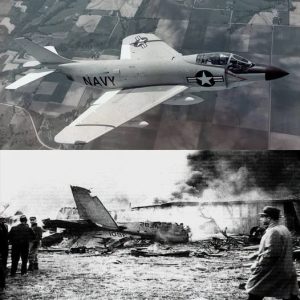
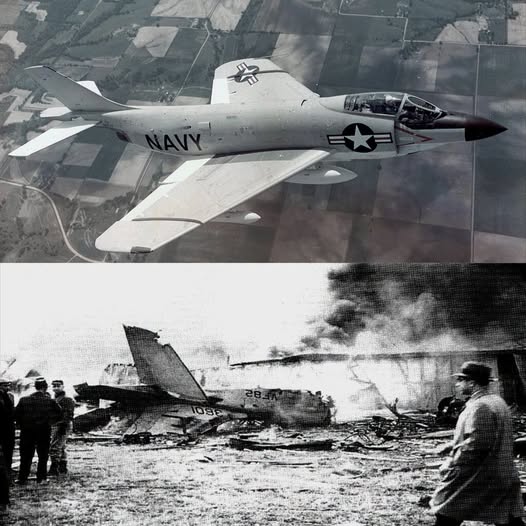
The aircraft involved was a McDonnell F3H-2 Demon, a Navy jet fighter operated by Fighter Squadron 82 and based at Naval Air Station Oceana in Virginia. The aircraft had departed at approximately 10:05 a.m. on what was described as a routine training mission.
According to historical accounts, the aircraft had been making practice runs at targets associated with Naval Auxiliary Air Station Harvey Point. The flight was supposed to be part of the regular training activities carried out by naval aviators during the Cold War era.
During the 1950s, military aviation was developing rapidly. Jet fighters were becoming faster and more sophisticated, requiring pilots to master demanding aircraft under a variety of conditions. Training flights were essential, but they also carried risks.
On that February morning, the flight ended in catastrophe.
The pilot was Ensign William W. Bell. Witnesses later described seeing a damaged aircraft approaching the school area at a relatively shallow angle. Reports indicated that the jet was burning as it descended toward the ground.
There had been no distress call from the aircraft, according to the historical account. That meant people on the ground had little or no warning that a serious emergency was unfolding above them.
A Terrifying Approach Toward the School
Perquimans County High School stood along Highway 17, just south of downtown Hertford. The school had approximately 500 students, making the area a busy center of activity for the local community.
The jet came down within roughly 200 yards of the school, an alarmingly short distance from classrooms and school facilities.
Earlier that morning, approximately 115 eighth-grade students had been outside on the baseball field. Hundreds of students were expected to use the field for physical education only minutes after the crash.
The timing could hardly have been more frightening.
Witnesses described the aircraft moving toward the school buildings while appearing to glide at a relatively flat angle. Some initially believed the pilot might still be inside the cockpit, desperately attempting to control the damaged fighter.
As the aircraft descended, it clipped the tops of small trees approximately 300 yards from the school’s garage building. It then struck a cornfield, hit a shallow depression in the ground, bounced upward, and finally crashed into the corner of the garage.
The impact destroyed the structure and set off a devastating chain of events.
Although the jet narrowly missed the main school buildings, the accident could easily have become a much larger tragedy had its path been only slightly different.
The Two Men Inside the Garage
Inside the school garage were two employees responsible for maintaining the county’s school transportation equipment.
They were J. Van Roach, 55, the chief county school mechanic, and his assistant, Preston Morgan, 26.
Both men were working when the aircraft struck the building.
The crash caused a violent explosion, and burning wreckage spread through the area. The garage contained vehicles and equipment, while oxygen and acetylene tanks and a small quantity of gasoline added to the danger.
Roach managed to stumble out of the building, but his clothing was burning. Raleigh Perry, a caretaker working at the nearby cemetery, rushed to help and threw dirt onto Roach in an effort to extinguish the flames.
It was a desperate attempt to save a man’s life amid the chaos.
Morgan was thrown out of the building by the force of the impact and landed beyond a fence near the baseball field. He suffered severe burns over approximately 35 percent of his body and was reported to be in critical condition.
Roach was taken for medical treatment, but his injuries proved fatal. He died at approximately 7:55 p.m. that evening.
The deaths and injuries transformed what might otherwise have been remembered as a narrow escape for an entire school into a deeply painful local tragedy.
The two men had been carrying out ordinary working duties. Neither had any reason to expect that a military aircraft would suddenly crash into their workplace.
Their story remains an important part of the human cost of the disaster.