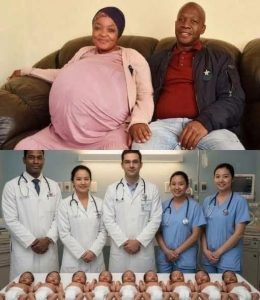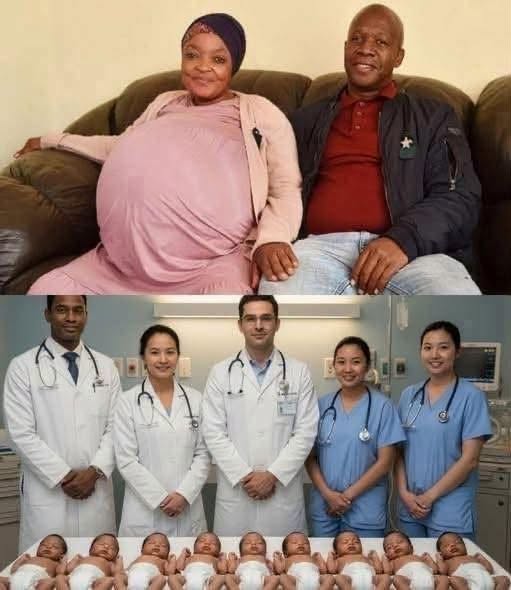
A Mother Gives Birth to 10 Babies — But One Wasn’t Human? The Shocking Story Behind a Viral Headline
Imagine preparing to welcome a new baby into the world, only to discover that your delivery has become the subject of an extraordinary story spreading across the internet. Now imagine seeing a headline claiming that a mother gave birth to ten babies, with one supposedly being something completely unexpected.
It sounds like the beginning of a shocking mystery. The headline has the ingredients that make people stop scrolling: a mother, an extraordinary birth, an unbelievable discovery, and a question that seems impossible to ignore.
But before accepting such a dramatic claim, there is an important detail to understand: there is no reliable evidence establishing that a mother gave birth to ten babies with one that was not human. Similar stories about extraordinary multiple births have circulated online, and fact-checkers have found that some were fabricated or created using artificial intelligence.
So what makes these stories so compelling, and what does medicine actually tell us about unusual births?
A Headline That Leaves Everyone Asking Questions
The phrase “but one wasn’t human” immediately creates a mystery. Readers naturally wonder what the headline means and whether doctors discovered something extraordinary in the delivery room.
Such wording encourages people to click because it withholds the most important information until the end.
However, a headline alone cannot establish that an event happened. Without a named mother, a verified hospital report, medical documentation, or credible news coverage, it would be irresponsible to describe the alleged discovery as a real event.
Extraordinary medical claims require especially careful verification. A genuine case involving ten babies would be a major medical event, attracting attention from doctors, researchers, and established news organizations.
When a post provides no verifiable details, readers should approach it with caution rather than assuming the most dramatic interpretation is true.
Can a Mother Really Give Birth to Ten Babies?
Multiple births are possible, but pregnancies involving very large numbers of babies are exceptionally rare and carry significant medical risks.
Twins are familiar to many families. Triplets and quadruplets are less common, while pregnancies involving five or more babies are considerably more unusual.
When several fetuses develop during one pregnancy, medical teams must carefully monitor the mother and babies. Premature delivery, low birth weight, and other complications can require specialized care.
The more babies involved, the more complicated the pregnancy may become. Doctors must consider the mother’s health, the development of each fetus, and the safest approach to delivery.
A story about ten babies being born at once would therefore require strong evidence before it could be accepted as fact.
There is a documented example that illustrates the difference between an extraordinary real birth and an unsupported viral claim.
In May 2021, Halima Cissé, a woman from Mali, gave birth to nine babies—five girls and four boys—in Morocco. The birth attracted international attention and became a significant medical milestone. <Cite refs={[“turn659320search0″,”turn659320search3”]}/>
That documented event demonstrates that remarkable multiple births can happen. It does not, however, provide evidence for claims about ten babies or a nonhuman newborn.
The Truth About the “Ten Babies” Stories
One of the most widely circulated stories appeared in 2021, when reports claimed that a South African woman named Gosiame Thamara Sithole had delivered ten babies.
The claim spread internationally and prompted widespread discussion. However, authorities in South Africa subsequently reported that their investigation had found no hospital records confirming the alleged births. Later government statements said that the reported ten-baby delivery had not occurred as claimed. <Cite refs={[“turn659320search1″,”turn659320search2″,”turn659320search4”]}/>
A similar story later circulated online about a woman named Amina in the United Kingdom. Fact-checkers investigated that claim and concluded that the supposed birth of ten babies was fabricated. <Cite refs={[“turn659320search0”]}/>
These examples show how an extraordinary story can become popular even when the underlying claim cannot be verified.
Some viral videos also combine misleading captions with images that have been reused from unrelated events. Other videos contain visual inconsistencies associated with AI-generated imagery.
This is why it is important to check the origin of a photograph or video rather than judging a story by how realistic it initially appears.
Why Artificial Intelligence Makes Viral Stories Harder to Judge
Artificial intelligence tools can generate convincing images and videos of events that never happened.
A video may appear to show doctors standing around a hospital bed, a mother holding several newborns, or nurses presenting an extraordinary delivery to a cheering crowd.
Yet realistic-looking imagery is not proof that the event occurred.
Fact-checkers have identified viral videos of supposed record-breaking births that were generated using AI. In some cases, small visual inconsistencies reveal that the scenes are artificial. <Cite refs={[“turn659320search7″,”turn659320search8”]}/>
Even when no obvious visual error is visible, a video still needs independent verification.
Readers should ask whether the hospital can be identified, whether reputable news organizations have reported the event, and whether the people shown can be connected to a real, documented occurrence.
If those basic details are missing, the safest response is to avoid treating the video as factual.
What If a Baby Is Born With an Unexpected Medical Condition?
Sometimes, a real birth involves a condition that surprises the family or medical team.
Congenital conditions can affect the development of organs, limbs, facial structures, or other parts of the body. Some conditions are identified during pregnancy, while others become apparent only after delivery.
In rare situations, doctors may discover an unusual developmental condition that requires additional tests and specialized treatment.
However, such conditions do not make a baby less human.
Every child deserves dignity, appropriate medical care, and protection from humiliating or misleading public descriptions. Medical differences should be discussed using accurate terminology and sensitivity toward the child and family.
The phrase “one wasn’t human” is therefore not a reliable medical description. Without a documented case, it is simply an unverified claim designed to provoke curiosity.
The Emotional Side of an Extraordinary Birth
For families expecting a child, childbirth can be one of life’s most emotional experiences.
Parents may feel excitement, nervousness, relief, and uncertainty as they wait to meet their newborn. When a baby requires additional medical attention, those feelings can become even more intense.
Families experiencing multiple births may face additional practical challenges, including longer hospital stays, specialized newborn care, and the financial and emotional demands of caring for several children.
Doctors, nurses, and other healthcare professionals work together to help mothers and newborns receive the attention they need.
Stories about remarkable births can inspire admiration for these families and the medical teams supporting them. But that admiration should be based on genuine experiences rather than invented events.
A real family’s story deserves to be told accurately, especially when sensitive medical information is involved.
How to Check the Story Before Sharing It
If you encounter a post claiming that a mother gave birth to ten babies and one was not human, consider these steps:
- Look for the mother’s name. Does the report identify her and provide credible information about the event?
- Check the hospital. Is there an identifiable medical institution or an official statement confirming the delivery?
- Search established news organizations. Look for independent reporting rather than pages repeating the same social media caption.
- Examine the images. Determine whether they come from the alleged event or have appeared online in unrelated stories.
- Be cautious with sensational language. Headlines promising an impossible discovery may be designed primarily to attract clicks and shares.
These simple checks can help prevent misinformation from spreading.
They also protect the dignity of real families whose names or photographs may be used without permission.
The Final Word
The headline “A Mother Gives Birth to 10 Babies — But One Wasn’t Human” is certainly attention-grabbing, but the claim has not been established by reliable evidence.
There are genuine medical stories involving extraordinary multiple births, including the documented delivery of nine babies to Halima Cissé in 2021. There are also well-documented examples of viral stories about ten babies that were later found to be false. <Cite refs={[“turn659320search0″,”turn659320search2”]}/>
The distinction matters because real childbirth experiences deserve respect, while fabricated stories can mislead readers and cause unnecessary confusion.
Behind every genuine birth story is a mother, a family, and a newborn whose well-being matters far more than the number of clicks a headline receives.
The next time an unbelievable medical story appears on your feed, take a moment to investigate before sharing it. Curiosity is natural, but reliable information is essential.
What do you think about shocking medical stories that go viral on social media? Do you check the source before sharing them? Share your thoughts respectfully in the comments.