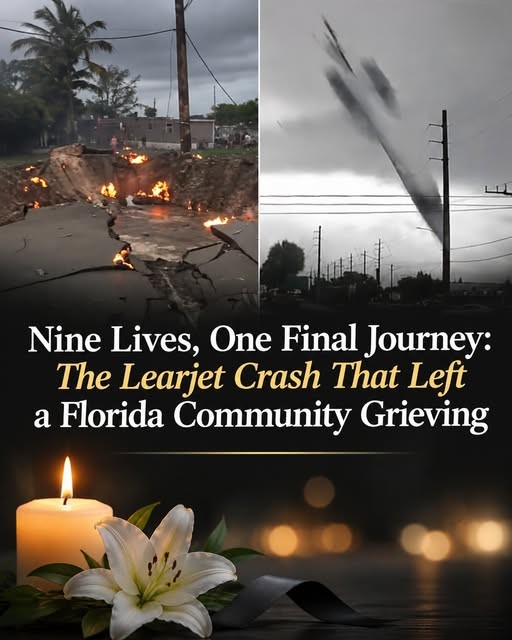
Nine Lives, One Final Journey: The Learjet Crash That Left a Florida Community Grieving
On Sunday, November 1, 2026, nine people boarded a private jet in Texas, expecting an ordinary journey to the beautiful islands of the Bahamas. Some were traveling with family. Others were accompanying friends. The destination promised sunshine, relaxation, and time away from everyday responsibilities.
But the journey would never reach its destination.
Just after midday, a Learjet 60 carrying nine people crashed in Palm Beach County, Florida, near the community of Greenacres. The impact created a devastating scene, leaving wreckage, flames, damaged roads, and a neighborhood struggling to understand what had just happened.
All nine people aboard the aircraft lost their lives.
What began as a routine private flight became one of the most heartbreaking aviation tragedies in the region. Behind the aircraft registration number, the emergency radio calls, and the investigation reports were nine individual lives, families, friendships, and futures that disappeared in a matter of moments.
And as investigators work to understand the final minutes of the flight, a grieving community is left with difficult questions.
This is the story of the final journey of Learjet N722BD.
1. A Journey That Was Supposed to End in the Bahamas
The aircraft involved was a Learjet 60, registered as N722BD.
It departed Austin-Bergstrom International Airport in Texas on the morning of November 1. Its planned destination was North Eleuthera Airport in the Bahamas.
There were nine people aboard: two pilots and seven passengers.
Among the passengers was Texas technology entrepreneur Adam Robinson, traveling with his wife, Helen Sharp, their two young children, Emma and Charlie, family friends Rachael Reed and Charmi Fehr, and their children’s caregiver, Anita Maria Cetina.
The aircraft was operated for a private flight, and the passengers were expecting to reach their destination safely.
At first, there was nothing publicly known to suggest that the journey would end in tragedy.
The aircraft climbed to cruising altitude and continued across the southeastern United States. But as it approached Florida, conditions became increasingly complicated.
The weather would soon become an important part of the investigation.
2. The Final Minutes Above Florida
As the Learjet approached southern Florida, the flight crew communicated with air traffic controllers about conditions surrounding the aircraft.
According to preliminary information presented by the National Transportation Safety Board, the crew reported light clear icing and moderate turbulence.
They also described precipitation and changes in the aircraft’s altitude.
The pilots requested permission to climb to a higher altitude, and air traffic control approved the request.
But events then unfolded with frightening speed.
Less than 30 seconds after the climb clearance, the aircraft began experiencing a dramatic loss of altitude.
Radio communications captured the crew reporting an accelerating descent and declaring an emergency.
The situation was deteriorating rapidly.
Air traffic controllers attempted to communicate with the aircraft as the crew struggled to respond to the emergency.
The final radio transmissions revealed just how serious the situation had become.
The aircraft was losing altitude at an extraordinary rate.
For the people aboard, those final moments were a devastating emergency. For investigators, the radio recordings may provide important information about what happened inside the cockpit.
Unfortunately, the aircraft did not recover.
3. The Crash That Shook a Florida Neighborhood
At approximately 12:50 p.m. Eastern time, the Learjet crashed near Military Trail and 10th Avenue North in Palm Beach County.
The impact was catastrophic.
The aircraft struck the ground in a residential area, creating a large crater and scattering debris across the surrounding roadway and neighborhood.
Fire erupted at the scene.
Images and videos from the area showed flames burning near the impact site, smoke rising into the sky, and emergency personnel rushing to respond.
For residents nearby, the noise and destruction were terrifying.
People who had been going about their normal Sunday afternoon suddenly found themselves close to a major aviation disaster.
Roads were closed as firefighters, law enforcement officers, and emergency crews worked to secure the area.
The crash also damaged nearby infrastructure and created concerns about utilities and the safety of surrounding homes.
It was a frightening reminder that aviation accidents can affect far more people than those aboard an aircraft.
4. Nine People, Nine Lives, Nine Families Forever Changed
Perhaps the most heartbreaking part of this tragedy is the loss of nine individual lives.
Authorities subsequently released the identities of those aboard.
The two flight crew members were pilot Jeffrey Gregory and co-pilot Nathalia Gadelha Filgueiras.
The seven passengers were Adam Robinson, Helen Sharp, their children Emma and Charlie, Rachael Reed, Charmi Fehr, and Anita Maria Cetina.
Each person had a story that extended far beyond the flight.
Adam Robinson was a technology entrepreneur whose professional life involved building and leading businesses. His wife, Helen Sharp, was remembered by family and friends for her personality and the warmth she brought to those around her.
Their children, Emma and Charlie, were only four and two years old.
They had their entire lives ahead of them.
Their loss makes this tragedy particularly difficult to comprehend.
Rachael Reed and Charmi Fehr were also remembered by loved ones for their adventurous spirits and close relationship. They had built a life together that included travel, friendship, and business interests.
Anita Maria Cetina cared for the Robinson children and was described by relatives as someone who had become an important part of the family.
The two pilots also left behind people who loved them.
Jeffrey Gregory and Nathalia Gadelha Filgueiras were performing their professional duties when the aircraft encountered the emergency.
Nathalia was just 20 years old and had been pursuing her aviation career.
Nine people were lost, and nine groups of loved ones were left facing an unimaginable reality.
5. The Young Co-Pilot Who Was Building Her Future
Among the victims was Nathalia Gadelha Filgueiras, whose death brought particular attention to the young age of the co-pilot.
At only 20 years old, she had already invested years into developing her aviation skills.
Her family had supported her interest in flying, and she had been working toward a professional future in aviation.
For a young person who had spent so much time pursuing a dream, the tragedy represents a life cut short.
Her final communications with air traffic control have become part of the public investigation into the crash.
It is important, however, not to confuse those recordings with proof of responsibility.
Investigators must examine the aircraft, its systems, the weather, the crew’s actions, and all available evidence before drawing conclusions.
The aviation community has also emphasized the importance of avoiding unsupported accusations against either crew member.
The focus should remain on understanding what happened and ensuring that the investigation establishes the facts.
6. Hundreds of Residents Faced an Unexpected Emergency
The disaster did not end with the loss of the aircraft.
The surrounding community also faced serious consequences.
Because the crash occurred near homes and a mobile home community, authorities had to consider the possibility of additional danger from fires, wreckage, and damaged infrastructure.
Hundreds of residents were evacuated while emergency personnel secured the area.
Reports indicated that approximately 600 people were affected by the evacuation.
Some residents temporarily lost access to their homes and personal belongings.
Imagine leaving your house for an ordinary Sunday afternoon and suddenly being told that you cannot return because an aircraft has crashed nearby.
For many people, the experience was frightening and confusing.
Families had to find temporary places to stay while authorities worked around the wreckage.
Road closures also disrupted transportation, and utility crews responded to assess damage.
The emergency response involved coordination between local authorities, firefighters, law enforcement, utility workers, and federal investigators.
Although the passengers and crew suffered the greatest loss, the accident also created a difficult situation for the people who lived near the crash site.
Their recovery would require time, assistance, and patience.
7. What Investigators Have Discovered So Far
The National Transportation Safety Board is leading the investigation, with assistance from the Federal Aviation Administration.
Investigators are examining several important areas.
One major focus is the weather.
The crew reported icing, turbulence, and precipitation before the aircraft entered its rapid descent.
Weather conditions near the ground included rain and thunderstorms, but investigators must establish what conditions the aircraft encountered at its cruising altitude.
Conditions at the surface do not necessarily reveal everything happening thousands of feet above.
Another important question concerns the possibility that the aircraft began breaking apart before reaching the ground.
NTSB officials said preliminary evidence indicated that some parts may have separated from the aircraft before impact.
Investigators are also examining the aircraft’s wreckage, maintenance history, flight data, and available cockpit recordings.
The cockpit voice recorder could be particularly important if it is recovered and its information can be accessed.
These recordings may help investigators understand what the pilots experienced and what happened during the final moments.
However, one important point must be emphasized: no final cause has been established.
Weather, mechanical issues, aircraft performance, and other possible contributing factors must be examined carefully.
It would be irresponsible to declare a cause before the investigation is complete.
8. The Questions That Still Need Answers
Whenever a major aviation accident occurs, families naturally want answers.
They want to understand what happened, why it happened, and whether anything could have prevented it.
In this case, several questions remain.
Why did the aircraft enter such a rapid descent?
What role did icing and turbulence play?
Did the aircraft experience a mechanical or structural problem?
What happened during the crew’s final communications with air traffic control?
And what evidence will investigators discover when they complete their examination of the wreckage?
These are not simply technical questions.
They matter because the answers may help prevent similar accidents in the future.
The NTSB’s work will involve reviewing evidence, interviewing witnesses, examining the aircraft, and reconstructing the sequence of events.
Aviation investigations can take months or longer.
Families and the public may have to wait before a complete explanation becomes available.
But obtaining accurate answers is essential.
9. A Community Remembers Those Who Never Returned
As the investigation continues, attention should also remain on the families and friends who are grieving.
For the Robinson family, the loss of two parents and their young children is devastating.
For the families of the other passengers, the sudden loss of loved ones has changed their lives forever.
For the families of the pilots, there is also the painful reality of losing people who dedicated themselves to aviation.
And for residents near the crash site, the memory of that Sunday afternoon will likely remain with them for a long time.
Behind every news report is a human story.
There are birthdays that will no longer be celebrated together, family gatherings that will never happen, conversations that will never take place, and dreams that will remain unfinished.
These are the things that make this tragedy so difficult.
The aircraft may eventually be removed. Roads may reopen. Homes may be repaired. Investigators may publish their final report.
But the families will continue living with the absence of the people they loved.
10. Nine Lives, One Final Journey
The November 1 Learjet crash is a heartbreaking reminder of how quickly an ordinary journey can become an unimaginable tragedy.
Nine people departed Texas expecting to reach the Bahamas.
Instead, their journey ended in Florida, leaving families grieving, a community shaken, and investigators searching for answers.
Their names deserve to be remembered as more than a list in an aviation report.
They were parents, children, friends, professionals, and loved ones.
They had plans for the future and people waiting for them.
As the NTSB continues its investigation, the hope is that the evidence will eventually provide answers and help improve aviation safety.
Until then, the most important thing is to remember the nine people who lost their lives and respect the families who are experiencing this terrible loss.
FINAL TRIBUTE
Nine people boarded an aircraft expecting another destination.
Nine lives ended before they could reach it.
May Jeffrey Gregory, Nathalia Gadelha Filgueiras, Adam Robinson, Helen Sharp, Emma Robinson, Charlie Robinson, Rachael Reed, Charmi Fehr, and Anita Maria Cetina rest in peace.
Our thoughts are with their families, friends, and everyone affected by this tragedy.
What do you think is the most important lesson the aviation industry should take from this accident? Share your thoughts respectfully in the comments.
If you believe these lives deserve to be remembered, please share this story. Subscribe for more carefully researched news stories, human-interest reports, and important events from around the world.