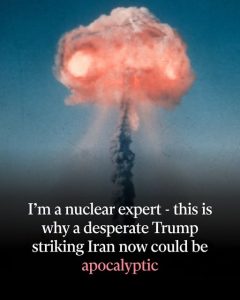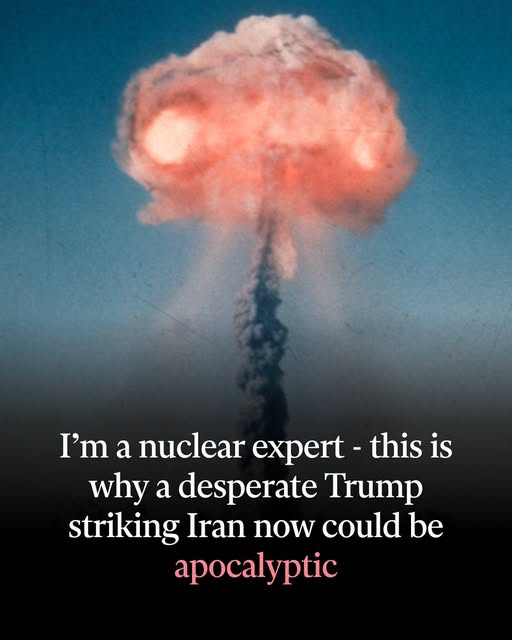
I’m a Nuclear Expert: Why a Desperate Trump Strike on Iran Could Turn Apocalyptic
A detailed geopolitical analysis of escalating tensions between the United States and Iran, the danger of another military confrontation, and the potentially devastating consequences for the Middle East and the rest of the world.
The world could be approaching one of the most dangerous moments in modern international politics. Tensions between the United States and Iran have reached an alarming level, and the possibility of renewed military action has raised serious questions about what could happen if President Donald Trump decides that another round of strikes is the only way to force Tehran into submission.
For Washington, military action might appear to offer a quick solution. American forces possess enormous conventional military capabilities, including advanced aircraft, precision-guided missiles, naval forces and sophisticated intelligence systems. A carefully planned operation could potentially destroy or weaken important Iranian military installations.
But military strength does not guarantee a predictable outcome.
Iran is a large country with significant military capabilities, regional allies and strategic control over important shipping routes. Even if American forces achieved their immediate battlefield objectives, the consequences could extend far beyond the original targets. A new confrontation could threaten American troops, regional governments, international shipping, energy supplies and millions of civilians.
The most frightening possibility is not necessarily that either side deliberately launches a nuclear weapon. It is that a conventional military confrontation could develop into a much larger crisis involving nuclear facilities, radioactive contamination fears, regional retaliation and escalating political pressure.
That is why experts warn that renewed attacks could carry consequences far greater than the military planners initially anticipate.
1. Why Trump could be considering another attack
The relationship between Washington and Tehran has been shaped by decades of distrust, sanctions, military confrontations and disagreements over Iran’s nuclear ambitions.
The conflict has become even more complicated following the fighting that began in February 2026. Although military operations have been interrupted by periods of negotiation and ceasefire efforts, the underlying disagreements remain unresolved.
President Trump faces several difficult choices. He could continue applying economic pressure, pursue a negotiated agreement or authorize another military campaign.
An analysis published by the Council on Foreign Relations on October 23 identified these three broad options: escalation, negotiation or waiting to see whether political and economic pressure changes Iran’s position.
Council on Foreign Relations
The pressure for military action is understandable from a strategic perspective. Washington wants to prevent Iran from developing nuclear weapons, protect American military installations and maintain security in the Persian Gulf.
However, there is a significant difference between demonstrating military superiority and achieving a lasting political victory.
Destroying military installations does not automatically eliminate the political motivations behind a conflict. It may instead strengthen hard-line elements within Iran, increase public anger and make future negotiations considerably more difficult.
Trump must also consider the domestic political consequences. Another prolonged war could become expensive, unpopular and difficult to explain to American voters.
The danger is that political pressure can encourage leaders to choose dramatic military action when a slower diplomatic solution might ultimately produce better results.
2. Iran is not an easy target
One of the biggest mistakes military planners could make is underestimating the complexity of Iran.
Iran has a population of millions, a large geographical area and military infrastructure spread across different regions. Some important installations are underground, heavily protected or located near civilian communities.
Its military capabilities include ballistic missiles, drones, naval forces and networks of regional allies.
American forces could potentially destroy numerous targets during an intensive air campaign. But that would not necessarily prevent Iran from retaliating.
Iran could target American military facilities in the Middle East, threaten commercial shipping, launch drone and missile attacks or encourage allied armed groups to increase their activities.
A Reuters analysis published on November 2 highlighted the concerns of Gulf countries that host American military installations. Officials fear that another confrontation could turn those installations into targets for Iranian retaliation.
The report also described potential threats to energy infrastructure, desalination facilities, communications networks and undersea cables.
Investing.com
This creates a dangerous strategic problem.
The United States might begin a military operation believing it can control the escalation. Iran, however, could respond in ways that expand the conflict beyond the original battlefield.
A strike intended to last several days could become a prolonged regional confrontation.
3. The nuclear danger is more complicated than a mushroom cloud
When people hear the word nuclear, they often imagine an enormous explosion followed by a mushroom cloud.
But the danger surrounding Iran’s nuclear facilities is not limited to the possibility of a nuclear weapon being used.
A conventional military attack against a nuclear-related installation could create serious safety and environmental concerns, depending on the facility, the materials present and the nature of the damage.
For example, an attack could damage buildings containing radioactive materials, disrupt safety systems or create uncertainty about the condition of sensitive equipment.
That does not mean every strike on a nuclear facility would cause a radioactive disaster. The consequences would depend on the specific target and the materials involved.
Nevertheless, even the possibility of radioactive contamination could create panic among nearby communities and neighboring countries.
There is another important concern: nuclear escalation.
Iran’s nuclear program is a central issue in the confrontation. If Iranian leaders conclude that conventional military power cannot protect their country from repeated attacks, the political debate inside Iran could shift toward more aggressive nuclear policies.
Military strikes might delay nuclear development while simultaneously increasing the determination of future Iranian leaders to pursue greater nuclear capabilities.
That would be a deeply troubling outcome.
The international community would then face a situation in which military action had damaged facilities but potentially made the underlying political problem harder to solve.
4. The Strait of Hormuz could become the center of a global crisis
One of the most important geographical locations in this confrontation is the Strait of Hormuz.
This narrow waterway connects the Persian Gulf with the Gulf of Oman and the wider Indian Ocean. It is one of the world’s most important routes for international energy transportation.
A significant portion of the world’s oil and liquefied natural gas shipments passes through this region.
If fighting intensified, commercial vessels could face missile threats, drone attacks, mines, naval confrontations and insurance restrictions.
Even without a complete closure of the waterway, uncertainty could disrupt international shipping.
The consequences would quickly reach countries far from the Middle East.
Oil prices could rise, transportation costs could increase and businesses dependent on international energy supplies could face additional expenses.
American consumers could also experience higher gasoline prices.
For developing countries that depend heavily on imported fuel, the economic consequences could be particularly severe.
A conflict that begins with military objectives could therefore develop into a global economic emergency.
5. American troops could face a dangerous retaliation campaign
Another major concern involves the thousands of American military personnel stationed throughout the Middle East.
American installations provide Washington with important military advantages. They support aircraft operations, intelligence gathering, logistics and regional security cooperation.
However, those installations could also become targets during a renewed confrontation.
Iran does not need to defeat the United States in a conventional military battle to impose serious costs.
It could attempt to overwhelm defensive systems through repeated drone and missile attacks, disrupt military logistics and create uncertainty across several countries simultaneously.
Even relatively limited attacks could produce casualties, damage equipment and force Washington to commit additional military resources to defensive operations.
The challenge would become more complicated if regional armed groups became involved.
American military commanders would need to protect personnel while continuing offensive operations and preventing the conflict from spreading.
This could create a cycle of retaliation.
An Iranian attack might lead to another American strike. That strike could produce further Iranian retaliation, potentially drawing additional countries into the confrontation.
The longer this cycle continues, the more difficult it becomes for either government to find a politically acceptable way to stop fighting.
6. Israel could become part of an even wider confrontation
Israel is another central factor in the crisis.
Israeli leaders have repeatedly expressed concern about Iran’s nuclear program and its regional military influence.
If Washington launches another major operation, Israel could face pressure to participate directly or increase its military readiness.
Iran could also respond by directing attacks toward Israeli territory or supporting allied groups operating in the region.
That would create additional risks for neighboring countries.
Lebanon, Syria, Iraq and other parts of the Middle East could experience increased instability.
A conflict involving the United States, Iran and Israel would be extremely difficult to contain because the countries involved have different security priorities and political objectives.
One government might believe that a limited attack is necessary to restore deterrence. Another might interpret the same action as an opportunity to weaken an opponent permanently.
Those different calculations can make escalation particularly dangerous.
The central question would no longer be simply whether Iran’s military installations could be destroyed.
It would become whether the governments involved could prevent a regional war from expanding.
7. Why a desperate military decision could backfire
Military decisions are not made in a political vacuum.
Presidents face pressure from military advisers, intelligence officials, political allies, foreign governments and voters. During an international crisis, the demand for decisive action can become overwhelming.
But acting quickly does not necessarily mean acting wisely.
If Trump believes that another military operation will demonstrate American strength, he must also consider what happens after the bombs stop falling.
Who would control the situation afterward?
Would Iran agree to negotiate, or would its leaders become even more determined to resist American demands?
Would regional governments support Washington, or would they distance themselves from an increasingly unpopular conflict?
Would American forces be able to protect every important military installation and commercial shipping route?
These questions are essential because military success and political success are not the same thing.
A country can win individual battles while losing the larger strategic objective.
An Associated Press report published on November 5 described the difficult choices facing Trump following Republican losses in the midterm elections. The report highlighted the political and economic costs of the Iran conflict, alongside the possibility of further military escalation.
AP News
If political frustration influences decisions about military action, the consequences could be particularly serious.
A president must resist the temptation to treat military force as a substitute for a workable diplomatic strategy.
8. Could the conflict actually become nuclear?
This is perhaps the most frightening question.
There is an important distinction between a nuclear accident, radioactive contamination and an actual nuclear weapons exchange.
These are three different scenarios, and they should not be confused.
A conventional bomb striking a nuclear-related installation does not automatically produce a nuclear explosion. Nuclear weapons require highly specialized conditions and cannot simply detonate because a conventional explosive hits nuclear material.
However, damage to a nuclear facility could create other dangers, including the release of radioactive substances if the affected installation contains such materials.
The greater strategic concern is the possibility of a chain of decisions that eventually brings nuclear weapons into consideration.
Imagine a situation in which a military confrontation becomes increasingly intense. Missile attacks continue, civilian casualties increase and both governments face growing pressure to demonstrate strength.
Military commanders could begin operating under extreme uncertainty.
Leaders might misinterpret an opponent’s intentions, misunderstand intelligence information or believe that they have only a short time to respond.
This is why communication channels, diplomatic contacts and clear military boundaries are so important.
Even when countries are enemies, they need ways to communicate during a crisis.
Nuclear powers must be especially careful because mistakes involving strategic weapons can have consequences that cannot be reversed.
There is no reason to assume that a renewed American strike would automatically lead to nuclear war. But dismissing the risks of escalation would be equally irresponsible.
9. Diplomacy may be the only lasting solution
Despite the growing tensions, diplomacy remains an option.
The United States and Iran have serious disagreements, but both governments have reasons to avoid an uncontrolled regional war.
Washington wants to protect American personnel, maintain international economic stability and prevent Iran from acquiring nuclear weapons.
Tehran wants to preserve its government, defend its national interests and reduce the economic pressure created by international sanctions.
Those objectives are difficult to reconcile, but negotiations could provide a framework for reducing the danger.
A potential agreement could include verifiable restrictions on nuclear activities, international inspections, arrangements concerning enriched uranium, guarantees against attacks and discussions about sanctions relief.
Such an agreement would require difficult compromises.
The United States would need confidence that Iran was meeting its nuclear commitments. Iran would need confidence that Washington would not simply abandon an agreement after receiving concessions.
International inspectors could play an important role in verifying compliance.
The Arms Control Association’s November 2026 analysis describes the unresolved diplomatic disagreements and the risks created by stalled negotiations. It also emphasizes that military strikes cannot necessarily solve the technical and political challenges surrounding Iran’s nuclear program.
Arms Control Association
Diplomacy may be slower and less dramatic than military action, but it offers something that bombing cannot guarantee: a framework for preventing the same crisis from returning.
10. The world cannot afford another uncontrolled war
The consequences of a major confrontation between Washington and Tehran would not remain confined to the Middle East.
European governments would face difficult security decisions. Asian economies could experience energy disruptions. International financial markets could become increasingly unstable.
Countries already struggling with inflation and economic uncertainty could face additional pressure.
Ordinary families would suffer the consequences of decisions made by political and military leaders.
For people living in Iran, the danger would be particularly immediate. Military operations could damage infrastructure, interrupt electricity and water supplies, disrupt hospitals and force families to leave their homes.
American service members could also face serious danger.
Civilians in neighboring countries could find themselves caught between competing military forces.
And if radioactive materials were released during an attack on a nuclear-related installation, the consequences could extend beyond national borders.
The international community therefore has a responsibility to encourage restraint and support meaningful negotiations.
The United Nations, European governments and regional powers should work to maintain communication between Washington and Tehran.
The objective should be to prevent another military confrontation from becoming a much larger disaster.
Final thoughts: A decision that could change the future
President Donald Trump faces a difficult decision over Iran.
Another military campaign might weaken Iranian military capabilities, but it could also create new dangers that are much harder to control.
The United States has enormous military power. Yet even the world’s strongest military cannot guarantee that a regional conflict will remain limited once retaliation begins.
The danger is not simply the number of missiles or aircraft involved. It is the possibility that one military decision could trigger another, creating a chain of escalation that neither government originally intended.
Nuclear facilities, international shipping, energy infrastructure and civilian populations could all become part of a crisis with worldwide consequences.
There is also a fundamental question that Washington must answer: What happens after another attack?
If military action does not produce a lasting political settlement, the United States could find itself facing the same problem again, potentially under even more dangerous circumstances.
A responsible strategy must therefore consider not only how to begin a military operation but also how to prevent it from becoming an endless conflict.
The world does not need another war driven by anger, political pressure or the desire to demonstrate strength.
It needs careful leadership, credible negotiations and a serious commitment to preventing nuclear escalation.
Because when the stakes involve millions of lives, international stability and the possibility of nuclear catastrophe, the cost of a mistake could be beyond anything political leaders can repair.