FIVE PEOPLE SHOT IN WASHINGTON, DC: DEADLY SHOOTING LEAVES ONE PERSON DEAD AND FOUR INJURED
A frightening shooting in Washington, DC, on Thursday morning, November 12, left five people shot and triggered a major police response in the Logan Circle neighborhood, just north of downtown. What began as reports of an active shooter near 15th Street NW and P Street NW developed into a barricade situation, with officers searching a gym and a nearby apartment building while urging people to stay away.
Authorities later confirmed that one person was killed and four others were wounded. The suspected gunman also died after suffering an apparent self-inflicted gunshot wound inside an apartment. One of the injured victims was reported to be in critical condition. The investigation remains ongoing, and officials have not announced a confirmed motive.
The incident unfolded shortly before 8 a.m., when police received reports of gunfire at a gym in the 1500 block of 15th Street NW. Officers arrived within roughly half a minute, according to the Metropolitan Police Department’s interim chief, Jeffery Carroll. Inside the gym, they found an adult male who had been shot. He was pronounced dead at the scene.
Police then located four additional people who had been shot nearby. Emergency responders transported the wounded victims to hospitals. Officials said one had critical injuries, while the others were being treated for injuries that were not described as life-threatening in early briefings.
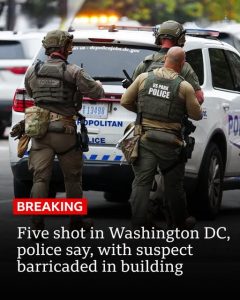
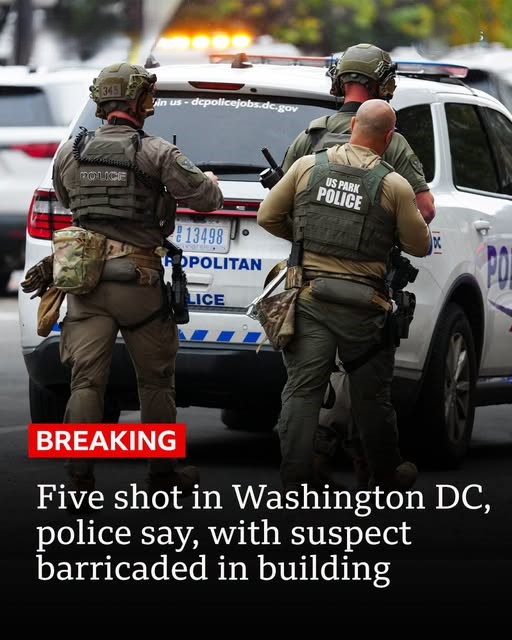
The shooting prompted a large emergency response in a busy part of the city. Officers in tactical equipment moved through the area as streets were closed and nearby buildings were checked. Police asked residents, workers, gym members, and commuters to avoid the scene. During the active phase of the incident, people in parts of Logan Circle and nearby Dupont Circle were told to shelter in place while officers worked to establish whether the shooter remained a threat.
The gym was identified in local reporting as VIDA Fitness. The location sits in a mixed-use area of homes, businesses, and busy streets, about a mile from the White House. The proximity to the center of the capital drew attention, but authorities did not indicate that the shooting was connected to any government building or national security target.
As officers secured the gym and searched a nearby apartment building, they heard additional gunfire from the building’s seventh floor. Police said the suspect had barricaded himself inside an apartment. Negotiators made contact and spoke with him for more than an hour. During that communication, officers heard a gunshot. They entered the apartment and found the suspect with an apparent self-inflicted gunshot wound. Later reports said he had died.
Police have not publicly identified the suspect or the victims in the information available at the time of reporting. Investigators are working to establish what led to the shooting, whether the suspect knew the victims, and what happened in the moments before the first shots were fired. Officials have indicated that the suspect lived in the apartment building and was also a member of the gym. That information may help investigators reconstruct the events, but it does not by itself establish a motive.
Witnesses described a sudden eruption of fear. People inside and around the gym heard gunshots and ran for safety. Some sought cover, while others hurried away from the building without knowing whether the gunfire was continuing or where the shooter might be. One witness told reporters that people were fleeing as police arrived. Such accounts underline how quickly an ordinary morning routine can turn into a life-threatening emergency.
The response affected more than the immediate block. Streets around 15th Street NW and P Street NW were closed, and police advised the public to use other routes. Nearby schools were placed on alert during the incident. Those precautions were lifted after authorities determined that the immediate threat had ended. Transit customers were also warned to expect a greater police presence in the area, while bus service experienced disruptions.
City officials acknowledged the fear and grief caused by the violence. Mayor Muriel Bowser described the shooting as a senseless act of gun violence and said the city was devastated by the loss of life. She thanked police officers, firefighters, emergency medical personnel, and other responders who worked to secure the scene and assist victims. Officials also said the White House had been briefed, reflecting the scale of the police response and the location of the incident.
The Metropolitan Police Department’s Emergency Response Team took part in the operation. Federal agencies, including the Bureau of Alcohol, Tobacco, Firearms and Explosives and the FBI, also assisted. Their presence is consistent with the need to process a serious crime scene, examine firearms and other evidence, and coordinate investigative work. It does not mean that investigators have reached conclusions about motive or any broader threat.
The death of the victim at the gym is the most devastating consequence of the attack. Four other people now face recovery from physical injuries and the emotional shock of being caught in gunfire. Their families and friends are waiting for answers, while the wider community is left to process an event that unfolded in a place many people visit for an ordinary workout.
For people who were nearby, the aftermath may be difficult even if they were not physically injured. Sudden loud noises, confusion, running crowds, police commands, and uncertainty about whether danger has passed can leave lasting stress. Witnesses and residents may need time and support as they return to familiar streets and businesses. Community members can help by respecting victims’ privacy, avoiding speculation, and relying on verified updates rather than rumors circulating online.
The episode also demonstrates why early reports during an active incident can change quickly. Initial alerts described an active shooting and urged people to avoid the area. At that stage, officers were still searching buildings and trying to determine where the suspect was. Later briefings clarified the number of victims, the fatality, the injuries, and the barricade situation. Subsequent reporting confirmed the suspect’s death. These updates are important distinctions: an emergency alert describes what authorities know at a particular moment, not necessarily the final account.
As of the latest reports, police had lifted the shelter-in-place order after the suspect was found dead and the immediate danger was considered over. Authorities nevertheless continued asking people to avoid the area while investigators worked. Road closures and police activity can remain in place after an active threat ends because detectives need to document the scene, collect evidence, interview witnesses, and establish a reliable timeline.
The central questions remain unanswered. Investigators must determine what prompted the gunfire, how the suspect obtained and used the weapon, and whether there were warning signs before the attack. They will also need to establish the sequence of events between the shooting at the gym, the movement to the apartment, and the final confrontation. Until officials release more information, claims about the motive or the suspect’s intentions should be treated cautiously.
For now, the facts are stark: five people were shot in the Logan Circle area on Thursday morning; one victim died and four were injured; and the suspect died from an apparent self-inflicted gunshot wound after barricading himself in a nearby apartment. The incident brought a large police and emergency response to a normally busy neighborhood and disrupted nearby streets, schools, and businesses.
A morning that began with people heading to work, exercising, and going about their daily lives ended in grief, fear, and unanswered questions. The injured victims deserve privacy and care as they recover. The person who was killed deserves to be remembered as more than a line in a breaking-news alert. And the community deserves a clear, careful account of what happened, based on evidence rather than speculation.
As the investigation continues, authorities are expected to provide further details when they can be confirmed. Until then, residents should follow official public-safety instructions, stay clear of any active police perimeter, and check reliable local reporting for updates. Behind every number in this incident are individuals, families, and neighbors whose lives have been changed. The work of understanding what happened is only beginning.
For those who live or work nearby, the return to normal will take longer than the removal of police tape. Employees may wonder when businesses can safely reopen, residents may have questions about access to their homes, and people who were inside the gym may replay the frightening moments in their minds. Local support services and trusted community organizations can provide practical help and emotional support. Anyone with information, photographs, or video relevant to the investigation should share it with police rather than posting unverified accusations. Protecting the privacy of victims and witnesses is equally important. Their names and personal circumstances should come from family notifications or official statements, not guesses online. A responsible account must leave room for facts still being established. Investigators may release additional information after interviews, forensic examinations, and notifications to relatives are completed.