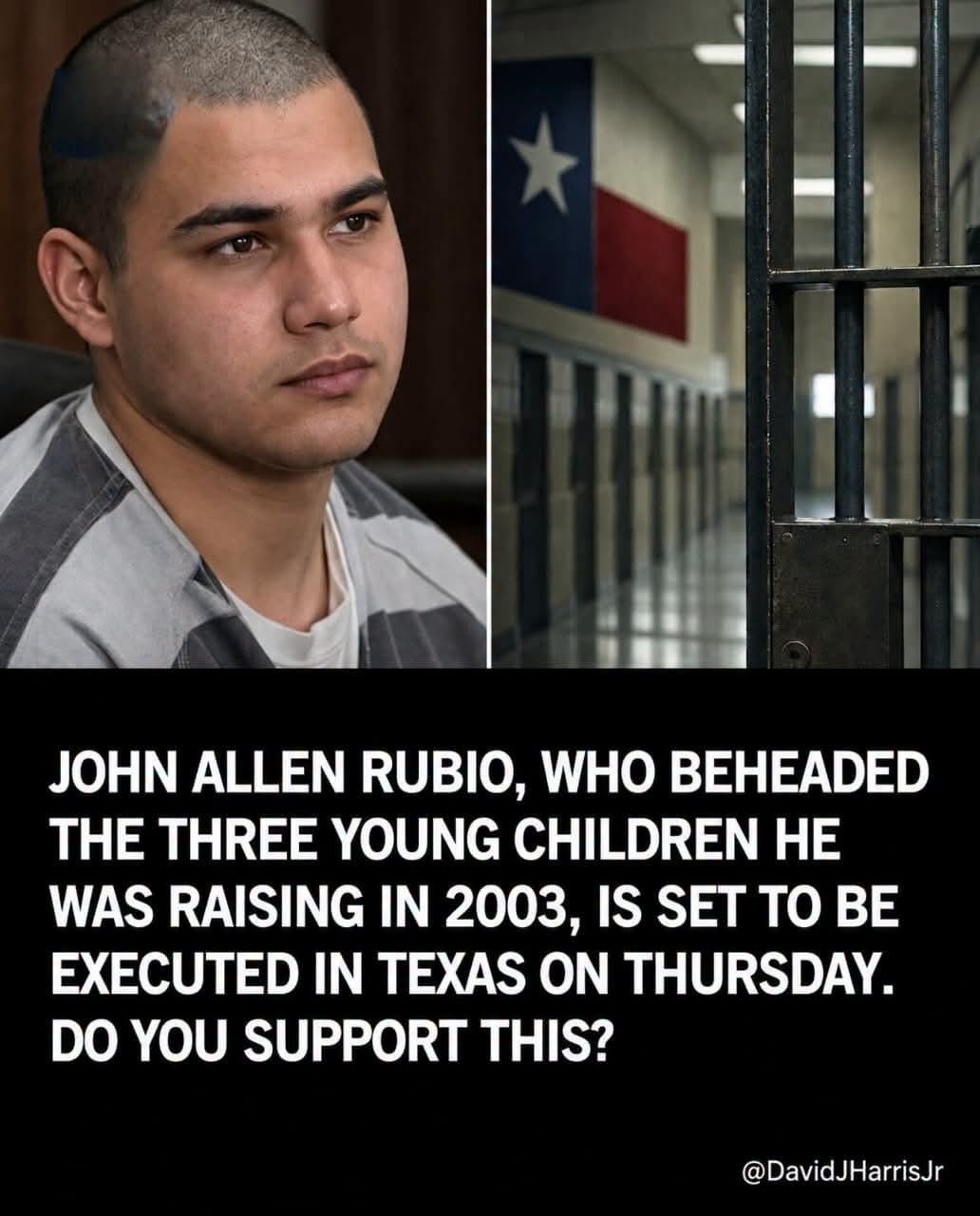
HEARTBREAKING: Texas Executes John Allen Rubio More Than 23 Years After the Tragic Deaths of Three Young Children
A heartbreaking chapter in one of Texas’s most disturbing criminal cases has reached its final conclusion. John Allen Rubio, the man convicted of killing three young children in Brownsville, Texas, was executed by lethal injection on Thursday, November 12, 2026.
Rubio, 46, was pronounced dead at 6:47 p.m. at the Huntsville Unit in Texas, according to the Texas Department of Criminal Justice.
His execution came more than 23 years after the deaths of three innocent children whose names became central to a case that shocked their community and attracted national attention.
Their names were Julissa, John Esteban, and Mary Jane.
They were only three years old, approximately one year old, and just two months old when their lives were taken in March 2003.
For the families affected by the tragedy, the passage of time could never erase what happened. The legal proceedings lasted years, and the case continued to generate difficult questions about mental illness, criminal responsibility, justice, and the death penalty.
A tragedy that shocked Brownsville
The case began in Brownsville, a South Texas community where the deaths of three young children sent shockwaves through the area.
On March 11, 2003, Rubio and his common-law wife, Angela Camacho, were involved in the killings of the three children.
The victims were Julissa Angela Quezada, Camacho’s three-year-old daughter; John Esteban Rubio, approximately one year old; and Mary Jane Rubio, Rubio’s two-month-old daughter.
The details of the crime were horrifying. Investigators determined that the children had been stabbed and beheaded.
The case quickly became one of the most disturbing criminal investigations in the region.
Authorities also reported that Rubio told investigators he believed the children were possessed by demons.
These statements became an important part of the legal proceedings and later discussions about his mental health.
However, the court proceedings would take years to reach their final conclusion.
The first conviction and a major legal development
In 2003, Rubio was convicted of capital murder and sentenced to death.
At the time, the prosecution presented evidence concerning the killings and the circumstances surrounding the children’s deaths.
However, his first conviction did not remain in place permanently.
In 2007, the Texas Court of Criminal Appeals overturned the conviction after determining that prosecutors had improperly relied on statements made by Camacho before she invoked her Fifth Amendment right against self-incrimination.
The ruling meant that Rubio would receive another trial.
It did not mean that the allegations had disappeared or that the case was over.
Instead, the legal process continued, placing the case back before the courts.
The 2010 retrial
In 2010, Rubio faced a second trial.
His defense team entered a plea of not guilty by reason of insanity.
The defense presented arguments concerning his mental health, including evidence that he had experienced symptoms associated with paranoid schizophrenia.
His attorneys argued that his mental condition affected his understanding of reality and contributed to his belief that the children were possessed.
The prosecution disputed the defense’s position.
After hearing the evidence, a second jury found Rubio guilty again and sentenced him to death.
The conviction established the legal basis for the sentence that remained in place through years of appeals and additional proceedings.
His common-law wife, Angela Camacho, was also convicted for her role in the children’s deaths.
She received three life sentences and remains imprisoned.
Years of appeals and questions about mental health
Even after the second conviction, the case continued through the legal system.
Rubio’s attorneys pursued multiple appeals and challenges, arguing that legal and mental-health issues deserved further examination.
One particularly important question was whether Rubio understood the punishment he faced.
In October 2026, a Texas judge reviewed psychiatric evaluations and determined that Rubio was competent to be executed.
The judge concluded that Rubio understood what he had done and why the state intended to carry out the death sentence.
His attorneys continued challenging the proceedings.
Another legal argument concerned testimony from a psychiatric expert during the 2010 trial. His defense argued that prosecutors had failed to correct allegedly false testimony concerning his mental-health history.
On November 5, the Texas Court of Criminal Appeals rejected his latest challenge.
The Texas Board of Pardons and Paroles also unanimously declined to recommend clemency or a 90-day reprieve on November 10.
With those efforts unsuccessful, the execution proceeded as scheduled.
His final hours in Texas
As the execution date approached, the case once again attracted attention from legal observers, community members, and organizations involved in the debate over capital punishment.
Some people believed the sentence represented the conclusion of a long legal process and an opportunity for justice.
Others questioned whether executing Rubio was the appropriate response, particularly given the mental-health evidence presented during his trials.
Anti-death-penalty advocates organized efforts to stop the execution and called for his sentence to be changed to life imprisonment.
Cameron County District Attorney Luis Saenz defended the legal process, emphasizing that Rubio had received trials and opportunities to appeal.
Ultimately, the courts and the clemency process did not prevent the execution.
On Thursday evening, November 12, the state of Texas carried out the sentence.
Rubio’s final statement
Before his death, Rubio delivered a final statement.
According to The Texas Tribune, he thanked his friends, family members, and prison staff for their religious support.
He also expressed love for Angela Camacho and apologized to her family and his own.
His statement included an acknowledgment that he could not change the past.
He spoke about his faith and expressed hope that others could come to understand God’s forgiveness.
He was pronounced dead at 6:47 p.m.
For the families connected to the victims, the execution marked the end of a long legal chapter, although the emotional consequences of the tragedy cannot be measured by a court ruling or a prison sentence.
Remembering the three children
Beyond the courtroom arguments, appeals, and discussions about punishment, the most important part of this story remains the three children who lost their lives.
Julissa was only three years old.
John Esteban was approximately one year old.
Mary Jane was just two months old.
They were children who should have had the opportunity to grow up, experience childhood, attend school, build friendships, and discover the world around them.
Their names deserve to be remembered beyond the circumstances of their deaths.
The case also left a lasting mark on Brownsville, where residents were forced to confront an unimaginable tragedy involving three of the community’s youngest and most vulnerable members.
A public vigil was held in their memory as the execution approached.
Community members gathered to remember the children and reflect on the long journey toward the conclusion of the case.
A case that raises difficult questions
The execution of John Allen Rubio also brings renewed attention to the broader debate over capital punishment in the United States.
Supporters of the death penalty argue that certain crimes are so severe that the ultimate punishment is justified, particularly when victims are young and defenseless.
Opponents argue that execution raises serious moral questions and that mental illness, the possibility of wrongful convictions, and the permanence of the punishment must always be considered.
The Rubio case included years of legal proceedings, a reversed conviction, a second trial, psychiatric arguments, and numerous attempts to challenge the sentence.
It demonstrates how complicated capital cases can become, even when the underlying crimes are exceptionally disturbing.
People may disagree about the death penalty, but the importance of protecting children and ensuring justice for victims remains a central concern.
Final thoughts
More than two decades after the deaths of Julissa, John Esteban, and Mary Jane, the legal case against John Allen Rubio has reached its final outcome.
His execution was carried out on November 12, 2026, in Huntsville, Texas.
The story is a painful reminder of the vulnerability of children and the devastating consequences of violence within families.
May the three young victims be remembered by their names, their childhoods, and the lives they should have been allowed to live.
What are your thoughts about this case? Do you believe the execution brought justice after more than 23 years, or do you believe life imprisonment should have been the punishment?
Share your thoughts respectfully. Remember that behind every headline are real people, grieving families, and three innocent children whose lives ended far too soon.