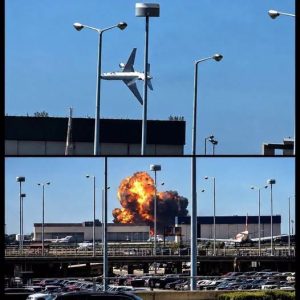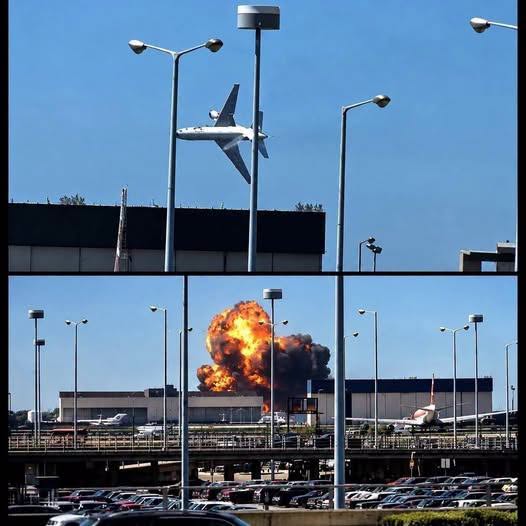
273 PEOPLE KILLED IN AMERICAN AIRLINES FLIGHT 191 AT CHICAGO’S O’HARE AIRPORT – THE HORRIFIC TRAGEDY THAT SHOCKED AMERICA
It was supposed to be an ordinary Friday afternoon. Hundreds of passengers boarded an American Airlines flight, expecting to reach their destination safely. Families were preparing for the Memorial Day weekend, travelers were making plans, and nobody could have imagined that one of the darkest chapters in American aviation history was about to unfold.
On May 25, 1979, American Airlines Flight 191 crashed shortly after taking off from Chicago’s O’Hare International Airport. The disaster claimed 273 lives, including everyone aboard the aircraft and two people on the ground.
Decades later, the tragedy remains one of the most devastating aviation accidents in American history.
A Flight That Never Reached Its Destination
American Airlines Flight 191 was operating a regularly scheduled passenger service from Chicago to Los Angeles.
The aircraft was a McDonnell Douglas DC-10-10, a wide-body passenger jet designed to carry large numbers of travelers across the country.
There were 271 people aboard: 258 passengers and 13 crew members.
For those passengers, the journey began like countless other commercial flights. They had checked in, boarded, found their seats, and prepared for takeoff.
The weather was clear, and visibility was good.
At approximately 3:04 p.m., the aircraft began its takeoff from runway 32R.
But something went terribly wrong.
The Terrifying Moments After Takeoff
As the aircraft began rotating for takeoff, its left engine and supporting pylon assembly suddenly separated from the wing.
The engine assembly fell onto the runway.
The aircraft continued climbing, reaching approximately 325 feet above the ground. However, the separation had caused serious damage to important aircraft systems.
The crew faced an emergency that was extremely difficult to understand from the cockpit.
The airplane began rolling to the left. Its wings continued moving beyond the normal limits, and the nose dropped below the horizon.
The aircraft lost control and crashed into an open field near the airport.
The impact destroyed the aircraft, and a devastating fire followed.
The entire sequence happened within seconds of takeoff.
273 Lives Lost
The consequences were heartbreaking.
All 271 people aboard Flight 191 died.
Two additional people on the ground also lost their lives, bringing the total death toll to 273.
Two other people on the ground were injured.
The crash also destroyed nearby property, including vehicles and a mobile home.
Emergency responders rushed to the scene, but the destruction was enormous.
For families waiting for loved ones, the news was devastating. A journey that should have ended with ordinary reunions instead became a national tragedy.
What Caused the Disaster?
Investigators from the National Transportation Safety Board conducted an extensive investigation to understand what had happened.
Their findings revealed that the engine separation was connected to damage caused during earlier maintenance work.
The left engine and pylon assembly had previously been removed and reinstalled using an improper maintenance procedure.
The investigation determined that this procedure caused structural damage to the pylon attachment area.
That damage eventually led to the engine and pylon separating during takeoff.
The separation also damaged hydraulic lines and contributed to the unexpected retraction of the left wing’s outboard leading-edge slats.
These slats help an aircraft generate lift, particularly during takeoff and landing.
Because the aircraft lost the proper configuration on one side, the wings developed an uneven aerodynamic condition.
The aircraft experienced an asymmetrical stall and rolled uncontrollably to the left.
The NTSB identified the maintenance-related damage and resulting loss of control as the central causes of the disaster.
The Investigation Changed Aviation Safety
The Flight 191 disaster exposed serious weaknesses in aircraft maintenance practices, communication, and regulatory oversight.
Investigators also identified problems involving the design of the engine attachment points and the aircraft’s systems.
The tragedy demonstrated that even a small structural problem during maintenance could eventually create catastrophic consequences.
Following the accident, the NTSB issued multiple safety recommendations to the Federal Aviation Administration.
The crash also led to renewed scrutiny of the DC-10 aircraft and its maintenance procedures.
The goal was to ensure that similar failures would not happen again.
The Families Never Forgot
Behind the technical investigation and aviation safety reports were hundreds of personal tragedies.
Parents lost children. Children lost parents. Husbands and wives lost their partners.
Friends lost people they expected to see again.
For the families, the passage of time could not erase the pain of May 25, 1979.
Every anniversary became an opportunity to remember those who never returned home.
The disaster also affected people who witnessed the crash and those who participated in the rescue and recovery efforts.
It was a reminder that aviation accidents affect far more people than those directly aboard an aircraft.
Remembering the 273 Victims
American Airlines Flight 191 remains an important part of aviation history.
The tragedy is remembered not simply because of the number of lives lost, but because of the lessons it taught the aviation industry.
Aircraft maintenance requires precision, communication, accountability, and strict adherence to approved procedures.
Every inspection matters. Every safety instruction matters. Every decision made by maintenance professionals can have consequences for the people who eventually board an aircraft.
The lives lost on Flight 191 should never be reduced to a statistic.
They were people with families, dreams, plans, and futures.
A Final Tribute
On May 25, 1979, 273 lives were lost in a disaster that changed American aviation forever.
The passengers and crew of American Airlines Flight 191 never reached Los Angeles.
Their story remains a powerful reminder of why aviation safety must always come first.
May the 273 victims never be forgotten, and may their families continue to receive the compassion and remembrance they deserve.
Do you remember hearing about the American Airlines Flight 191 tragedy? Share your thoughts and take a moment to remember the 273 lives lost.