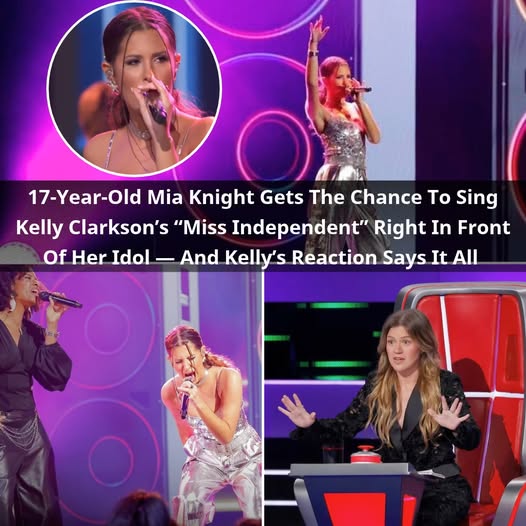
Kelly’s journey gives her a special perspective when she meets aspiring singers. She knows that a young performer may be carrying years of hope into a single audition or musical opportunity. A few minutes onstage can represent countless hours of practice, encouragement from family, personal sacrifices, and the determination to keep going even when the future feels uncertain.
That is part of what makes moments like Mia’s performance so appealing to viewers. They are not only about whether someone can sing a difficult song. They are also about the connection between generations of performers: an established artist meeting someone who hopes to follow a similar path.
“Miss Independent” was an interesting choice because its message centers on confidence and self-reliance. The song celebrates someone who has learned to stand on her own rather than depending on another person to define her worth. For a 17-year-old singer preparing to build her own future, those themes can feel particularly relevant.
The song also presents musical challenges. Its lively rhythm requires energy, its melody demands control, and its familiar chorus gives listeners something to compare with the original recording. When a young singer chooses a well-known song, the audience often recognizes every detail. That familiarity can make the performance exciting, but it can also raise expectations.
Mia therefore had an important task: she needed to bring her own personality to the material. Copying every detail of Kelly’s original interpretation would not necessarily make the performance memorable. A promising young artist must learn when to honor the original and when to let an individual style come through.
That is one of the most valuable lessons for anyone pursuing music. Inspiration is a starting point, not a destination. Artists can admire the singers who came before them while still discovering what makes their own voices different. A cover performance can become a first step toward that discovery.
For Mia, the opportunity to sing before Kelly could also serve as a reminder that musical dreams become more real when people are willing to take chances. It is easy to imagine performing a favorite song in a bedroom, in front of friends, or while practicing alone. Doing it in front of the artist who made the song famous is an entirely different experience.
The nerves are understandable. Even experienced performers can feel pressure when they know that someone they respect is listening closely. A singer may wonder whether the performance will meet expectations, whether a difficult note will come out correctly, or whether the person watching will understand how much the opportunity means.
But courage does not mean having no fear. It means choosing to perform even when the nerves are present. That is an important part of Mia’s story, regardless of what happens next in her musical journey.
Kelly’s reaction is described as a highlight of the encounter, and it is easy to understand why viewers would be interested in that exchange. When a young person performs a song connected to an artist they admire, even a brief response can carry emotional weight. A smile, a moment of encouragement, or a few thoughtful words can become something the young performer remembers for years.
It is important, however, not to assume details that have not been provided. Without a complete account of the exchange, the exact words Kelly may have said or every expression she made should not be invented. The heart of the moment is already clear: Mia had the chance to share her voice with an artist whose music mattered to her.
That kind of encouragement can be meaningful, but it does not have to determine an entire career. One performance does not guarantee fame, a record deal, or a place in the music industry. What it can provide is experience, confidence, and a memory that may help a young singer continue working toward her goals.
At 17, Mia has time to learn, grow, experiment, and discover the kind of artist she wants to become. The music business can be demanding, and talent alone is rarely enough. Singers need discipline, patience, resilience, and a willingness to accept constructive feedback. They also need to remember why they began singing before the pressure of competition and public attention becomes overwhelming.
Kelly’s own career offers an example of how a major opportunity can open a door without making the journey effortless. Winning “American Idol” brought her into the public spotlight, but building a lasting career required continued work, new music, live performances, and the ability to connect with listeners through different stages of life. Her success was not simply one television moment; it grew through years of commitment.
For young performers watching Mia, that may be the most useful lesson. A special opportunity is worth celebrating, but the work continues afterward. The next rehearsal matters. The next song matters. Learning from mistakes matters. Every performance can teach something that helps a singer become stronger.
The story may also encourage parents, teachers, and music supporters to recognize how important encouragement can be. Young artists need room to try, make mistakes, and develop their confidence. They benefit from honest guidance, but they also need people who remind them that their value is not measured by one audition, one reaction, or one result.
Music has a remarkable ability to connect people who might otherwise never meet. A song released years ago can become meaningful to a teenager growing up in a completely different moment. When that teenager gets the chance to perform it for the original singer, the distance between inspiration and real life suddenly feels much smaller.
That is why Mia’s choice of “Miss Independent” makes the encounter so appealing. It brings together a familiar song, a young performer with a dream, and an artist whose career has inspired listeners across generations. It is a reminder that music does not belong only to the person who first records it. Every new interpretation gives a song another opportunity to reach someone.
Whether Mia eventually chooses a professional career in music or carries singing into another part of her life, this experience can remain a meaningful chapter in her story. She took a chance, stood before someone she admired, and shared a song that clearly held significance for her.
For Kelly, meeting young singers can also be a reminder of the influence an artist may have without even realizing it. A song that was once part of her own career can become the soundtrack to another person’s hopes. That is one of the lasting gifts of music: its ability to travel beyond the moment it was created and become part of someone else’s journey.
In the end, the most important part of Mia Knight’s performance is not whether it turns into a viral sensation or leads immediately to another opportunity. It is the courage behind the decision to sing. At 17, she had a chance to stand in front of her idol and make a familiar song her own.
For anyone who has ever dreamed of meeting a musical hero, that is a moment worth celebrating. And for every young singer still practicing in a bedroom, school music room, or local stage, Mia’s experience offers a simple reminder: keep learning, keep singing, and do not be afraid to take the opportunity when it comes.
A dream does not become a reality all at once. Sometimes it begins with a song, a stage, and the courage to let someone you admire hear your voice.