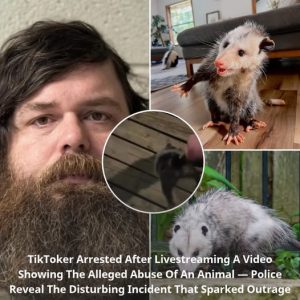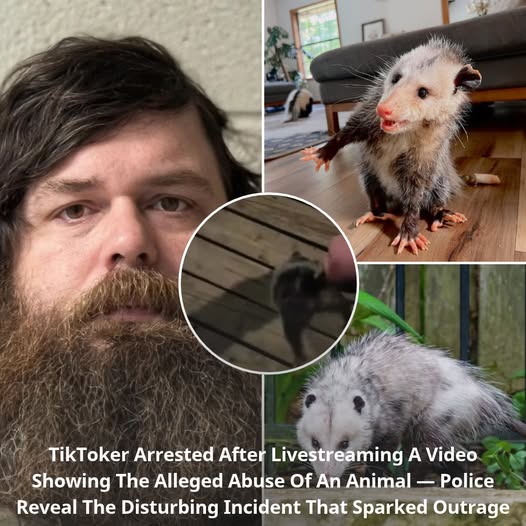
TikToker Arrested After Disturbing Animal Abuse Livestream Sparks Outrage — Police Reveal What Happened in Tennessee
A disturbing incident involving a TikTok livestream has sparked widespread outrage after a 34-year-old Tennessee man was arrested following allegations of animal cruelty. The shocking footage, which reportedly circulated across social media, prompted concerned viewers to contact law enforcement and demand an investigation.
The case has attracted attention not only because of the disturbing allegations but also because the incident was reportedly broadcast live, allowing viewers to witness what appeared to be an act of violence against a helpless animal.
Authorities identified the arrested individual as Brandon Terry Honea, a Tennessee taxidermist and TikTok livestreamer. He was arrested on November 11, 2026, and charged with aggravated animal cruelty in connection with the alleged killing of a wild opossum.
According to reports, the incident occurred in the Fayetteville area of Lincoln County, Tennessee. What began as a livestream eventually became the subject of multiple complaints, a multi-agency investigation, and serious criminal allegations.
The footage reportedly showed Honea grabbing an opossum by its tail and repeatedly slamming it against a porch. A woman could allegedly be heard pleading with him to stop.
The video caused immediate concern among viewers, many of whom reportedly contacted authorities after seeing what had happened.
For animal lovers, the incident raised an especially painful question: How can an animal become the subject of such disturbing treatment while an audience watches?
How the Incident Came to Authorities’ Attention
According to reporting about the investigation, authorities began receiving complaints on November 9 after the alleged animal abuse video circulated online.
The Lincoln County Sheriff’s Office confirmed that it had received multiple calls concerning an incident involving a wild opossum. The Fayetteville Police Department also received reports and became involved in the investigation.
The number of complaints demonstrated how quickly people can respond when disturbing footage appears online. Viewers who believed an animal had been harmed did not simply ignore what they had seen. They contacted authorities and shared information that could help investigators understand the incident.
The case also involved the Tennessee Wildlife Resources Agency, commonly known as TWRA, because opossums are classified as Class 2 wildlife in Tennessee.
That classification made the wildlife agency’s involvement important as investigators examined the circumstances surrounding the animal’s alleged killing.
The agencies worked to establish what happened, identify the individual involved, and determine whether criminal charges were appropriate.
What the Livestream Allegedly Showed
Reports describing the video say the opossum was grabbed by its tail and repeatedly struck against a porch.
A woman could reportedly be heard asking the man to stop. That detail became particularly upsetting for viewers because it suggested that someone present recognized the animal’s suffering and was pleading for the behavior to end.
The animal reportedly did not survive.
The footage provided to investigators showed that the opossum had been killed, and authorities indicated that the animal could not be recovered.
Because the video was already circulating, investigators had material that could help them examine the reported incident. However, the full circumstances remain matters for the legal process, and allegations should not be confused with a final judicial determination.
The incident illustrates how livestreaming can turn a private action into a public event almost instantly. Once footage reaches viewers, it can be copied, shared, reported, and examined by people far beyond the original audience.
That reach can also help authorities receive information about possible wrongdoing.
The Explanation Reportedly Given by the Arrested Man
Reports indicate that Honea claimed the opossum had been killing his chickens.
For someone raising poultry, discovering that an animal is attacking chickens can be frustrating and upsetting. Protecting livestock and securing a property are understandable concerns for rural residents and anyone responsible for farm animals.
However, concerns about livestock do not automatically justify every possible response toward wildlife.
There are lawful and humane ways to address conflicts between wildlife and domestic animals. Depending on the circumstances and applicable regulations, property owners may seek advice from wildlife officials, use appropriate protective enclosures, or explore other permitted methods.
The distinction between protecting livestock and causing unnecessary suffering is central to the public discussion surrounding this case.
Honea reportedly claimed that the Tennessee Wildlife Resources Agency had told him he had done nothing wrong. However, investigators did not confirm that account.
Lincoln County investigator Cheyenne Gonzalez told TMZ that the sheriff’s office could not comment on what the wildlife agency allegedly told Honea. She emphasized that deputies conducted their own investigation and independently brought the charges.
That clarification is important because the reported explanation remains an allegation, not an established finding about what any agency advised.
Police Investigation Leads to Arrest
Following the complaints and investigation, Honea was arrested on Wednesday, November 11.
The Lincoln County Sheriff’s Office confirmed that he was charged with aggravated animal cruelty. The arrest represented a significant development after days of public concern about the footage.
The Fayetteville Police Department also played a role, contacting the Tennessee Wildlife Resources Agency and offering assistance with the investigation.
The sheriff’s office and police department worked alongside the wildlife agency as officials examined the incident.
Authorities have not publicly provided every detail of the investigation, and the case remains subject to the legal process.
Nevertheless, the arrest demonstrated that reports submitted by members of the public had received attention from law enforcement.
For viewers who had contacted authorities, the development may have offered some reassurance that their concerns were being taken seriously.