The name Baba Vanga continues to surface whenever mysterious predictions or viral prophecies begin circulating online. Known as the “Nostradamus of the Balkans,” she has been credited—often retroactively—with foreseeing major world events. Whether one believes in her abilities or views the claims with skepticism, her legend has taken on a life of its own, especially in the age of social media.
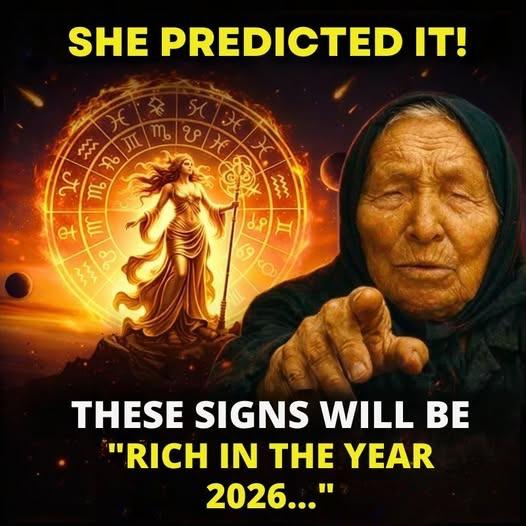
Recently, a new wave of attention has focused on a sensational claim: that certain “signs” will receive $1 million in 2026, along with references to three predictions that have supposedly already come true. At first glance, this sounds like a mix of astrology, prophecy, and wishful thinking—but to understand it properly, we need to separate fact from interpretation.
First, it’s important to clarify that there is no verified record of Baba Vanga making a specific prediction about people receiving $1 million based on zodiac signs or any similar grouping. Much of what circulates today comes from reinterpretations, secondhand accounts, or entirely fabricated claims attributed to her name. Like many prophetic figures, her legacy has been reshaped over time, often molded to fit current events or trending narratives.
That said, the fascination with these claims reflects something deeper: people’s desire for hope, prosperity, and a sense that the future holds something extraordinary for them. The idea that certain individuals—or “signs”—are destined for financial windfalls taps into a universal longing for sudden change and good fortune.
The mention of “three signs that have already come true” is another common feature of viral prophecy content. Typically, these refer to broad, loosely defined events that can be interpreted in multiple ways. For example, Baba Vanga is often said to have predicted global disasters, technological advancements, or geopolitical shifts. Because these topics are so general, it’s easy to match them to real-world developments after the fact.
Take, for instance, claims that she foresaw major storms, economic crises, or breakthroughs in science. While some of these may appear accurate, they are usually vague enough that they could apply to many different situations. This phenomenon is known as retrofitting—interpreting past statements to align with current events. It doesn’t necessarily mean the predictions were precise; rather, they are flexible enough to seem correct in hindsight.
The $1 million claim follows a similar pattern. It combines the authority of a well-known prophetic figure with a highly specific and appealing outcome: financial gain. Adding a timeline—2026—makes it feel more concrete, while still being far enough in the future to avoid immediate verification. This blend of specificity and ambiguity is what makes such claims so compelling.
Another layer to this story is the use of the word “signs.” This could be interpreted in multiple ways. Some readers may assume it refers to zodiac signs, linking the prophecy to astrology. Others might think of “signs” as symbolic indicators—events or milestones that signal a coming change. This ambiguity allows the claim to resonate with a wider audience, as people project their own beliefs and expectations onto it.
Psychologically, these kinds of narratives thrive because they offer a sense of control and anticipation. In uncertain times, the idea that a major reward is destined for certain individuals can be comforting. It creates a feeling that life is guided by a larger plan, even if the details are unclear.
However, it’s also important to approach such claims critically. Financial outcomes—especially something as specific as receiving $1 million—are influenced by a wide range of factors, including economic conditions, personal decisions, opportunities, and sometimes luck. They are not determined by prophecy or predetermined signs. Believing otherwise can lead to unrealistic expectations or even exploitation by those who use such claims to promote scams or misleading schemes.
This doesn’t mean there’s no value in engaging with these stories. On the contrary, they can serve as inspiration—encouraging people to think about their goals, take action, and remain open to opportunities. If someone interprets the idea of “receiving $1 million” as motivation to improve their financial situation, invest wisely, or pursue new ventures, then the narrative has a positive impact, regardless of its origin.
It’s also worth noting that Baba Vanga’s enduring popularity says as much about modern culture as it does about her legacy. In a world saturated with information, people are drawn to stories that promise insight into the future. Prophecies, whether ancient or modern, offer a sense of mystery and possibility that cuts through the noise of everyday life.
As 2026 approaches, it’s likely that more claims and interpretations will emerge, each adding new layers to the story. Some will point to events as evidence that the prophecy is unfolding, while others will dismiss it entirely. This cycle of belief and skepticism is part of what keeps such narratives alive.
In the end, the idea that certain “signs” will receive $1 million is less about a literal prediction and more about the human imagination. It reflects our hopes, our curiosity, and our desire to find meaning in the unknown. Whether or not anything resembling this claim comes true, the real takeaway lies in how we respond to it.
Rather than waiting for a prophecy to deliver fortune, the more reliable path is to create opportunities through informed decisions, persistence, and adaptability. The future is shaped not by predetermined signs, but by the actions we take and the choices we make along the way.
So while the legend of Baba Vanga continues to inspire intrigue, it’s best viewed as a cultural phenomenon rather than a financial roadmap. The promise of $1 million may capture attention, but the real power lies in understanding the story behind it—and using that understanding to navigate the world with both curiosity and clarity.