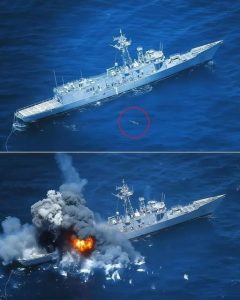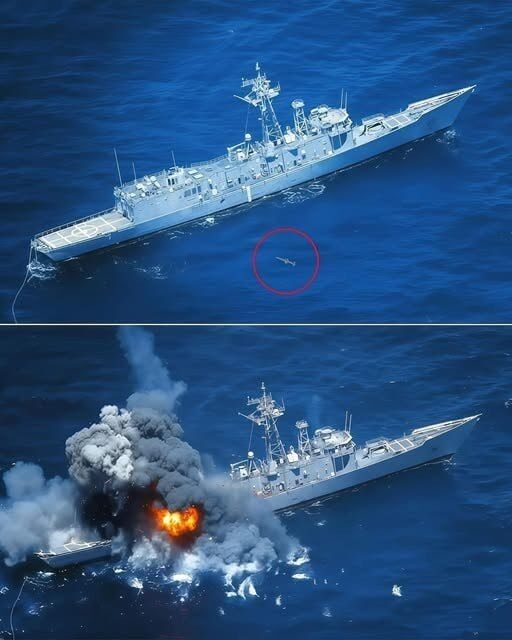
USS Rodney M. Davis (FFG-60) Sinks After Devastating Strike — What We Know So Far
In a dramatic and deeply concerning development at sea, reports have emerged claiming that the USS Rodney M. Davis (FFG-60) has sunk following a sudden and powerful strike. The incident, which allegedly occurred during a tense maritime operation, has sparked widespread speculation, confusion, and concern among military analysts and the public alike.
However, before diving into the details of the claim, it is essential to understand the background of the vessel at the center of this story. The USS Rodney M. Davis was an Oliver Hazard Perry-class guided-missile frigate commissioned into the United States Navy in 1987. Designed primarily for escort and anti-submarine warfare missions, the ship played a significant role in various naval operations throughout its service life. It was known for its versatility, reliability, and capability to operate in high-risk environments.
The frigate was named after Sergeant Rodney Maxwell Davis, a U.S. Marine who was posthumously awarded the Medal of Honor for his heroic actions during the Vietnam War. The ship carried this legacy for decades, participating in operations across the globe, including the Persian Gulf and Pacific regions.
Despite its long and active service, the USS Rodney M. Davis was officially decommissioned by the U.S. Navy in 2015. After decommissioning, the vessel was transferred to the Mexican Navy, where it was renamed ARM Hermenegildo Galeana. Since then, it has served under Mexico’s naval command rather than the United States.
This context raises an important point: any current reports describing the USS Rodney M. Davis as an active U.S. Navy vessel involved in recent combat operations are likely inaccurate or misleading. As of now, there is no verified or credible evidence from official defense sources, such as the U.S. Department of Defense or the Mexican Navy, confirming that the ship has been attacked or sunk in a recent incident.
So where did the claim originate?
In recent years, social media platforms and viral content channels have increasingly circulated sensational headlines involving military hardware and dramatic naval confrontations. These stories often use real ship names to create a sense of authenticity, but they frequently lack credible sourcing or factual backing. In many cases, such claims are either exaggerated, misinterpreted, or entirely fabricated.
The alleged sinking of the USS Rodney M. Davis appears to follow this pattern. The phrase “hit by… see more” is a common tactic used in viral posts to provoke curiosity and encourage clicks without providing verifiable details. This style of headline often signals that the information may not be reliable.
Military incidents of this magnitude—particularly involving a naval vessel—would typically be widely reported by reputable news organizations and confirmed by official statements. The absence of such confirmation strongly suggests that the claim should be treated with skepticism.
That said, the scenario itself—of a naval vessel being struck and potentially sunk—is not outside the realm of possibility in modern warfare. Naval ships face a range of threats, including anti-ship missiles, submarines, mines, and aerial attacks. Advances in missile technology, such as supersonic and hypersonic weapons, have significantly increased the risks faced by surface vessels.
In real-world incidents, ships have been damaged or sunk due to missile strikes or other forms of attack. For example, the sinking of naval vessels in past conflicts has demonstrated how quickly situations can escalate and how devastating such events can be. These incidents underscore the importance of advanced defense systems, situational awareness, and strategic planning in naval operations.
If a ship like the USS Rodney M. Davis—or its current Mexican Navy counterpart—were to be involved in an incident, several factors would determine the outcome. These include the nature of the attack, the ship’s defensive capabilities, the crew’s response, and the availability of support from nearby forces. Modern warships are equipped with radar systems, electronic countermeasures, and close-in weapon systems designed to intercept incoming threats, but no system is entirely foolproof.
Another important consideration is the geopolitical context. A confirmed attack on a naval vessel could have serious international implications, potentially escalating tensions between nations. This is why accurate information and official confirmation are critical in understanding such events.
For now, the lack of credible evidence suggests that the reported sinking of the USS Rodney M. Davis is not a verified घटना. It serves as a reminder of the importance of critically evaluating information, especially when it comes from unclear or sensational sources.
In today’s digital age, misinformation can spread rapidly, often outpacing factual reporting. Taking a moment to verify claims through trusted sources can help prevent unnecessary panic and confusion. When it comes to matters of national security and military activity, relying on official statements and reputable journalism is essential.
In conclusion, while the story of the USS Rodney M. Davis being struck and sunk may sound alarming, there is currently no confirmed evidence to support it. The ship itself has not been part of the active U.S. Navy for years, and any claims about its involvement in recent combat should be approached with caution.
As always, staying informed means staying critical. Not every dramatic headline reflects reality, and in situations like this, the truth is often far less sensational—but far more important.