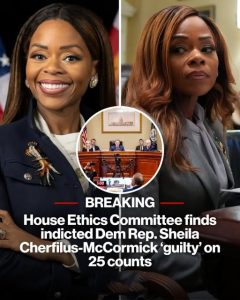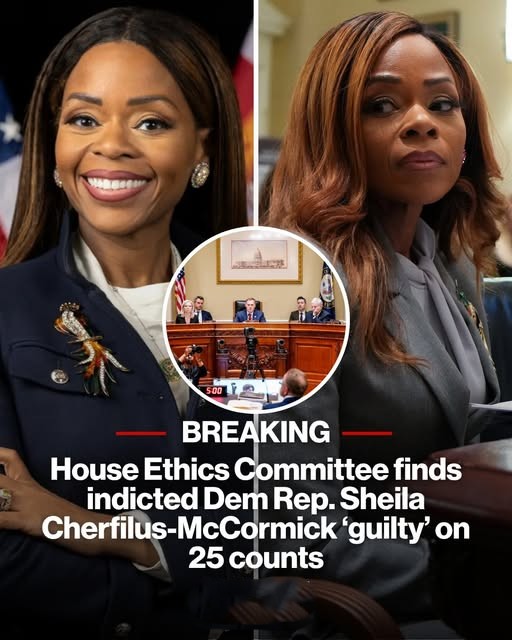
House Ethics Committee Finds Indicted Democratic Rep. Sheila Cherfilus-McCormick ‘Guilty’ on 25 Counts — Political Shockwaves Spread Across Washington
Washington, D.C. — A dramatic development on Capitol Hill has intensified scrutiny of ethics enforcement in Congress after the House Ethics Committee concluded its investigation into Democratic Representative Sheila Cherfilus-McCormick, issuing findings that she was responsible for violations across 25 separate counts tied to campaign finance practices, misuse of official resources, and reporting irregularities.
The announcement has sparked fierce political debate, raising questions not only about the future of the Florida lawmaker’s career but also about broader accountability standards within the U.S. House of Representatives.
The Investigation: How It Began
The ethics probe began quietly months earlier after federal prosecutors filed an indictment alleging financial misconduct connected to campaign expenditures and business relationships linked to Cherfilus-McCormick’s political operation.
Initial complaints centered on:
- Alleged improper payments routed through consulting firms
- Questions surrounding donor disclosures
- Claims that congressional resources were used for political activity
At first, the investigation drew limited national attention. Ethics inquiries are not uncommon in Congress, and many conclude without severe penalties.
However, investigators soon expanded the scope of the review.
According to committee sources, auditors examined thousands of pages of financial records, communications, and internal campaign documents. Interviews reportedly included former staff members, consultants, and outside vendors connected to the congresswoman’s operations.
By the time the committee finalized its findings, the case had grown into one of the most extensive internal disciplinary reviews in recent congressional history.
The 25 Counts Explained
While the committee’s full report spans hundreds of pages, the findings reportedly fall into several major categories:
1. Campaign Finance Violations
Investigators concluded that multiple expenditures were improperly categorized, allegedly masking the true purpose of payments.
Examples cited include:
- Consulting contracts lacking documented services
- Payments overlapping between campaign and personal expenses
- Late or incomplete financial disclosures
The committee stated these actions violated House rules requiring transparency and accurate reporting.
2. Misuse of Official Resources
Another set of counts focused on whether government-funded offices, staff time, or communication tools were used to advance campaign interests.
House regulations strictly prohibit:
- Campaign planning on official time
- Use of congressional staff for political fundraising
- Government equipment supporting election activity
According to the committee, evidence suggested repeated boundary violations rather than isolated incidents.
3. Failure to Cooperate Fully
Several counts involved alleged delays or inconsistencies during the investigative process itself.
The report claimed investigators encountered:
- Missing documentation
- Conflicting explanations
- Incomplete responses to formal requests
Ethics officials emphasized that cooperation with oversight bodies is itself a requirement under House rules.
Cherfilus-McCormick’s Response
Through legal counsel, Cherfilus-McCormick strongly denied wrongdoing and criticized the committee’s conclusions.
In a statement released shortly after the findings became public, her office argued:
- The investigation relied on “misinterpretations of complex campaign regulations.”
- Political motivations influenced the inquiry.
- The congresswoman intends to challenge the conclusions through all available legal channels.
Supporters within her party echoed concerns about due process, noting that ethics findings do not automatically equal criminal conviction.
Political Fallout
The reaction in Washington was immediate.
Some Democratic leaders called the situation “deeply troubling,” emphasizing the need for public trust in government institutions. Others urged caution, stressing that ethics findings represent an internal congressional process separate from ongoing court proceedings.
Republican lawmakers, meanwhile, framed the report as evidence of broader accountability issues, demanding swift disciplinary action.
Possible consequences now under discussion include:
- Formal censure by the House
- Removal from committee assignments
- Financial penalties
- Calls for resignation
The House leadership has not yet announced what disciplinary steps will follow.
Understanding the Role of the House Ethics Committee
The House Ethics Committee occupies a unique position in American government.
Unlike criminal courts, it does not determine criminal guilt. Instead, it evaluates whether members violated congressional rules or damaged institutional integrity.
Its responsibilities include:
- Investigating misconduct allegations
- Recommending sanctions
- Protecting ethical standards within Congress
Historically, ethics investigations are politically sensitive because they involve lawmakers judging their own colleagues. As a result, findings often carry enormous reputational consequences even before legal outcomes are finalized.
Legal vs. Ethical Accountability
One of the central issues in the Cherfilus-McCormick case is the distinction between ethical violations and criminal liability.
Legal experts note:
- A member can be found in violation of House ethics rules without being convicted in court.
- Conversely, criminal charges require proof beyond a reasonable doubt before a judge or jury.
The ethics ruling may influence public perception and political standing, but the ultimate legal outcome will depend on federal judicial proceedings still underway.
Impact on Florida Politics
Cherfilus-McCormick represents a district in South Florida that has traditionally leaned Democratic but remains politically competitive.
Local reactions have been mixed:
- Some constituents expressed disappointment, citing expectations of transparency.
- Others argued the investigation reflects partisan pressure common in national politics.
Political analysts suggest the controversy could reshape upcoming elections, potentially encouraging primary challengers or stronger opposition campaigns.
A Broader Debate About Congressional Ethics
Beyond one lawmaker, the case has reignited a long-standing national conversation:
How effectively does Congress police itself?
Critics argue internal oversight lacks independence and moves too slowly. Reform advocates have proposed:
- Independent ethics prosecutors
- Stronger financial disclosure enforcement
- Faster investigative timelines
Supporters of the current system counter that elected officials must retain constitutional authority over legislative discipline.
The Cherfilus-McCormick findings are now being cited by both sides as evidence supporting their arguments.
What Happens Next?
Several major steps are expected in the coming weeks:
- House Leadership Review — Leaders will determine whether to bring disciplinary measures to a full House vote.
- Legal Proceedings Continue — Federal courts will address the criminal indictment separately.
- Political Consequences Unfold — Party leaders, donors, and constituents will decide whether support remains viable.
Historically, ethics findings can mark turning points in congressional careers, even before courts reach final verdicts.
The Larger Significance
The case highlights a recurring tension in American democracy: balancing political competition with institutional integrity.
Public confidence in elected officials depends heavily on transparency and accountability. When allegations escalate to ethics convictions, the impact extends beyond one individual — affecting trust in Congress as a whole.
Whether Cherfilus-McCormick ultimately survives politically or legally remains uncertain. What is clear is that the Ethics Committee’s ruling has already reshaped the conversation around standards of conduct on Capitol Hill.
As Washington watches closely, the outcome may influence not only one representative’s future but also how Congress approaches ethical oversight in an era of heightened political polarization.
If you want, I can also write a breaking-news TV style version, a neutral investigative analysis, or a viral headline social media version of this story.