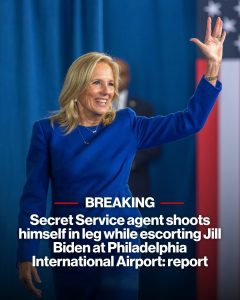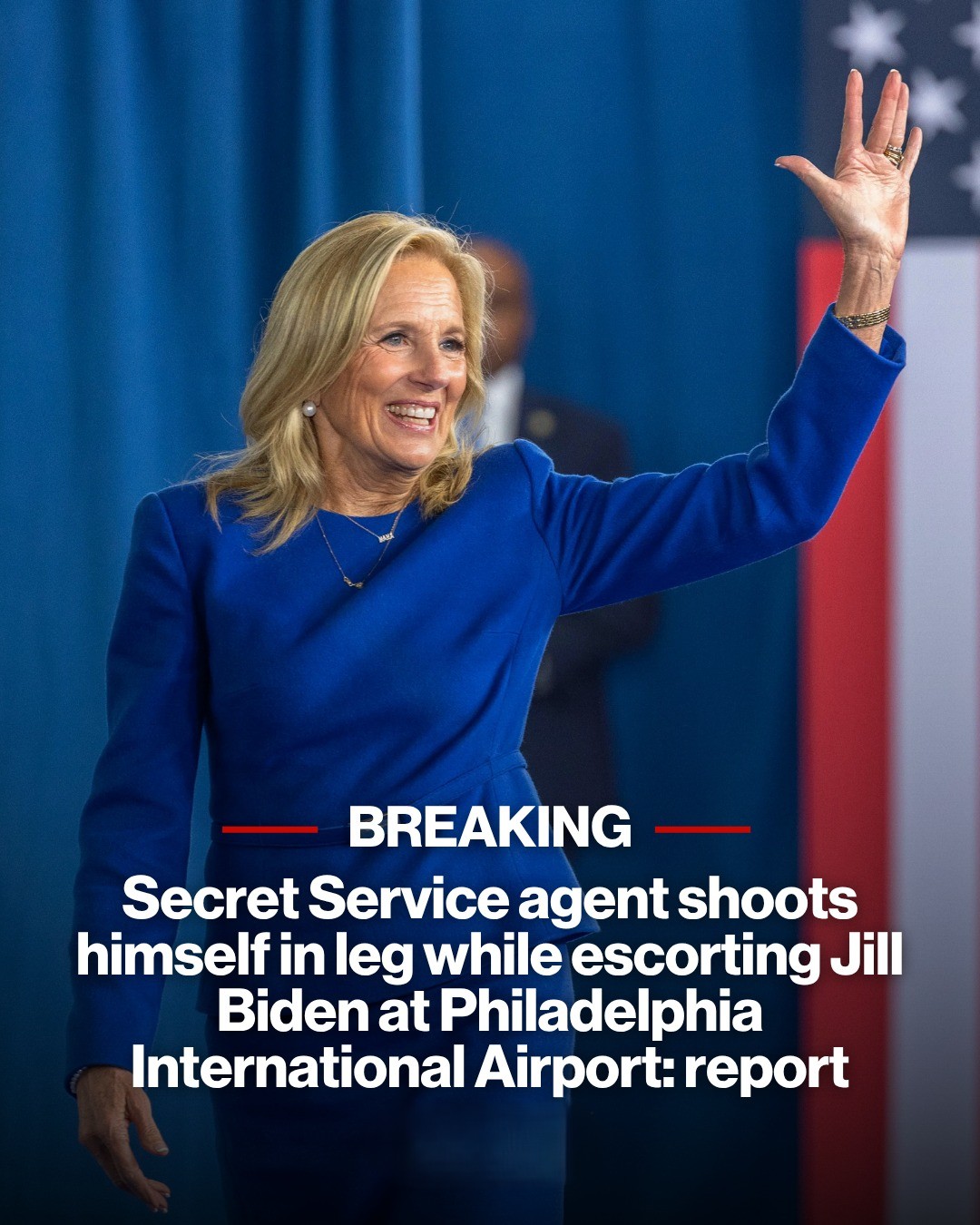
Secret Service Agent Shoots Himself in Leg While Escorting Jill Biden at Philadelphia International Airport
A routine protective operation turned into an unexpected security incident after a member of the United States Secret Service accidentally discharged his firearm while escorting First Lady Jill Biden at Philadelphia International Airport, authorities confirmed.
The incident, which occurred during what officials described as a standard arrival and movement procedure, resulted in the agent sustaining a gunshot wound to his own leg. No civilians, staff members, or protectees were injured, and the First Lady was safely moved from the area within seconds.
The event has prompted an internal review and renewed public attention to the intense operational demands faced by federal protective agents.
The Incident
According to preliminary reports from federal law enforcement sources, the discharge happened shortly after Jill Biden’s aircraft arrived in Philadelphia for a scheduled public appearance.
Protective teams had established a secure corridor between the aircraft and a motorcade positioned on the tarmac. As agents conducted routine movements around the First Lady, one agent’s service weapon fired unexpectedly.
Witnesses described hearing a single loud pop, followed by immediate coordinated action from nearby agents.
Within moments:
- Protective personnel shielded the First Lady.
- Medical responders rushed to assist the injured agent.
- Airport operations temporarily paused near the secure zone.
Officials emphasized that the situation never posed a direct threat to Jill Biden or members of the public.
Immediate Response
The Secret Service is trained extensively for emergency scenarios — including accidental injuries within the protective team itself. Sources familiar with the response said the reaction followed established protocol almost perfectly.
Agents quickly formed a protective perimeter while medical staff applied first aid to the wounded officer. Emergency medical services transported the agent to a nearby hospital for evaluation.
Authorities later confirmed the injury was non-life-threatening, describing it as a gunshot wound to the lower leg.
The First Lady’s schedule continued with only minor delays.
What Officials Are Saying
In a brief statement, the Secret Service confirmed:
- The firearm discharge appeared accidental.
- No threat actors were involved.
- An internal investigation is underway.
Officials declined to release the agent’s name, citing privacy and personnel policies.
A spokesperson stressed that accidental discharges are taken extremely seriously due to the agency’s mission of protecting national leaders and maintaining public safety.
Understanding Secret Service Protective Operations
Protecting high-ranking officials like the First Lady requires layers of coordination rarely visible to the public.
Typical protective operations include:
- Advance security planning days or weeks before travel
- Coordination with local police and airport authorities
- Tactical positioning of armed agents
- Continuous situational awareness in crowded environments
Agents must remain prepared to respond instantly to threats while operating in dynamic settings such as airports, where civilians, staff, and vehicles constantly move through shared spaces.
Because agents carry loaded firearms at all times during protective assignments, strict handling protocols are enforced.
How Accidental Discharges Can Occur
While rare, accidental firearm discharges among trained personnel can happen under specific conditions.
Security experts point to several possible contributing factors:
1. High-Stress Environments
Protective agents operate under intense pressure. Even routine movements demand total vigilance, and fatigue or split-second adjustments can create risk.
2. Equipment Handling
Modern duty holsters are designed to prevent unintended firing, but improper positioning or interference with trigger mechanisms can lead to accidents.
3. Movement in Tight Spaces
Airports involve stairs, vehicles, luggage, communication devices, and close coordination among multiple agents — increasing the chance of equipment snagging or misalignment.
Investigators will examine whether mechanical malfunction, human error, or environmental conditions played a role.
Security Protocol Review
Following any incident involving a weapon discharge, the Secret Service typically initiates a multilayered review process.
This includes:
- Forensic examination of the firearm
- Review of body-camera and surveillance footage
- Interviews with witnesses and team members
- Analysis of training compliance
The agency may also temporarily reassign the involved agent pending completion of the investigation, which is standard procedure rather than disciplinary action.
Impact on First Lady’s Visit
Despite the alarming nature of the incident, officials confirmed that Jill Biden remained calm and cooperative throughout the response.
Sources familiar with the event said she was quickly escorted into a secure vehicle and informed of the situation once safety was assured.
Her scheduled engagements in Philadelphia — focused on education initiatives and community outreach — proceeded later that day.
Observers noted that such continuity reflects the resilience built into presidential and vice-presidential travel operations, where contingency planning accounts for nearly every scenario.
Public and Political Reaction
News of the accidental shooting spread rapidly across national media and social platforms, drawing mixed reactions.
Some commentators expressed concern about firearm safety among federal protective agents, while others emphasized the rarity of such incidents given the thousands of protective missions conducted annually without issue.
Security analysts cautioned against overreaction, noting that even elite law enforcement agencies occasionally experience accidental injuries.
“The key question isn’t whether mistakes happen,” one former federal security official said. “It’s how quickly and transparently they’re addressed.”
The Human Side of Protective Work
Secret Service agents operate largely out of public view, often working long hours, traveling constantly, and maintaining high-alert status for extended periods.
Their responsibilities include protecting:
- The President
- The Vice President
- The First Family
- Visiting foreign leaders
Agents must balance vigilance with discretion, remaining prepared for threats ranging from lone actors to coordinated attacks.
Incidents like the Philadelphia airport discharge serve as reminders that behind the sharply dressed security presence are individuals performing physically demanding and mentally exhausting work.
What Happens Next
The internal review will determine whether:
- Additional training measures are necessary,
- Equipment protocols require adjustment,
- Or disciplinary action is warranted.
Historically, outcomes of such investigations range from procedural updates to retraining requirements rather than punitive measures, depending on findings.
Officials expect the review process to take several weeks.
A Reminder of Security Realities
While dramatic headlines may focus on the accidental shooting itself, experts say the broader takeaway lies in the rapid and effective response that prevented escalation.
The protective detail successfully:
- Secured the First Lady,
- Provided immediate medical care,
- Maintained public safety,
- Continued operations without widespread disruption.
In the world of executive protection, even unexpected incidents become tests of preparedness — and in this case, authorities say established protocols worked as intended.
As investigations continue, the injured agent is expected to recover fully, and federal officials reaffirm that protective operations for national leaders remain among the most carefully managed security missions in the United States.