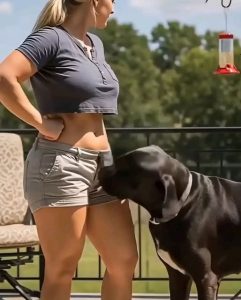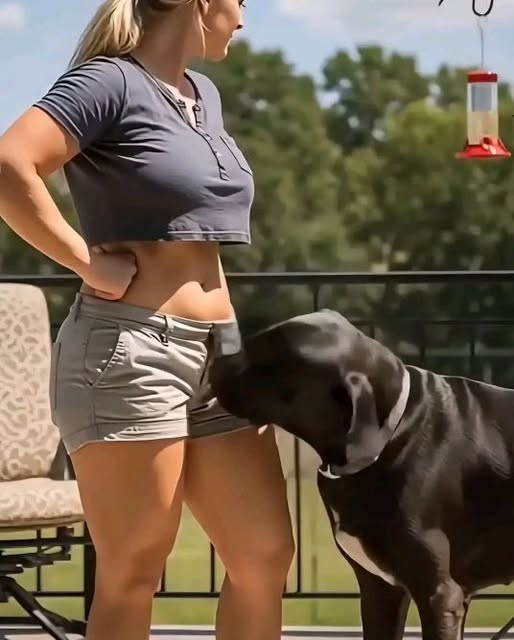
Did You Know That If a Dog Smells Your Private Areas, It’s Because You Have Something Interesting to Tell Them?
If you’ve ever been greeted by a dog that immediately presses its nose into your private area, you probably felt embarrassed, confused, or even slightly offended. Many people joke about it, while others wonder if something is wrong with them. The truth, however, is far less awkward and far more fascinating. When a dog smells your private parts, it isn’t behaving badly — it’s simply using the most powerful sense it has to understand who you are.
Dogs live in a world dominated by scent. Humans rely mostly on vision and speech, but dogs rely on smell the way we rely on conversation. To a dog, scent carries stories, emotions, identity, and health information all at once. What seems like an uncomfortable moment for us is actually a perfectly normal greeting ritual for them.
A dog’s nose is one of the most advanced sensory tools in the animal kingdom. While humans have only a few million scent receptors, dogs possess hundreds of millions. Their brains dedicate an enormous amount of processing power to interpreting smells. Imagine walking into a room and instantly knowing everyone’s mood, recent activities, and even subtle biological changes without anyone speaking — that’s essentially what dogs experience through scent.
So why do dogs aim for such a personal area of the body? The answer lies in biology. Humans have specialized sweat glands concentrated in areas like the groin and armpits. These glands release chemical compounds that carry strong scent information. Dogs instinctively seek out these areas because they provide the richest source of data about a person.
In dog-to-dog greetings, sniffing the rear is completely standard. Dogs learn about each other’s age, sex, health, and emotional condition through this behavior. When greeting humans, dogs adapt the same instinct. Since our faces are much higher than theirs, the strongest scent signals they can easily reach are around waist level. From their perspective, they are simply saying hello in the most polite way they know.
Many people worry that a dog sniffing them means something is medically wrong. In most cases, that assumption is unnecessary. Dogs sniff because they are curious, not because they are diagnosing illness. However, dogs are capable of detecting subtle chemical changes in the human body. Research has shown that trained dogs can sense shifts related to blood sugar levels, hormonal changes, infections, and even certain diseases. Everyday pets are not medical experts, but their noses are sensitive enough to notice differences in body chemistry.
Hormones play a major role in attracting a dog’s attention. A person who is pregnant, menstruating, ovulating, or experiencing hormonal fluctuations may produce scents that stand out more strongly. Dogs may also show increased curiosity toward someone who has recently exercised, sweated, or interacted with other animals. Even something as simple as a new laundry detergent or food smell can make you more interesting to a dog.
Emotions also have a scent. Humans release tiny chemical signals when they feel stressed, anxious, excited, or afraid. Dogs can detect these emotional cues instantly. This is one reason dogs often approach nervous people or linger around someone experiencing strong emotions. They aren’t trying to embarrass you; they’re gathering information about how you feel.
Interestingly, dogs may sniff certain people more than others. New visitors almost always receive extra attention because unfamiliar scents are exciting. Children, due to their height, often experience this behavior more frequently. People wearing loose clothing or carrying strong scents from outdoors may also attract a dog’s curiosity.
From the dog’s perspective, nothing about this behavior is inappropriate. Dogs do not understand human ideas of personal space or modesty. They are not capable of embarrassment in the way humans are. To them, scent exploration is respectful communication. When humans react suddenly — laughing loudly, jumping away, or scolding — dogs may become confused because they believe they were engaging politely.
If the behavior makes you uncomfortable, it can be redirected gently. Remaining calm is important because excitement encourages dogs to continue investigating. Turning slightly away removes easy access, and offering your hand for the dog to smell provides an alternative greeting. Owners can also train dogs to sit before greeting people, helping them learn more socially acceptable ways to say hello in human environments.
Understanding this behavior reveals something meaningful about the relationship between dogs and humans. Dogs experience us on a level we rarely think about. They notice details we cannot see — subtle shifts in mood, chemistry, and energy. Their world is richer in scent than ours is in color or sound.
Rather than viewing the moment as awkward, it can help to see it as a reminder of how differently animals experience life. Dogs are honest creatures. They do not judge appearance, status, or social expectations. They respond to authenticity carried in scent. When a dog smells you, it is learning about the real you beyond words or appearances.
The next time a dog greets you nose-first, remember that you are not being singled out for any strange reason. You simply carry information that the dog finds interesting. In canine language, that quick sniff is the equivalent of a handshake, introduction, and conversation all combined into one simple action.
So if a dog smells your private areas, it isn’t because you did something wrong. It’s because you are a fascinating collection of scents telling a story only a dog can fully read. To them, you are not awkward or embarrassing — you are simply new, informative, and worth getting to know.
In the end, that curious sniff is just a dog’s way of saying, “Hello. Tell me who you are.”