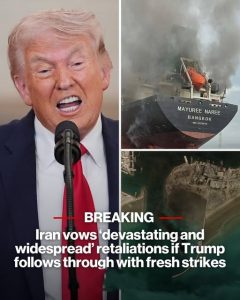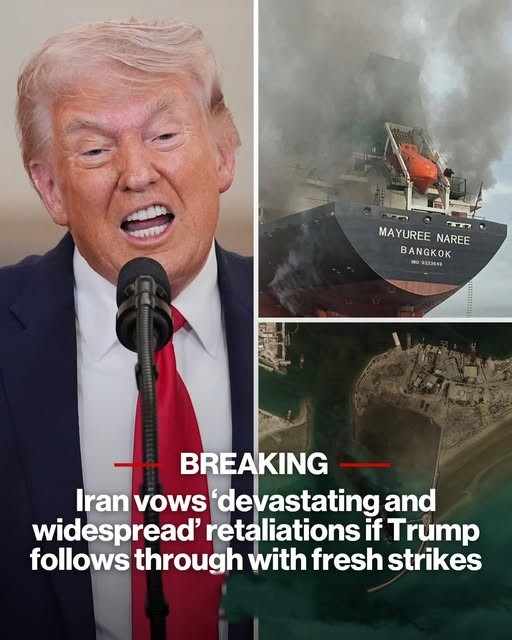
Iran Vows “Devastating and Widespread” Retaliation if Trump Follows Through With Fresh Strikes
The Middle East stands once again at the edge of a dangerous turning point. Rising rhetoric, military brinkmanship, and rapidly escalating threats between Iran and the United States have transformed an already volatile conflict into a moment many analysts describe as one of the most serious confrontations in decades. Iran’s latest warning — promising “devastating and widespread” retaliation — signals that the crisis may soon enter an even more unpredictable phase.
A War of Warnings
Tensions surged after U.S. President Donald Trump issued new threats to expand military strikes against Iran unless Tehran complies with American demands regarding maritime access through the strategically vital Strait of Hormuz. The narrow waterway is one of the world’s most critical energy arteries, carrying a large portion of global oil shipments.
Iran’s central military command responded sharply. State media broadcast a warning declaring that if attacks on civilian infrastructure continue, Iran’s next response will be far more destructive and geographically widespread. The statement was not framed as a possibility but as a certainty if escalation continues.
The language reflects a major shift. Rather than signaling restraint, Iranian officials are openly preparing domestic and international audiences for a broader confrontation — one that could extend beyond traditional battlefields.
The Trigger: Strait of Hormuz Pressure
At the center of the crisis lies control over the Strait of Hormuz. The United States has demanded that Iran guarantee safe passage for commercial shipping after repeated disruptions and attacks on vessels in the region.
President Trump reportedly issued an ultimatum, warning Iran to reopen the passage or face intensified strikes targeting critical infrastructure such as bridges, energy facilities, and power systems.
For Washington, freedom of navigation represents both an economic necessity and a demonstration of global military credibility. For Tehran, however, control of regional waterways is one of its most powerful strategic tools.
The clash therefore is not merely military — it is symbolic. Whoever controls the strait influences global energy markets, diplomatic leverage, and perceptions of power in the Middle East.
Escalation on Both Sides
The confrontation intensified following a dramatic U.S. rescue mission involving an American aviator whose aircraft had been shot down over Iranian territory. The successful extraction avoided what officials feared could become a hostage crisis, but it also hardened positions on both sides.
Instead of opening diplomatic channels, the incident fueled harsher rhetoric.
Iran has already demonstrated willingness to strike regional infrastructure targets in neighboring Gulf countries, signaling that any conflict will not remain confined to Iranian soil. Meanwhile, U.S. officials have discussed expanded military options designed to pressure Iran into compliance.
The result is a classic escalation cycle: action triggers retaliation, retaliation invites stronger counteraction, and each step narrows the space for diplomacy.
Civilian Targets and Global Alarm
Perhaps the most alarming aspect of the current standoff is the growing discussion of civilian infrastructure as potential targets.
Historically, both nations avoided openly threatening non-military systems due to humanitarian and political risks. Now, those limits appear to be eroding. Iranian leaders warn that attacks on civilian targets would unleash broader retaliation, while American threats increasingly reference infrastructure tied to Iran’s economic survival.
Such developments worry international observers because attacks on power grids, ports, or transportation networks can rapidly spiral into humanitarian crises affecting millions of civilians.
Beyond immediate casualties, long-term consequences could include mass displacement, economic collapse, and regional instability stretching far beyond Iran’s borders.
Regional Domino Effect
The Middle East’s geopolitical landscape means no conflict remains isolated. Iran maintains alliances and proxy relationships across multiple countries, including Lebanon, Iraq, Syria, and Yemen. Any escalation risks activating allied groups capable of targeting U.S. forces and regional partners simultaneously.
Shipping lanes could become unsafe. Oil prices might surge overnight. Global markets — already sensitive to energy disruptions — would likely react instantly.
Analysts warn that even limited strikes could trigger asymmetric retaliation: cyberattacks, drone strikes, missile launches, or disruption of additional strategic waterways such as the Bab el-Mandeb Strait, another vital maritime chokepoint mentioned in Iranian warnings.
This broader battlefield makes the crisis uniquely dangerous compared with previous confrontations.
Strategic Calculations in Washington
Inside the United States, the conflict also carries political weight. Reports indicate growing frustration within the administration as Iran refuses to concede despite weeks of pressure and military engagement.
Military escalation presents risks for American leadership. A prolonged conflict could become costly, politically unpopular, and difficult to exit without appearing to retreat.
At the same time, backing down after issuing strong ultimatums may weaken deterrence credibility — a factor that often drives leaders toward tougher decisions even when risks increase.
The result is a strategic dilemma: escalate to maintain pressure or de-escalate to prevent a wider war.
Iran’s Perspective
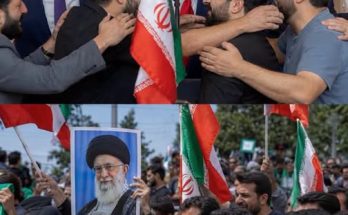
From Tehran’s viewpoint, resisting American demands is framed as national survival. Iranian leaders portray themselves domestically as defending sovereignty against foreign coercion.
By threatening massive retaliation, Iran seeks to reshape the cost-benefit calculation for Washington. The message is clear: any attempt to force compliance militarily will come at a price high enough to deter further escalation.
This strategy relies on deterrence through uncertainty — convincing adversaries that retaliation could spread unpredictably across the region.
Diplomacy Under Strain
Diplomatic channels remain fragile. Earlier pauses in attacks suggested potential negotiations, but renewed threats have undermined momentum toward talks.
International actors, including European and regional governments, continue urging restraint, fearing a conflict that could destabilize global security structures already strained by multiple crises worldwide.
Yet diplomacy becomes increasingly difficult once military timelines, deadlines, and public ultimatums dominate the conversation.
A World Watching the Clock
The current moment feels like a ticking clock. Each public statement, military movement, or maritime incident carries the potential to ignite wider conflict.
History shows that wars often begin not with a single decisive action but through gradual escalation — miscalculations layered upon miscalculations until neither side can step back without losing face.
Iran’s warning of “devastating and widespread” retaliation is therefore more than rhetoric. It is a signal that both nations may be approaching a point where strategic caution gives way to irreversible confrontation.
Whether diplomacy re-emerges or escalation accelerates will likely depend on decisions made in the coming days — decisions shaped by politics, military realities, and the fragile balance between deterrence and disaster.
For now, the world watches closely, aware that the next move could reshape the Middle East and send shockwaves far beyond its borders.