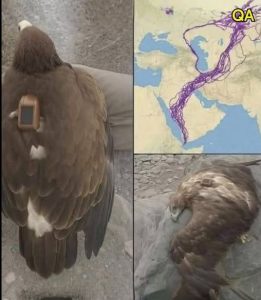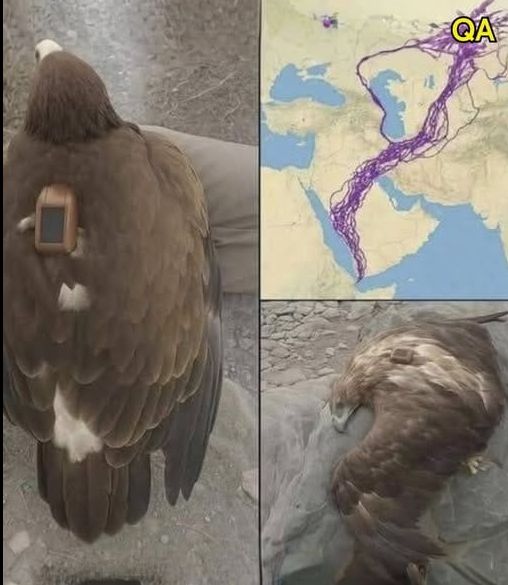
For decades, scientists believed they understood how large birds of prey migrated. Eagles, hawks, and falcons were known for predictable seasonal journeys guided by food availability, weather patterns, and instinctive navigation skills refined over thousands of years. But one eagle—tracked continuously for nearly twenty years—challenged everything researchers thought they knew.
The story began quietly in the early 2000s when wildlife biologists attached a lightweight GPS transmitter to a young Golden Eagle as part of a long-term migration study. The goal was simple: collect data on migration routes to better protect habitats and reduce human-wildlife conflicts. What scientists discovered instead became one of the most mysterious animal tracking cases ever recorded.
A Routine Experiment Turns Extraordinary
At the time, GPS tracking technology was still evolving. Researchers had only recently begun using satellite transmitters small enough to be carried safely by birds. The tagged eagle—later nicknamed “Artemis” by researchers—was expected to follow familiar migration corridors across mountain ranges and open plains.
During its first year, everything looked normal. The eagle migrated south for winter and returned north in spring, using thermal air currents to glide long distances while conserving energy. Scientists logged thousands of data points showing textbook raptor behavior.
Then, in year three, something strange happened.
Instead of following known migration routes, Artemis veered hundreds of miles off course.
At first, researchers suspected equipment malfunction. GPS errors were common in early tracking devices. But repeated signals confirmed the bird was deliberately traveling toward areas no recorded golden eagle had ever used before.
The Unexplained Journeys
Over the next several years, Artemis displayed patterns that baffled experts:
- It avoided traditional feeding grounds.
- It paused for weeks in remote, seemingly unsuitable habitats.
- It crossed geographic barriers other eagles rarely attempted.
- It returned to specific isolated locations with astonishing precision.
Scientists compared Artemis’s route with weather systems, prey populations, and environmental conditions. None explained its movements.
Even more puzzling was the bird’s remarkable consistency. Every few years, Artemis revisited the same remote valley—an area lacking abundant prey and far from known nesting territories.
Why would a powerful predator repeatedly travel somewhere that offered no obvious survival advantage?
Technology Reveals Hidden Behavior
As tracking technology improved, newer satellites delivered increasingly precise data. Researchers realized Artemis wasn’t wandering randomly. The eagle was following an incredibly complex route shaped by invisible environmental forces.
One hypothesis emerged: the bird might be navigating using Earth’s magnetic field. Many migratory species possess magnetoreception—the ability to sense magnetic lines running across the planet. Artemis’s unusual path appeared to align with subtle magnetic variations rather than terrain or climate.
Another possibility involved cultural transmission. Some scientists suggested the eagle could be following a forgotten ancestral route passed down genetically from generations long gone, preserving migration knowledge humans had never documented.
A Life Longer Than Expected
Golden eagles typically live 20 to 30 years in the wild, but maintaining uninterrupted tracking for two decades was unprecedented. Artemis survived harsh winters, storms, habitat loss, and increasing human development.
The longevity of the data allowed researchers to observe something rare: how migration behavior evolves within a single lifetime.
Around year twelve, the eagle modified its route again. Instead of traveling alone, GPS data suggested temporary coordination with other migrating raptors. Scientists theorized that younger birds might have begun following Artemis, learning alternative migration strategies.
If true, one individual eagle may have reshaped migration patterns for an entire regional population.
The Human Factor
As researchers investigated further, they discovered an unexpected clue. Several of Artemis’s mysterious stops were near regions undergoing ecological recovery after decades of environmental damage. Forests were regrowing, prey species were returning, and human disturbance had decreased.
The eagle seemed to recognize environmental opportunities before scientists themselves documented them.
In essence, Artemis behaved like an ecological scout—testing emerging habitats and adapting faster than human conservation models predicted.
This realization changed how scientists viewed animal intelligence. Migration wasn’t just instinct; it involved decision-making, learning, and exploration.
Changing Scientific Understanding
The twenty-year study forced researchers to reconsider several long-held assumptions:
- Migration routes are flexible, not fixed.
- Individual animals can innovate behavior.
- Wildlife may detect environmental recovery earlier than humans.
- Long-term tracking is essential for understanding true animal behavior.
Artemis demonstrated that animals are not merely following ancient scripts. They are active participants in changing ecosystems.
The case also highlighted the importance of patience in science. Had the tracking project ended after five years—as most studies do—the eagle’s extraordinary patterns would have remained undiscovered.
A Symbol of Resilience
By the twentieth year, Artemis had become more than a research subject. The eagle symbolized resilience in a rapidly changing world. Climate change, habitat fragmentation, and human expansion were altering ecosystems worldwide, yet this single bird adapted continuously, rewriting its own survival strategy.
Researchers published multiple papers analyzing the data, and conservation organizations began using similar long-term tracking approaches to monitor other species.
The story inspired new questions:
- How many animals are quietly innovating survival strategies?
- Are humans underestimating wildlife intelligence?
- Could animals help guide conservation decisions?
The Final Signal
Eventually, the GPS transmitter stopped sending signals. Whether the battery finally failed or Artemis reached the natural end of its life remains unknown. There was no dramatic conclusion—only silence after decades of remarkable data.
Yet the eagle’s legacy endured.
The information collected transformed migration science, influencing wildlife protection policies across continents. New conservation corridors were designed not only around historical routes but also around potential future paths animals might discover themselves.
Lessons from a Single Eagle
The mystery of Artemis reminds us that nature still holds profound secrets. Despite advanced technology and centuries of observation, humans continue to learn from the wild rather than fully understand it.
For twenty years, one eagle quietly challenged scientific certainty, teaching researchers humility and curiosity. Its journey proved that exploration is not uniquely human; it is a fundamental instinct shared across life on Earth.
In the end, the greatest discovery was not where the eagle flew—but what its flight revealed: animals are explorers, innovators, and survivors navigating a world just as complex to them as it is to us.
And somewhere high above mountains and invisible magnetic lines, the legacy of that GPS-tracked eagle continues to shape how humanity sees the natural world—one wingbeat at a time.