Trapped Between Earth and Breath: A Story of Curiosity, Risk, and Survival
The cave did not look dangerous from the outside.
It opened quietly at the base of a limestone cliff, half-hidden behind vines and moss, as if nature itself had tried to forget it existed. Sunlight spilled across the entrance, warming the rocks and masking the darkness beyond. To most hikers, it was just another geological curiosity.
To Daniel Reyes, it was an invitation.
Daniel had always been drawn to places few people dared to go. As a geologist and amateur cave explorer, he believed every hidden space carried a story waiting to be uncovered. He had mapped abandoned tunnels, crawled through narrow passages beneath deserts, and spent countless nights studying formations shaped over millions of years.
But this cave felt different the moment he stepped inside.
The air changed instantly—cooler, heavier, almost still. His headlamp cut a thin beam through the darkness, revealing walls shimmering with mineral deposits. Water dripped somewhere deeper inside, echoing softly like a ticking clock.
He paused at the entrance, checking his equipment: helmet, rope, oxygen monitor, backup light. Everything was in order.
“Just another exploration,” he whispered to himself.
He walked forward.
The Pull of Curiosity
The passage narrowed quickly. What began as an easy walk turned into a crouch, then a crawl. Daniel felt the familiar thrill rising—the excitement of discovery mixed with quiet caution.
Every few feet, the cave revealed something new: delicate stalactites, smooth rock carved by ancient rivers, pockets of untouched sediment. No footprints disturbed the dust.
He realized he might be the first person to enter this chamber.
Curiosity pushed him deeper.
After nearly an hour, he reached a tight opening barely wider than his shoulders. Beyond it, his light revealed a larger chamber glowing faintly with reflective crystal surfaces.
He hesitated.
Experienced cavers followed a simple rule: never enter a space you aren’t sure you can exit.
But curiosity has a way of whispering louder than caution.
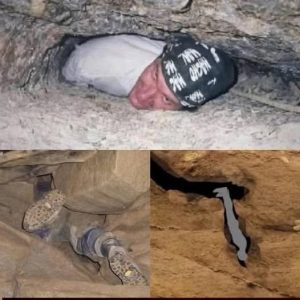
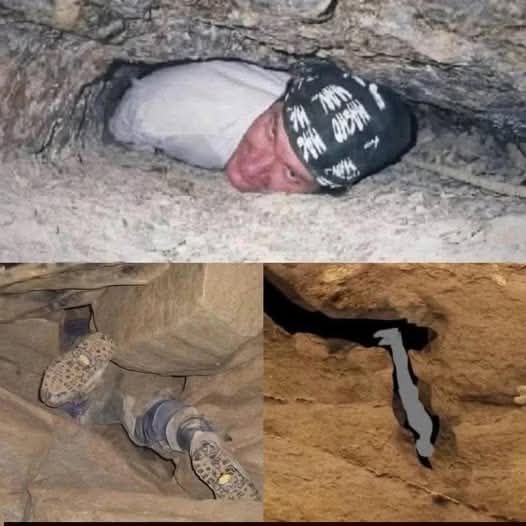
Daniel removed his backpack, pushed it ahead, and began squeezing through the narrow gap.
Halfway in, the rock shifted.
At first, it was only a faint grinding sound. Then came a sudden collapse of loose sediment above him. Dust exploded into the air, and the passage tightened instantly around his chest.
He tried to move forward.
Nothing.
He tried to move backward.
Still nothing.
Daniel Reyes was trapped.
Between Earth and Breath
The realization arrived slowly, then all at once.
The rock pressed against his ribs, restricting his breathing. Every inhale felt shallow, every exhale strained. Panic surged through him like electricity.
He forced himself to stop moving.
Panic wastes oxygen.
He closed his eyes and counted breaths the way rescue instructors had taught him years earlier.
One.
Two.
Three.
The cave was silent except for his heartbeat.
His oxygen monitor beeped softly. Air levels were safe—for now—but carbon dioxide could build quickly in confined spaces. He needed to stay calm.
He reached for his radio.
Static answered him.
The cave walls blocked the signal.
He was alone, wedged between stone formed long before humanity existed.
The Fight Against Fear
Minutes stretched into what felt like hours. Darkness pressed against him from all directions. His headlamp illuminated only inches of rock.
Daniel’s thoughts drifted unexpectedly—not to fear of death, but to ordinary memories.
His mother laughing in the kitchen.
His younger sister teasing him about his adventures.
The promise he’d made to call home after the trip.
He realized how fragile life truly was.
Not dramatic disasters or heroic moments—but quiet decisions that suddenly became irreversible.
He tested his position carefully. The rock pinned his hips, and loose debris blocked backward movement.
Forward was the only option.
But pushing forward required compressing his chest further, risking suffocation.
He took a slow breath.
Then another.
Curiosity had brought him here. Survival would require patience.
Time Becomes the Enemy
Hours passed.
The temperature dropped as his body lost heat against the stone. Muscles cramped from immobility. His throat dried despite careful rationing of water.
He began talking aloud just to hear a human voice.
“You’ve trained for this,” he told himself. “Think.”
He analyzed the situation like a scientist instead of a victim.
The collapse came from unstable sediment above him. If he could remove enough debris, space might reopen behind him.
But his arms were partially trapped.
Carefully, painfully, he began scraping away small pieces of rock with his fingers. Each movement sent dust raining into his face. Progress was slow—agonizingly slow—but tiny fragments fell away.
He worked methodically.
Dig. Rest. Breathe.
Dig. Rest. Breathe.
Survival reduced life to its most basic rhythm: effort and air.
The Edge of Exhaustion
At some point, exhaustion blurred his sense of time. His light dimmed slightly, reminding him that batteries—and hope—were finite.
Doubt crept in.
What if no one knew where he was?
What if rescue never came?
What if this cave became his final discovery?
Fear tightened his chest more than the rock itself.
Then, faintly, he heard something.
A distant echo.
At first he thought it was imagination—but the sound came again.
Voices.
Someone shouting his name.
Relief hit so suddenly he almost cried.
He yelled back, his voice cracking. “I’m here!”
The response echoed through the tunnels. Rescue teams had followed his planned route after he failed to check in.
He wasn’t alone anymore.
The Long Rescue
Rescuers worked carefully, understanding that sudden movement could trigger another collapse. They spoke to him constantly, keeping him conscious and calm while clearing debris inch by inch.
Hours passed as specialized tools chipped away at the rock around his body.
At last, pressure eased slightly around his chest.
“On three,” a rescuer called.
They pulled gently.
Pain shot through his legs as circulation returned, but suddenly—miraculously—he slid free.
Hands grabbed him, guiding him backward through the passage.
For the first time in nearly a day, Daniel could fully expand his lungs.
He inhaled deeply.
Air had never tasted so alive.
Emerging Into Light
When he finally exited the cave, dawn painted the sky in pale gold. Fresh air rushed across his face. Birds sang somewhere above, unaware of how extraordinary the moment felt.
He lay on the ground, staring upward, overwhelmed by something deeper than relief.
Gratitude.
The earth that had nearly taken his breath now gave him perspective instead.
Curiosity had led him into danger—but survival taught him humility.
Some mysteries, he realized, demand respect as much as exploration.
What Survival Changed
Recovery took weeks. Bruised ribs healed slowly, but the psychological impact lingered longer.
Daniel returned to exploration eventually—but differently.
He planned more carefully. Traveled with partners. Turned back when instinct warned him.
He still loved discovery.
But he no longer chased risk for its own sake.
Because he had learned something few people ever understand so clearly:
Life exists in the space between earth and breath.
Between curiosity and caution.
Between ambition and awareness.
Between the desire to explore and the wisdom to survive.
And every breath—every single one—is a gift earned moment by moment.
The cave remained where it had always been, silent and ancient.
But Daniel walked away carrying its greatest lesson:
Survival isn’t just escaping danger.
It’s returning to the world ready to live more carefully, more gratefully, and more fully than before.