Warning: Never Put the Charger Like This…
It was supposed to be an ordinary evening.
Maya had just returned home after a long day at work. Her apartment felt warm and quiet, the kind of peaceful silence she usually loved. She tossed her keys onto the table, kicked off her shoes, and collapsed onto the couch.
Her phone battery flashed red: 2% remaining.
“Of course,” she sighed.
She reached for her charger lying near the outlet beside the sofa. The cable was slightly bent near the plug, and the adapter had a small crack along one side. She had noticed it weeks ago but ignored it. After all, it still worked.
Everyone does it.
She plugged the charger into the wall and connected her phone. The familiar charging sound chimed, and the screen lit up.
Problem solved.
Or so she thought.
A Small Habit Nobody Questions
Maya scrolled through social media while her phone charged beside her on the couch. The cable stretched tightly from the outlet, twisted underneath a pillow.
The charger felt warm.
She noticed—but didn’t think much of it.
Most people don’t.
Chargers heat up sometimes. Cables bend. Adapters crack. Phones charge overnight. Nothing bad ever happens… until it does.
Across the world, thousands of small electrical accidents begin exactly like this—with tiny warning signs ignored because they seem harmless.
Maya adjusted herself, pulling a blanket over her legs. The charger remained wedged awkwardly between the couch cushion and the wall outlet.
Hidden.
Pressed.
Strained.
The First Warning Sign
Twenty minutes later, Maya smelled something faint.
A sharp, plastic scent.
She frowned and sniffed the air.
“Probably outside,” she murmured.
But the smell grew stronger.
She glanced down and noticed the charger brick was unusually hot—almost too hot to touch.
She unplugged it quickly.
The metal prongs were warm, and the plastic near the crack looked slightly darker.
Her heart skipped.
For a moment, she considered throwing it away.
Instead, she shrugged.
“It’s fine,” she said. “I’ll just be careful.”
She plugged it back in—this time upside down so the cable bent sharply downward toward the floor.
A small decision.
One that nearly changed everything.
What Most People Don’t Realize
Chargers are designed to sit freely in outlets where heat can escape. When cables are bent tightly, crushed under furniture, or plugged at unsafe angles, electricity meets resistance.
Resistance creates heat.
Heat weakens insulation.
Weak insulation exposes wires.
And exposed wires can spark.
But danger rarely announces itself loudly at first. It builds slowly, quietly, invisibly.
That night, Maya left her phone charging while she went to shower.
Steam filled the bathroom while water rushed loudly from the showerhead.
In the living room, the charger continued working harder than it should have.
The bent cable strained internally.
Tiny electrical arcs began forming where the wire had weakened.
A faint flicker appeared at the outlet.
Then another.
The Moment Everything Changed
Maya stepped out of the shower wrapped in a towel.
That’s when she heard it.
Pop.
A sharp electrical sound.
The apartment lights flickered briefly.
Her stomach tightened.
She walked toward the living room—and froze.
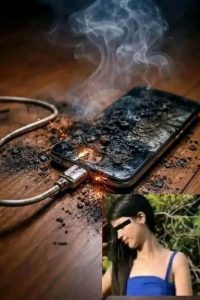
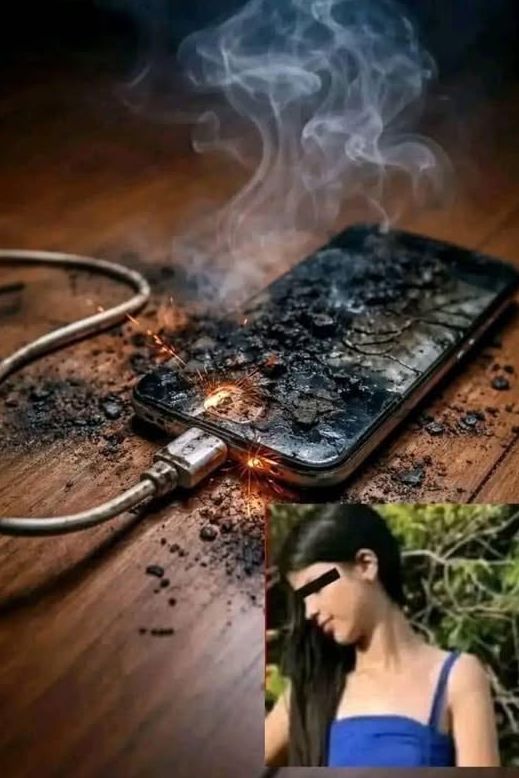
A thin trail of smoke curled upward from the outlet.
“Wait… what?”
She rushed forward and saw the charger glowing faintly near the plug. The cable insulation had begun melting where it bent sharply against the wall.
Panic surged.
She grabbed the charger instinctively.
Instant regret.
Heat burned her fingers, and she dropped it immediately.
The plastic casing cracked open, revealing scorched wiring inside.
Another spark snapped loudly.
Maya stumbled back, heart pounding.
She ran to the breaker panel and shut off the power.
Silence fell over the apartment.
No lights.
No hum.
No danger—at least for now.
Her hands shook as realization hit her.
That charger could have started a fire.
If she had been asleep…
If the couch had caught flame…
If the spark had spread…
The outcome might have been devastating.
Lessons Hidden in Everyday Objects
Later that night, Maya sat at her kitchen table staring at the damaged charger.
Something so small had nearly caused something irreversible.
She searched online and learned shocking facts:
- Damaged chargers are one of the leading causes of small electrical fires at home.
- Charging devices under pillows or blankets traps heat.
- Cheap or cracked adapters can fail without warning.
- Using phones while cables are sharply bent weakens internal wiring.
- Leaving chargers plugged in overnight increases risk if they’re damaged.
She realized how common her habits were.
Everyone she knew charged phones on beds, couches, or crowded outlets.
Nobody thought twice.
Until something happened.
The Hidden Danger of “Just This Once”
The biggest problem wasn’t ignorance.
It was familiarity.
People trust objects they use every day. Phones, chargers, extension cords—they feel harmless because they are part of routine.
But electricity demands respect.
Maya remembered all the times she had:
- Slept with her phone charging beside her pillow.
- Used a frayed cable because replacing it felt unnecessary.
- Bought the cheapest charger online without checking quality.
- Plugged adapters loosely into worn outlets.
Each moment carried risk she never considered.
And she wasn’t alone.
Changing the Habit
The next morning, Maya threw away the damaged charger and bought a certified replacement.
She rearranged her charging area completely:
- No more charging on the couch or bed.
- Cables placed where they could rest naturally without bending.
- Chargers unplugged when not in use.
- Devices charged on hard, open surfaces where heat could escape.
Simple changes.
But powerful ones.
She even texted her friends:
“Seriously—check your chargers. I almost caused a fire last night.”
Most replied with laughing emojis at first.
Then several admitted they were using cracked cables too.
It made her realize how easily accidents spread—not through bad luck, but shared habits.
A Message Worth Sharing
Weeks later, Maya barely thought about the incident anymore.
But every time she plugged in her phone, she paused for a second.
She checked the cable.
She made sure nothing covered it.
She remembered the smell of smoke.
And she understood something important:
Safety isn’t dramatic.
It’s quiet choices repeated daily.
One evening, her younger cousin visited and plugged a charger into the wall sideways, forcing the cable to bend sharply behind a chair.
Maya immediately stopped him.
“Warning,” she said gently. “Never put the charger like that.”
He rolled his eyes at first.
Until she showed him the burned adapter she kept as a reminder.
His expression changed instantly.
He fixed the cable.
Sometimes awareness travels person to person, preventing accidents long before they happen.
The Real Warning
Most electrical accidents don’t begin with explosions or obvious danger.
They begin with small things:
A cracked charger.
A bent cable.
A phone charging under a pillow.
An outlet overloaded just a little too much.
Things people ignore because nothing bad has happened yet.
But safety isn’t about reacting after disaster—it’s about preventing it before it starts.
So remember:
If a charger feels hot, replace it.
If a cable is damaged, stop using it.
If it’s bent, covered, or forced into position—fix it immediately.
Because sometimes the difference between an ordinary night and an emergency is just one small decision.
And the warning is simple:
Never put the charger like this… even once.