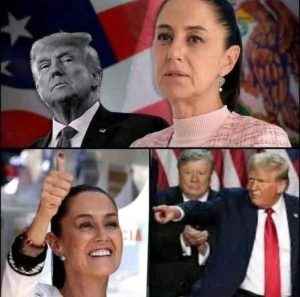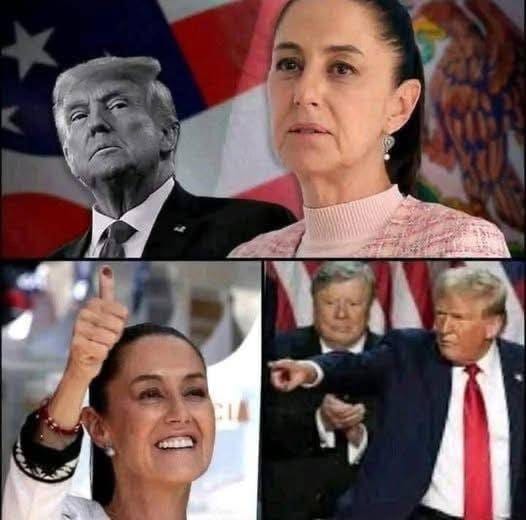
Political relations between neighboring countries often produce moments that capture global attention, especially when strong personalities and high-stakes diplomacy are involved. Recently, headlines emerged after Mexico’s president publicly addressed comments and perceptions surrounding former U.S. President Donald Trump, offering remarks that quickly sparked international discussion.
The statement, delivered during a press briefing in Mexico City, reflected the evolving tone of U.S.–Mexico relations and highlighted how political dialogue between the two nations continues to shift in response to changing leadership, economic priorities, and regional challenges.
A Statement That Drew Worldwide Attention
Mexico’s president, Claudia Sheinbaum, was speaking to reporters about bilateral cooperation when she was asked directly about Trump’s influence on cross-border relations and his ongoing political presence in the United States.
Rather than responding with confrontation, Sheinbaum adopted a measured tone. She emphasized that political disagreements should not be interpreted as personal hostility, noting that diplomacy requires separating rhetoric from long-term cooperation.
Her key message, summarized by international media outlets, was that Trump should not be viewed solely through the lens of controversy or past tensions. Instead, she framed him as a political figure representing a segment of American voters whose concerns must be understood within democratic dialogue.
The comment immediately circulated across global news platforms, with analysts interpreting it as an attempt to reduce political polarization between the neighboring countries.
Historical Context Behind the Remarks
Relations between Mexico and the United States have experienced periods of both partnership and strain. During Trump’s presidency from 2017 to 2021, immigration policies, border wall proposals, and trade negotiations often dominated headlines.
The renegotiation of NAFTA into the United States–Mexico–Canada Agreement (USMCA) illustrated this complicated dynamic. While negotiations were intense, the final agreement ultimately reinforced economic cooperation among North American partners.
Sheinbaum’s remarks appeared to acknowledge this complexity. By stating that Trump is “not simply an adversary,” she signaled recognition that political leaders can simultaneously disagree on policy while maintaining necessary economic and diplomatic ties.
Diplomatic Language Matters
Political observers noted that Sheinbaum’s wording was careful and strategic. Modern diplomacy often requires leaders to avoid escalating tensions, especially with a country as economically interconnected as the United States.
Mexico’s economy relies heavily on trade with its northern neighbor. Millions of jobs on both sides of the border depend on stable relations, making diplomatic tone as important as policy decisions.
Experts interpreted her statement as an effort to promote pragmatic engagement rather than ideological confrontation. Instead of revisiting past disputes, she focused on shared challenges such as migration management, economic development, and regional security.
Reaction in the United States
In the United States, reactions to the comments varied along political lines. Supporters of Trump viewed the statement as evidence that international leaders recognize his political significance beyond partisan narratives.
Others interpreted it as a diplomatic necessity rather than political endorsement. Analysts emphasized that foreign leaders frequently maintain respectful language toward influential American figures regardless of domestic political debates.
Media commentators pointed out that leaders across the world often prepare for multiple political scenarios in the U.S., including the possibility of Trump’s continued influence or future leadership roles.
Mexico’s Strategic Approach
Sheinbaum’s administration has emphasized stability and economic cooperation as central pillars of its foreign policy. Her government faces pressing domestic priorities, including economic modernization, energy policy reform, and addressing migration flows through Mexico.
Maintaining a constructive relationship with Washington is therefore essential. By avoiding inflammatory rhetoric, the Mexican president positioned her country as a steady diplomatic partner focused on solutions rather than political rivalry.
Observers noted that her approach reflects a broader trend among international leaders who increasingly prioritize economic continuity over ideological clashes.
Immigration and Shared Challenges
One of the most sensitive issues in U.S.–Mexico relations remains migration. Both countries confront pressures related to asylum seekers, border security, and humanitarian responsibilities.
Sheinbaum highlighted that migration is not a problem one nation can solve alone. She argued that cooperation—regardless of which political leaders are involved—is the only sustainable path forward.
Her remarks suggested that dialogue must continue even when political perspectives differ sharply. In that sense, her statement about Trump underscored a broader diplomatic philosophy: engagement over isolation.
Public Opinion in Mexico
Within Mexico, reactions were similarly mixed. Some citizens appreciated the president’s pragmatic tone, viewing it as mature leadership that prioritizes national interests over personal disagreements.
Others felt cautious, remembering past tensions during Trump’s presidency. Public debate reflected Mexico’s diverse political landscape, where opinions about U.S. politics often mirror concerns about trade, migration, and national sovereignty.
Despite differing views, many commentators agreed that maintaining respectful communication with influential American figures is essential for Mexico’s long-term stability.
The Role of Media Narratives
The rapid spread of the story also highlighted how media framing shapes political perception. Headlines focusing on dramatic phrases sometimes overshadow the nuanced reality of diplomatic communication.
Political speeches often contain complex messages intended for multiple audiences: domestic voters, foreign governments, business leaders, and international markets. Short excerpts can appear more provocative than the full context suggests.
In this case, analysts emphasized that Sheinbaum’s broader speech focused on cooperation rather than controversy.
A Changing Era of Leadership
The exchange reflects a new chapter in North American politics. Both Mexico and the United States are navigating shifting political landscapes marked by economic uncertainty, technological transformation, and evolving global alliances.
Leaders increasingly recognize that collaboration between neighboring countries is unavoidable, regardless of individual political personalities.
By reframing discussion around Trump in diplomatic rather than confrontational terms, Sheinbaum demonstrated how international leaders adapt their messaging to changing geopolitical realities.
Looking Ahead
As future elections and policy debates unfold in the United States, Mexico’s leadership will likely continue preparing for multiple outcomes. Diplomatic flexibility allows governments to maintain continuity even amid political change.
The statement about Trump ultimately reveals less about personal opinions and more about strategic governance. Nations rarely have the luxury of choosing their neighbors; cooperation becomes a necessity rather than an option.
For citizens watching from both sides of the border, the episode serves as a reminder that international relations operate beyond headlines. Political disagreements may dominate news cycles, but behind the scenes, diplomacy often seeks balance, stability, and mutual benefit.
Final Thoughts
The Mexican president’s remarks sparked attention because they challenged simplified narratives about political rivalry. By stating that Donald Trump is not merely an adversary, Claudia Sheinbaum highlighted the complexity of modern diplomacy—where cooperation and disagreement coexist.
In a world increasingly shaped by rapid media reactions, her comments underscored an enduring principle of international relations: lasting partnerships depend not on personalities alone but on shared interests, economic realities, and the willingness to keep dialogue open.
As North America continues to face economic, environmental, and migration challenges, that pragmatic approach may prove more influential than any single political moment.