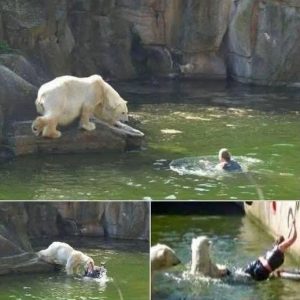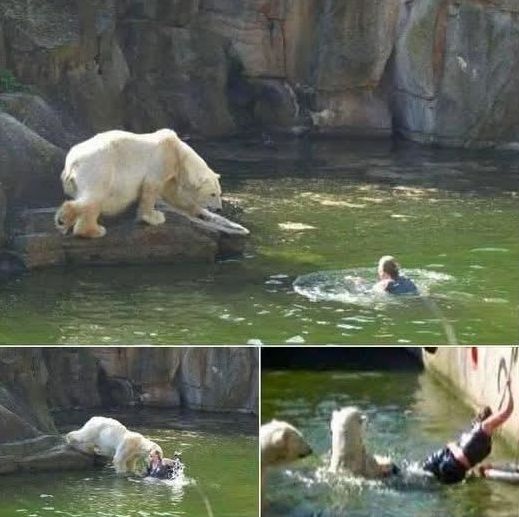
A quiet morning at Berlin Zoological Garden, one of Europe’s oldest and most visited zoos, turned into a scene of terror when a 32-year-old woman made a decision that stunned visitors, shocked animal experts, and sparked worldwide debate about human behavior around dangerous wildlife.
What began as a routine feeding session quickly escalated into a life-threatening encounter between a human and one of nature’s most powerful predators.
The Moment Everything Changed
The incident occurred during feeding time — a period when polar bears are especially alert, excited, and focused on food. According to witnesses, the woman climbed over multiple safety barriers designed to keep visitors at a safe distance.
These barriers were not accidental obstacles. They included fences, warning signs, and protective walls meant to prevent exactly this type of situation.
Yet, determined to enter the enclosure, the woman reportedly scaled the outer fence and dropped several meters into the habitat below.
At first, spectators believed it was part of a demonstration or performance. Within seconds, panic replaced curiosity.
The polar bears noticed her immediately.
A Predator’s Natural Response
Polar bears are not merely large animals — they are the largest land predators on Earth, capable of overpowering seals, walruses, and even large prey in harsh Arctic environments.
When the woman landed inside the enclosure, several bears approached her cautiously.
Then instinct took over.
One bear lunged.
Witnesses described screams echoing across the zoo as the animal knocked the woman into the water surrounding the habitat. The bear bit and struck her repeatedly while others circled nearby, drawn by movement and excitement during feeding time.
Visitors watched in horror, many unable to comprehend what they were seeing.
Chaos Among Spectators
Parents rushed to shield children’s eyes. Some people shouted at the bears in a desperate attempt to distract them. Others alerted zoo staff, who were already racing toward the enclosure after noticing unusual movement.
Zookeepers faced an incredibly dangerous dilemma:
- Enter too quickly, and they risked provoking the bears further.
- Wait too long, and the woman could die.
Seconds felt like minutes.
Emergency protocols were immediately activated.
The Dramatic Rescue
Zoo staff used every available method to save the woman without harming the animals.
Keepers began throwing pieces of meat into different areas of the enclosure to lure the bears away. At the same time, they used loud noises and visual distractions to redirect the animals’ attention.
Gradually, the bears moved toward the food.
That brief distraction gave rescuers the chance they needed.
Staff members pulled the injured woman from the water using ropes and poles, avoiding direct confrontation with the predators. She was rushed to a nearby hospital with severe injuries, including bites and deep wounds, but miraculously survived the attack.
Many observers later described the rescue as nothing short of heroic.
Why Did She Jump In?
One of the most disturbing aspects of the incident was the unanswered question: why would anyone enter a polar bear enclosure?
Authorities never confirmed a clear motive.
Speculation ranged from emotional distress to a desire for attention or thrill-seeking behavior. Some reports suggested the act may have been impulsive rather than planned.
Zoo officials emphasized that the woman had deliberately ignored multiple warning systems.
The tragedy, they said, was entirely preventable.
The Bears Were Not to Blame
Following the incident, animal welfare groups and zoo management made one thing clear:
The bears behaved exactly as nature intended.
Polar bears are not aggressive out of cruelty — they are hunters responding to unfamiliar movement within their territory. Experts explained that once a human enters an enclosure, the animal interprets the situation as either prey intrusion or threat.
Importantly, none of the bears were euthanized or punished.
Investigations concluded they had acted naturally and were not responsible for the event.
This decision sparked broader discussion about how society views wild animals in captivity.
The Hidden Danger of Zoos
Zoos often create an illusion of safety.
Visitors see animals daily, separated by glass or railings, and subconsciously forget the raw power these creatures possess.
But behind those barriers remain instincts shaped by thousands of years of evolution.
Even famous zoo animals — such as Knut, the beloved polar bear cub who once attracted global crowds — are still wild at heart despite human care.
Experts stress that captivity does not eliminate danger.
It only contains it.
Psychological Impact on Witnesses
Beyond physical injuries, the event deeply affected witnesses.
Children reportedly cried for hours afterward. Some visitors required counseling after seeing the attack unfold. Zoo staff themselves experienced emotional trauma, forced to confront a situation where a human life and animal welfare hung in balance.
For zookeepers, such incidents are among the worst possible scenarios — moments when human recklessness forces animals into situations they never chose.
Legal Consequences
Authorities issued the woman a citation for trespassing after determining she knowingly violated safety restrictions.
While recovering in hospital, she faced not only medical treatment but also legal responsibility for putting herself, zoo employees, and the animals at risk.
The incident reignited debate about whether stricter penalties should exist for individuals who enter animal enclosures.
Many experts argue that such actions endanger both humans and animals equally.
Lessons Learned
The Berlin Zoo attack became an international reminder of several hard truths:
1. Wild Animals Are Never Safe to Approach
No matter how calm or familiar they appear, predators retain powerful instincts.
2. Safety Barriers Exist for a Reason
Fences, signs, and distances are carefully designed based on animal behavior science.
3. Human Curiosity Can Become Dangerous
Moments of impulse can lead to irreversible consequences.
A Story That Still Resonates
Years later, the incident remains one of the most talked-about zoo accidents in modern Europe.
It was not simply an animal attack.
It was a collision between human emotion and natural instinct — a stark reminder that respect for wildlife must never fade, even in controlled environments.
The woman survived, the bears remained unharmed, and the zoo strengthened its security measures. Yet the memory of that terrifying day continues to echo through discussions about responsibility, mental health, and humanity’s complicated relationship with nature.
In the end, the lesson is simple but powerful:
Wild animals do not become tame because we build walls around them.
Sometimes, the greatest danger in a zoo is not the animals themselves — but forgetting what they truly are.