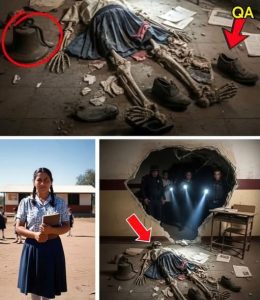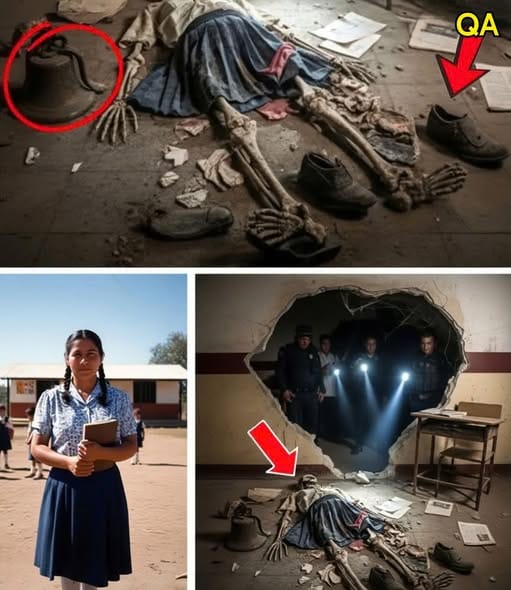
The classroom door had been bricked over so thoroughly that the wall looked like any other in the abandoned wing of Hawthorne High. Twenty-five years of dust, silence, and institutional amnesia had turned Room 217 into myth. Students whispered about it during lunch. Faculty changed the subject. The administration called it “structural maintenance.” But when the wrecking crew finally swung their hammers in the spring of 2026, the bricks fell away like a scab.
Inside, time had frozen at 3:17 p.m. on May 22, 2001.
Desks stood in perfect rows, papers still fluttering on some as if a breeze had just died. A half-erased equation lingered on the blackboard: *2H₂ + O₂ → 2H₂O*. Chalk dust hung in the air like frost. The clock on the wall had stopped, its hands locked in place. And at the teacher’s desk sat Mr. Elias Harrow, or what remained of him.
He wasn’t decayed. That was the first impossible thing.
His body looked preserved, almost mummified in a thin layer of crystalline frost that shimmered under the demolition crew’s flashlights. Eyes open. Tie straight. One hand still resting on a red grading pen. The temperature inside the sealed room was twenty-three degrees colder than the hallway outside.
The discovery made national news by evening. By morning, the county had the building locked down and a forensic team in hazmat suits moving like ghosts through the relic.
I was there because my mother had been a student in that class.
—
I arrived two days later with a press pass I probably shouldn’t have been granted. The story had already twisted into tabloid territory: *Frozen Teacher Found After Quarter Century!* But I wasn’t chasing clicks. I wanted to know why my mother still woke up screaming sometimes when it stormed.
The school smelled of mildew and old paper. Yellow caution tape crisscrossed the second-floor hallway. A bored deputy waved me through after checking my ID.
Room 217 looked smaller than I’d imagined. Seventeen desks. Seventeen chairs. Seventeen names I would later memorize.
Mr. Harrow’s body had already been removed, but the frost remained in patches, clinging to the floorboards like spilled sugar. The forensics people said the room had been hermetically sealed by the cement job—perfectly airtight, perfectly insulated. No mold. No rot. Just… stasis.
I found my mother’s desk in the third row, center. *L. Moreau* carved into the wood with a ballpoint pen. A dried-out daisy pressed between the pages of a textbook still open to *The Lottery* by Shirley Jackson.
And beneath the desk, a notebook that didn’t belong to any student.
—
The notebook was black, spiral-bound, and smelled faintly of ozone. The handwriting inside was Mr. Harrow’s—tight, slanted, obsessive. The first entry was dated April 3, 2001.
*They’re watching me again. Not the students. Something else. The air bends when I turn quickly.*
I flipped pages. The entries grew stranger.
*May 9: Time stuttered today during third period. I asked a question. Got the same answer three times from three different kids before the loop broke. They didn’t notice.*
*May 14: I found ice crystals on the inside of the windows even though it’s 78 degrees outside. The thermometer in my desk reads -4°C when I hold it.*
*May 19: They asked me to stay after school. Not the students. The room itself. I can feel it breathing.*
The final entry, dated May 22, 2001—the day everything stopped—was only three lines.
*I understand now. The classroom isn’t sealed from the world.*
*We are sealed from time.*
*If you’re reading this, I’m sorry. Close the door.*
I closed the notebook with shaking hands.
—
That night I met with Dr. Ruth Aoki, the lead forensic anthropologist. She looked like she hadn’t slept in forty-eight hours.
“The preservation is… anomalous,” she said, rubbing her eyes. “Cellular degradation is almost nonexistent. It’s like the room created its own cryogenic field. But that’s not even the weird part.”
She slid a photograph across the table. It showed the blackboard from multiple angles. The chemical equation I’d seen earlier was only the top layer. Beneath it, in faint but visible script, were hundreds of tiny tally marks. Thousands. Some in groups of seven. Some in groups of seventeen.
“Time loops,” Dr. Aoki said quietly. “We think the room reset itself every seven days for twenty-five years. Same moment. Same second. 3:17 p.m. The same lesson repeating forever while the world moved on.”
I thought of my mother’s nightmares. The way she sometimes stared at clocks like they might betray her.
“What happened to the students?” I asked.
She hesitated. “They’re… still in there. In a sense.”
—
The breakthrough came from the security footage the school had digitized before the sealing. Grainy, silent, black-and-white.
At 3:12 p.m. on May 22, 2001, Mr. Harrow locked the classroom door from the inside. He told the students it was a safety drill. Then he walked to the board and began writing something they couldn’t see from their seats.
At 3:15, frost began forming on the windows.
At 3:16, every student in the room stood up at the exact same second, like puppets on strings.
At 3:17, the lights flickered. The footage warped—colors bleeding into negative for three frames. When it cleared, Mr. Harrow was alone at his desk, frozen. The students were gone. Not fled. Gone. Desks empty. Backpacks still hanging from chairs.
Seventeen kids erased from time.
—
I went back to the school at 2:45 a.m. with bolt cutters and a terrible idea.
The room felt alive when I stepped inside. The air had weight. My breath fogged immediately. The temperature dropped so fast my teeth ached.
I sat at my mother’s old desk and opened the black notebook again. Then I spoke aloud.
“Mr. Harrow. If you’re still here… I want to know what you traded them for.”
The clock on the wall clicked. Just once.
I kept talking. Told him about my mother—how she’d dropped out after that year. How she’d never spoken his name. How she still checked every lock three times before bed.
The frost on the floor crept toward me in delicate fractal patterns.
At 3:10, the door to the classroom slammed shut by itself.
I didn’t panic. I’d expected it.
At 3:15, the temperature plummeted. My phone screen cracked from the cold.
At 3:16, I heard seventeen voices whispering at once. Children’s voices. Some laughing. Some crying. All saying the same thing:
*We want to go home.*
I stood up. Walked to the blackboard. Picked up a piece of chalk that shouldn’t have still existed after twenty-five years.
I wrote the only thing I could think to write.
*Let them go. Take me instead.*
The room screamed.
Not with sound—with absence. Every molecule of air rushed toward the center of the room like a black hole opening. Desks rattled. Papers flew. The frost exploded upward in a glittering storm.
And then, for one impossible second, I saw them.
Seventeen teenagers standing in their old places, staring at me with ancient eyes. My mother among them—seventeen and terrified and beautiful. She mouthed something I couldn’t hear.
Mr. Harrow was standing too. The frost had left his body. He looked at me with something like gratitude. And sorrow.
He nodded once.
The clock lurched forward.
3:18 p.m.
The temperature normalized. The papers settled. The whispering stopped.
When the police found me the next morning, I was sitting at the teacher’s desk with frost in my hair and seventeen sets of footprints melted into the floor, leading toward the door.
They never found Mr. Harrow’s body again.
—
My mother called me that afternoon. For the first time in twenty-five years, she sounded… lighter.
“I had the dream again,” she said. “But this time I walked out of the classroom. The sun was shining. You were waiting outside.”
I didn’t tell her what I’d done. Some secrets need to stay frozen.
Room 217 is being demolished next week. The new principal wants a memorial garden. I think that’s fitting.
Time moves forward again.
But sometimes, late at night, I feel a chill on the back of my neck. I hear seventeen voices laughing in the distance.
And I wonder if Mr. Harrow is still teaching somewhere else.
Somewhere cold.
Somewhere timeless.