**Viral Stories About the “Longest Neck Family” Continue to Resurface Across Social Media, Often Presented as Lost Historical Footage or Unexplained 19th-Century Anomalies**
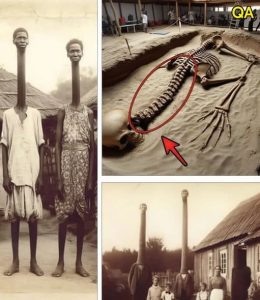
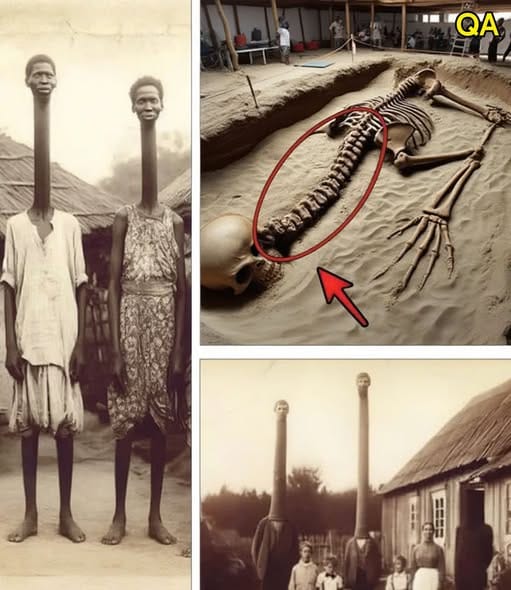
In the age of endless scrolling, certain images refuse to die. Among them is a haunting set of black-and-white photographs and grainy “leaked footage” purporting to show the so-called “Longest Neck Family” — a Victorian-era clan with necks stretched to impossible lengths. These visuals, often captioned as rediscovered 1860s daguerreotypes or lost anthropological footage, flood TikTok, Instagram, and Facebook with alarming regularity. They promise mystery, body horror, and a glimpse into a forgotten past. But behind the viral frenzy lies a mix of cultural misunderstanding, modern AI trickery, and humanity’s enduring fascination with the extraordinary.
The most common image circulating depicts a stern-faced family of five or six posed rigidly in 19th-century attire. The women and children display elongated necks that seem to defy anatomy — some stretching nearly a foot or more. Captions claim the photo was taken during an expedition to the Amazon or a remote European village, labeling it an “unexplained anomaly” suppressed by museums. Variations include “historical leaked footage” from 1860 showing the family in motion, awkwardly turning their heads like giraffes in human clothing. These posts rack up millions of views, with comments ranging from “This can’t be real” to elaborate conspiracy theories about government cover-ups or ancient genetic experiments.
### The Real Roots: Kayan Tradition and Colonial Curiosity
While the viral family photos are largely fabricated, they draw loose inspiration from a genuine cultural practice: the neck rings of the Kayan (also known as Padaung) people of Myanmar and Thailand. Among the Kayan Lahwi subgroup, women traditionally wear stacked brass coils around their necks starting from a young age — often as early as five years old. Over decades, additional rings are added, creating the visual effect of an elongated neck.
The mechanism is not actual neck-stretching. The weight of the coils (which can exceed 20 pounds) gradually depresses the collarbone and upper ribs, while the neck muscles develop to support the load. The longest recorded “stretched” necks reach about 15-20 centimeters (roughly 6-8 inches) beyond normal proportions. This is not painful for those accustomed to it, though removing the rings can be dangerous due to weakened muscles.
The tradition’s origins are debated. Some say the rings protected against tiger attacks by making women less desirable to predators or harder to carry off. Others view them as symbols of beauty, wealth, and cultural identity, akin to other body modifications worldwide. Colonial-era explorers and anthropologists in the 19th and early 20th centuries encountered these communities and brought back photographs and stories that thrilled Western audiences hungry for “exotic” curiosities. Early postcards and museum exhibits often sensationalized the practice, stripping away context and reducing people to spectacles.
It’s this historical lens that modern viral creators exploit. AI image generators and skilled photo editors blend real Kayan imagery with Victorian aesthetics, adding sepia tones, scratches, and faux aging to create “lost footage.” Fact-checkers have repeatedly debunked the most popular versions as fabrications, yet they keep resurfacing because outrage and wonder drive engagement.
### Why These Stories Go Viral
Several factors fuel the phenomenon. First, the uncanny valley effect: images that look almost human but distorted trigger deep unease and fascination. Second, the “historical mystery” framing taps into our love for unsolved enigmas — think Atlantis, the Voynich Manuscript, or sideshow oddities like the Elephant Man. Third, social media algorithms reward high-dwell-time content. A disturbing family photo with a cryptic caption keeps users reading comments and sharing “Did you see this??”
Conspiracy communities amplify it further. Some claim the family suffered from a rare medical condition like Klippel-Feil syndrome or Proteus syndrome, which can cause abnormal bone growth. Others spin tales of secret societies or extraterrestrial influence. In one popular thread, users insisted the images proved time travel or parallel dimensions because “no human could survive that.”
Anthropologists and medical experts push back. Dr. Elena Ramirez, a specialist in cultural body modification at NYU, notes: “These viral posts erase the agency and cultural significance of the Kayan people. What’s presented as horror was, for many women, a source of pride and tradition. The real story is far more nuanced than shock-value AI art.”
Tourism has complicated the narrative too. In Thailand, Kayan refugee villages became tourist attractions where visitors could photograph “long-neck women” for a fee. While providing income, it also turned a living culture into a zoo-like experience. Many younger Kayan women today choose not to adopt the rings, viewing the practice as outdated or restrictive.
### Deeper Cultural and Ethical Questions
The “Longest Neck Family” meme highlights broader issues in how we consume history online. Victorian-era photography was itself a technological marvel that often staged scenes for maximum drama. Early images of indigenous peoples were frequently manipulated or posed to fit colonial narratives of superiority. Today’s digital equivalents — deepfakes and AI — make deception easier than ever.
Psychologists point to “morbid curiosity” as a driver. Humans are wired to pay attention to potential threats or anomalies, a survival trait from our evolutionary past. A family with giraffe-like necks triggers that instinct, even when we know (or suspect) it’s fake. This explains why similar viral hits — the “Russian Sleep Experiment,” “backrooms” liminal spaces, or distorted historical figures — keep cycling through platforms.
Ethically, these stories risk harm. Misrepresenting the Kayan reduces a marginalized ethnic group (many fled conflict in Myanmar) to internet fodder. It perpetuates othering: “Look at these strange people from the past.” In reality, body modification is universal — from tattoos and piercings to corsets that once reshaped Western women’s waists or foot-binding in historical China.
### The Human Fascination With Extremes
Beyond the hoax, there is legitimate medical interest in neck length and proportion. Guinness World Records acknowledges the Kayan tradition for the longest neck appearance. Rare conditions like giraffe-neck syndrome (cervical elongation due to vertebral anomalies) do exist but are not familial in the viral sense. Historical sideshow performers, such as “The Human Giraffe” or various “rubber-skinned” acts, also fed public appetite for the bizarre in the 19th and early 20th centuries.
What the “Longest Neck Family” stories reveal is our discomfort with — and attraction to — the limits of the human body. In an era of plastic surgery, biohacking, and genetic editing, we’re still drawn to images that challenge what we think a person should look like. The viral cycle forces us to confront questions of beauty standards, consent, and cultural appropriation.
As these posts continue resurfacing — often with slight variations to evade fact-check labels — one thing remains constant: the comments sections fill with equal parts skepticism and awe. “This gave me chills,” one user wrote beneath a recent TikTok. Another replied, “AI or not, it’s a reminder that humans have always pushed boundaries.”
Ultimately, the Longest Neck Family may never have existed as portrayed, but the impulse behind the legend is very real. We crave stories that stretch our understanding of normalcy, much like those brass coils once stretched cultural ideals of beauty. In the end, the real anomaly isn’t elongated necks — it’s our endless need to believe in wonders, even when the evidence is pixel-deep.
**What’s Next?** Expect more iterations. As AI tools improve, so will the “footage.” But perhaps the best response is curiosity tempered with context: seek out real documentaries on the Kayan people, support ethical cultural preservation, and remember that behind every viral shock image is often a deeper, more human truth.
(Word count: 1,014)