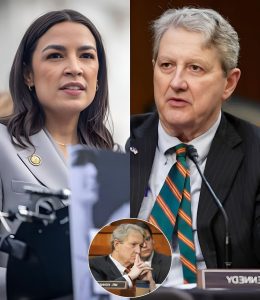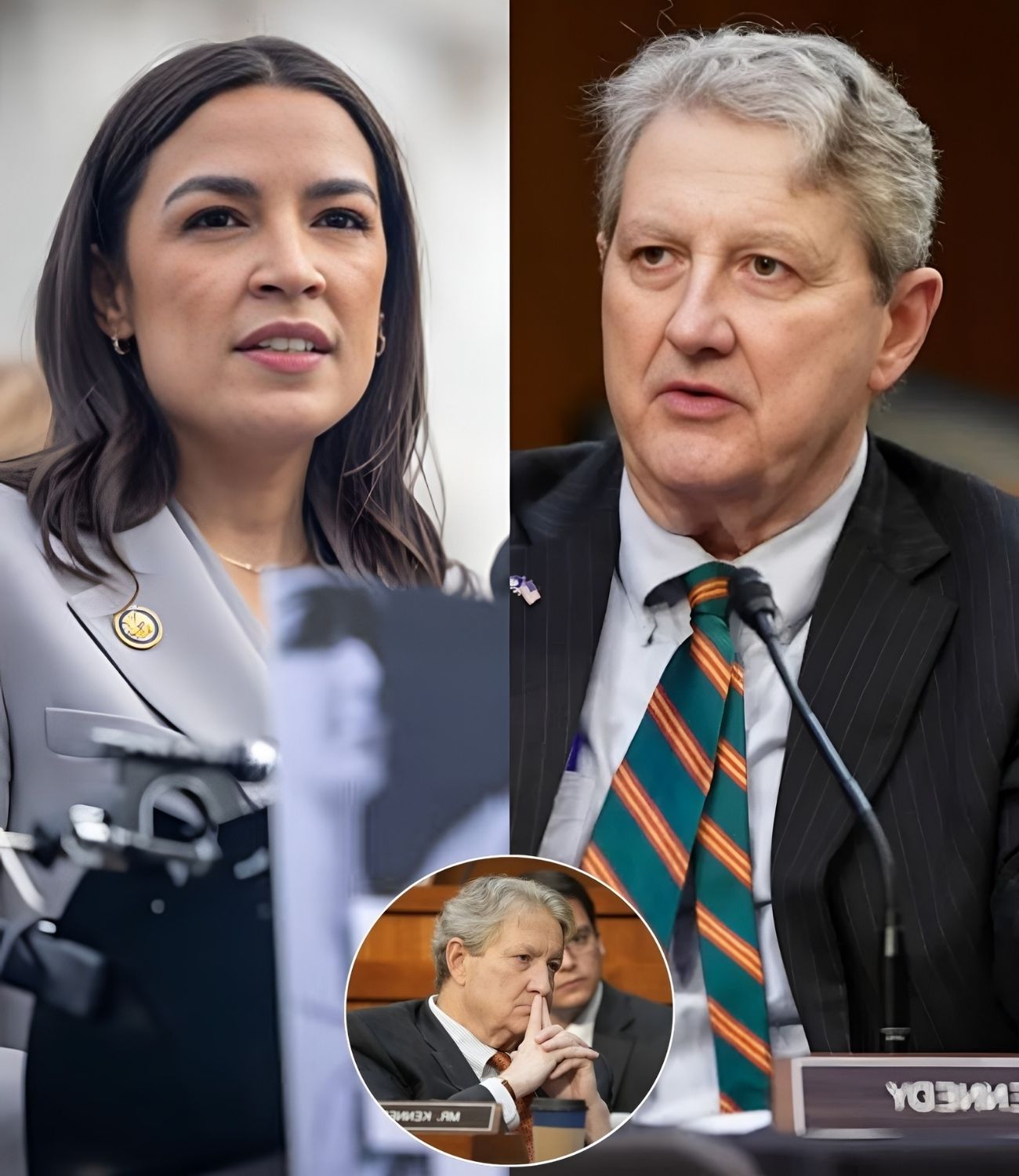
“SAY ONE MORE DUMB WORD, OLD BOY, AND I’LL EMBARRASS YOU ON NATIONAL TV”
The sentence didn’t explode. It didn’t need to. It landed—clean, sharp, and final—like a blade placed gently on a table so everyone could see exactly where things were headed.
The studio lights hummed overhead, indifferent to the sudden tension that rippled through the room. Five cameras were trained on the panel, red tally lights glowing like watchful eyes. Millions of viewers sat on couches, scrolled on phones, half-listening—until that line cut through the noise.
“Say one more dumb word, old boy, and I’ll embarrass you on national TV.”
There it was. Not shouted. Not snarled. Delivered with a calm that made it worse.
For a fraction of a second, time stalled.
The man on the other side of the desk—gray-haired, confident to the point of arrogance—froze mid-smirk. He had come into the segment loose and cocky, tossing jabs the way he always did, assuming the rules of polite television would protect him. They always had before. He mistook restraint for weakness. He mistook silence for surrender.
That was his first mistake.
Around them, the panel shifted. One host leaned back slightly, eyes widening. Another glanced down at her notes, suddenly fascinated by the paper. The moderator’s hand hovered near his cue cards, instinctively preparing for damage control that might already be too late.
The audience could feel it—that invisible click when a line is crossed and the conversation is no longer safe.
The old boy cleared his throat. He tried to laugh it off. A soft chuckle, the universal retreat of someone who realizes too late that the room has turned on him.
“Oh, come now,” he said, waving a hand. “Let’s keep this civil.”
Civil.
The word hung in the air like an insult.
The response came instantly.
“I have been civil,” she said, voice steady. “You’ve mistaken that for permission.”
Now the cameras loved her. They always do in moments like this. Producers know it too. Somewhere behind the glass, someone mouthed don’t cut away.
This wasn’t chaos. This was control.
She leaned forward—not aggressively, not theatrically—just enough to change the geometry of the table. Power doesn’t always announce itself. Sometimes it just takes up space.
“You’ve spent the last ten minutes talking over me,” she continued. “You misquoted facts, mocked the premise, and leaned on tired insults because you assumed I wouldn’t call you on it. That ends now.”
The old boy opened his mouth.
Bad idea.
“Ah,” she said softly, lifting a finger. “That’s the dumb word I warned you about.”
There was no yelling. No name-calling. What followed was far worse.
She dismantled him piece by piece.
Dates. Quotes. Archived clips. Statements he’d made years ago and hoped everyone forgot. Contradictions stacked neatly, one on top of another, until the structure of his argument collapsed under its own weight. Every sentence was measured. Every pause intentional. This wasn’t a rant—it was a lesson.
The audience at home felt it shift from entertainment to something closer to awe.
He tried to interrupt again. The moderator attempted to step in. She didn’t raise her voice. She didn’t need to.
“I’m not finished,” she said, eyes locked on him. “You’ve had decades of uninterrupted airtime. You can give me thirty seconds.”
Thirty seconds stretched into an eternity.
By the time she was done, the old boy looked smaller—not physically, but conceptually. The confidence that had carried him into the studio had evaporated, replaced by a tight jaw and eyes darting toward the exit lights.
Silence followed. The dangerous kind. The kind producers hate and viewers love.
Finally, the moderator cleared his throat. “Well,” he said, forcing a smile, “that was… spirited.”
Spirited.
Social media detonated before the segment even ended. Clips spread faster than the control room could blink. Captions wrote themselves. The quote—Say one more dumb word, old boy—was already being printed on mugs somewhere.
But the real impact wasn’t the viral moment. It was the message beneath it.
This wasn’t about age. Or ego. Or even the argument itself.
It was about a shift.
For years, the old boy had thrived on the assumption that he could provoke without consequence, that sharp elbows were part of the game but accountability was optional. Tonight, he learned otherwise—live, unedited, and in high definition.
After the cameras cut, staffers exhaled. Some smiled. Some shook their heads. One producer muttered, “That’s going to be a long night.”
She stood, adjusted her jacket, and walked off set without looking back.
No victory lap. No gloating.
Just composure.
Because the most devastating embarrassment isn’t humiliation—it’s exposure. And on national TV, with nowhere to hide, the old boy had finally been seen for exactly what he was.
All because he said one dumb word too many.