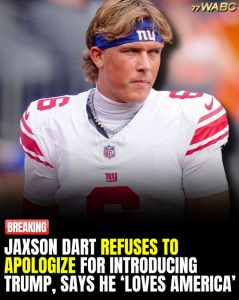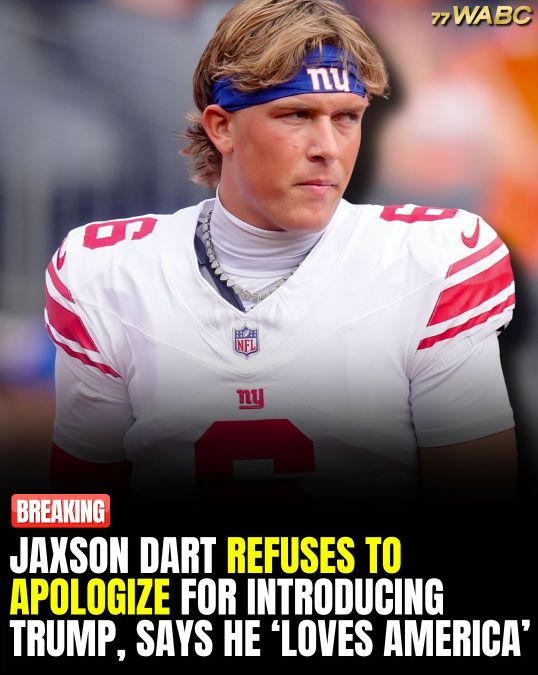
**Jaxson Dart Says He Will Respect the President No Matter Their Political Affiliation**
In the high-pressure world of the NFL, where every word and action is scrutinized under the bright lights of New York media, New York Giants quarterback Jaxson Dart found himself at the center of a political firestorm. The 23-year-old signal-caller, drafted 25th overall in 2025 out of Ole Miss, had introduced President Donald Trump at a recent rally for Rep. Mike Lawler. The move drew sharp backlash from some teammates and fans in a deeply divided locker room and city. But Dart stood firm in his post-rally remarks, delivering a message that cut through the noise: he would respect the President no matter their political affiliation.
“I’ve always respected the office of the presidency,” Dart said during his media availability. “Regardless of political affiliation, regardless of political party. The president position has always been a position that I’ve well respected.” His words, delivered with the calm poise of a young man raised in Kaysville, Utah, with deep family ties to the military, resonated with some while frustrating others who saw it as deflection. For Dart, it wasn’t about endorsing policies—it was about honoring the institution.
Jaxson Dart’s journey to this moment began far from the political spotlight. Born on May 13, 2003, the 6-foot-2, 223-pound quarterback starred at Corner Canyon High School in Utah, earning national honors before heading to USC and then thriving at Ole Miss under Lane Kiffin. His arm talent, mobility, and leadership made him a first-round pick for the Giants, where he quickly earned the starting job in 2025, throwing for over 2,200 yards, 15 touchdowns, and showing flashes of elite play.
Off the field, Dart has cultivated an image as a level-headed competitor. Raised in a household that emphasized service—his family has Air Force connections—respect for American institutions runs deep. That background shaped his decision to introduce the President. “It was a unique opportunity,” he explained. “I love this country, and I’ve been somebody who has always respected the different perspectives people may have.”
The rally appearance wasn’t without consequences. Teammate Abdul Carter, an edge rusher known for his intensity, pushed back publicly, stating that some issues outweigh football and that he would oppose such alignments. The Giants’ locker room, a melting pot of backgrounds from across the nation, suddenly felt the weight of national divisions. Veterans like Jameis Winston called for unity, urging the team to focus on “love over hate.” Behind closed doors, the team held meetings. Hugs were exchanged. Football, as it often does, forced perspective.
Yet the external pressure mounted. Media outlets dissected every angle. Social media erupted with praise from conservatives who saw Dart as refreshingly non-partisan in his institutional respect, and criticism from liberals who viewed the appearance as tacit endorsement. Trump himself thanked Dart online, noting a surge in his jersey sales to No. 1. An invitation to the White House followed.
Through it all, Dart refused to retreat into silence. In his statements, he repeatedly circled back to the same core principle: respect for the office transcends party lines. “I lay my body on the line for my guys each and every week,” he said. “Being on the Giants offers me a cool opportunity to be in a locker room where it’s a melting pot of people from everywhere.”
—
This stance reflects a broader philosophy that many athletes have tried to navigate in the modern era. Sports and politics have collided more frequently since the 2010s—Colin Kaepernick’s protests, players speaking on social justice, endorsements, and boycotts. Dart’s approach stands out for its simplicity: treat the presidency with dignity regardless of who holds it. It echoes a more traditional view of civic respect, one his military-influenced upbringing reinforced.
Critics argued it was naive or evasive. In a polarized time, introducing a sitting president at a rally inevitably carries weight. Some teammates worried it could fracture team chemistry heading into crucial games. Others appreciated the honesty. One anonymous veteran told reporters the locker room discussion ultimately strengthened bonds by forcing open conversations about beliefs.
Dart’s own performance on the field provides context. In his young career, he has shown remarkable composure under pressure. Whether escaping the pocket on designed runs or delivering accurate passes in critical moments, he carries himself with maturity beyond his years. That same steadiness defined his handling of the controversy. He didn’t dodge questions. He didn’t attack critics. He simply reiterated his values.
For young athletes like Dart, the microscope is unrelenting. At 23, he is still building his legacy. One misstep in wording could alienate fans, sponsors, or teammates. Yet he chose principle over convenience. “My intentions were just that,” he emphasized—honoring the opportunity while maintaining respect across divides.
—
Looking ahead, this episode may define part of Dart’s public persona. In New York, a city with strong opinions on all sides, the quarterback must balance leadership with authenticity. Giants fans are passionate; they want wins first, but many also project their values onto players. Dart’s jersey flying off shelves suggests his stance resonated with a significant portion of the fanbase eager for athletes who prioritize unity and institutional respect.
His family’s influence looms large. Growing up in Utah with stories of service instilled a sense of duty. Military families often emphasize that while policies change, the symbols of the nation—the flag, the office of president, the Constitution—deserve reverence. Dart has carried that forward without apology.
Teammates have largely moved on. Football demands focus. Practices resumed. Playbooks were studied. The melting pot locker room, as Dart described it, returned to its primary mission: winning games. But the conversation he sparked lingers. In an era where many athletes align strongly with one side, his measured respect for the office offers a different model—one rooted in civility amid disagreement.
As the 2026 season approaches, Dart will face defenses designed to confuse him. Off the field, he’ll navigate continued questions about politics. His response will likely remain consistent: respect the individual in the role while competing fiercely for his team. He has expressed love for the country that gave him this platform. That love, he believes, includes honoring its highest elected office even when occupants differ from personal views.
In interviews, Dart has avoided deep policy dives. He focuses on shared ground—hard work, sacrifice, unity in diversity. It’s a message that feels increasingly rare but resonates with those tired of endless division. Whether it shields him from future controversies remains to be seen. For now, it positions him as a quarterback unafraid to lead with conviction on more than just the field.
The Giants organization backed him quietly, emphasizing player autonomy while stressing team goals. Coach Brian Daboll and GM have steered conversations back to football, but they recognize their young QB’s growing voice carries influence.
—
Ultimately, Jaxson Dart’s declaration—“I will respect the President no matter their political affiliation”—is more than damage control. It’s a window into his character. In a fractured America, where sports often serve as both unifier and battleground, Dart chose the unifier’s path. He introduced the President not as a partisan act, he insists, but as an American honoring the office.
As he drops back in the pocket this season, fans will watch more than his arm. They’ll watch how he leads men from every background. His early words suggest a quarterback who understands that true leadership sometimes means standing for respect when it’s unpopular. Whether that sustains him through the inevitable pressures of New York remains the next test in his promising career.
The country, like his offensive line, will keep watching. And Dart, true to his upbringing and words, will keep respecting the highest office—red, blue, or otherwise—while chasing victories on Sundays.