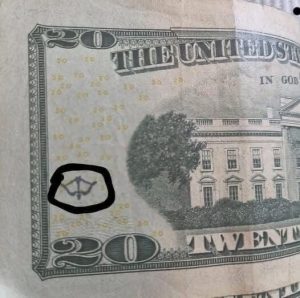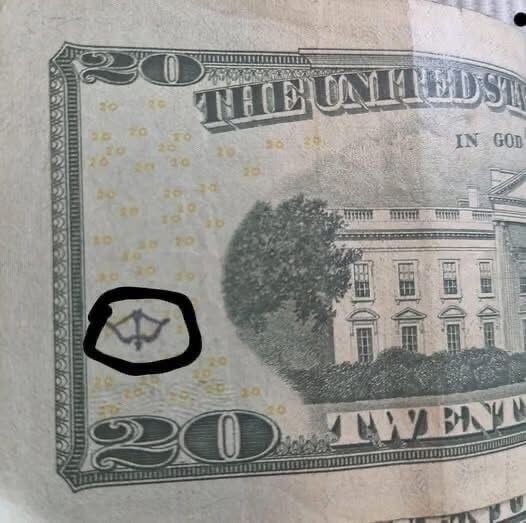
If you’ve ever pulled a $20 bill from your wallet and noticed what looks like a bow-and-arrow–style symbol, you’re not alone—and you’re not imagining things. Thousands of people every year pause over that same detail, wondering whether they’ve stumbled onto a secret code, a rare misprint, or a hidden political message.
The truth is less conspiratorial—but far more interesting.
What you’re seeing is part of the intentional, layered design language of U.S. currency, created to fight counterfeiting and preserve continuity across generations of banknotes. To understand it, you have to look at how American money is actually made—and why nothing on it is accidental.
First: Is It Really a “Bow and Arrow”?
The short answer: no, not literally.
The longer answer: it resembles one because your brain is excellent at finding patterns—even where none were consciously intended.
On modern $20 bills, especially those redesigned since the early 2000s, there are ornamental scrolls, fine line engravings, and symbolic shapes embedded into the artwork. Some of these curved lines intersect in a way that can look like a bow with an arrow pulled taut—particularly near Andrew Jackson’s portrait, the background security elements, or the decorative borders.
But there is no officially recognized bow-and-arrow symbol on U.S. currency.
So why does it look like one?
The Real Source: Anti-Counterfeiting Design
U.S. paper currency is designed and printed by the Bureau of Engraving and Printing (BEP), working in coordination with the Federal Reserve and the U.S. Treasury.
Their number-one concern isn’t aesthetics.
It’s security.
To stop counterfeiters, designers use:
-
Micro-engraving
-
Interlaced line work
-
Guilloché patterns (repeating geometric curves)
-
Asymmetric ornamental shapes
-
Intentional visual complexity
These designs are meant to be:
-
Extremely difficult to reproduce
-
Easy for machines and trained eyes to authenticate
-
Hard for casual observers to fully “parse”
When curved lines overlap, taper, and converge at sharp points, the human brain often interprets them as tools or weapons—bows, arrows, spears, anchors—because those are familiar shapes with tension and direction.
That doesn’t mean they were designed to represent those objects.
It means your perception is doing what it does best: pattern recognition.
Why the Brain Sees Weapons and Symbols
Psychologists call this phenomenon pareidolia—the tendency to see meaningful images in random or abstract patterns. It’s why people see:
-
Faces in clouds
-
Animals in rock formations
-
Hidden messages in currency
Money is especially prone to this effect because:
-
We examine it closely
-
We associate it with power and authority
-
We expect symbolism to be intentional
So when you notice a sharp triangular point intersecting a curved line, your mind jumps to: arrow.
Once you see it, you can’t unsee it.
Is It Native American Symbolism?
This is a very common follow-up question.
The answer: no.
Although Andrew Jackson is associated with America’s frontier period—and controversially with Native American removal—the modern $20 bill’s background artwork does not include Native American iconography like bows, arrows, or tribal symbols.
Including such imagery would require explicit acknowledgment in official Treasury documentation, and no such explanation exists.
What does exist is 19th-century engraving tradition, which heavily favored:
-
Curled ribbons
-
Laurel-like arcs
-
Sharp terminals
-
Classical European design language
These artistic conventions predate modern symbolism debates and were chosen for visual density, not cultural messaging.
Why the $20 Bill Gets Extra Attention
People report seeing strange symbols more often on $20 bills than on other denominations—and that’s not a coincidence.
The $20 bill:
-
Is one of the most commonly circulated notes
-
Was redesigned multiple times (1998, 2003, 2013)
-
Contains more color, shading, and layered security features than older bills
Each redesign added:
-
Subtle background patterns
-
Color-shifting ink
-
Security threads
-
Watermarks
-
Fine line structures
More layers = more visual intersections = more chances for your brain to “find” symbols.
Is It a Printing Error?
Almost always: no.
True printing errors—like missing ink, double prints, or misaligned plates—are rare and obvious. A consistent “symbol” that appears on many $20 bills is by definition not an error.
Collectors look for:
-
Off-center prints
-
Inverted backs
-
Blank sections
A bow-like shape that appears consistently is part of the master plate design.
Is There a Hidden Message?
There is no evidence—historical, documentary, or official—that the U.S. government hides secret symbols on currency meant to convey covert messages.
What is true is that currency designers intentionally use:
-
Complexity to defeat scanners
-
Organic shapes to confuse reproduction
-
Visual noise to frustrate counterfeiters
Any “hidden symbol” would undermine those goals by creating a fixed, identifiable marker.
Why People Care So Much About Currency Symbols
Money is one of the few objects:
-
Everyone handles
-
Few people understand
-
That represents authority, value, and trust
Throughout history, people have searched coins and notes for:
-
Religious meaning
-
Political signals
-
Warnings
-
Hidden power structures
That instinct hasn’t disappeared—it’s just moved to modern bills.
When you notice something unusual, you’re participating in a very old human habit: interrogating the symbols of power.
The Bottom Line
Your $20 bill does not contain a secret bow and arrow.
What it does contain is:
-
Extremely dense security artwork
-
Curved and pointed engraving elements
-
Patterns designed to confuse counterfeiters—not communicate symbols
Your brain connects the dots into a familiar image because that’s what human brains do best.
So if you spotted it and wondered—you’re not strange, paranoid, or alone.
You’re observant.
And next time you look at your money, you may notice something else no one ever pointed out to you before.
That’s not a hidden message.
That’s just how carefully—and cleverly—it was designed.