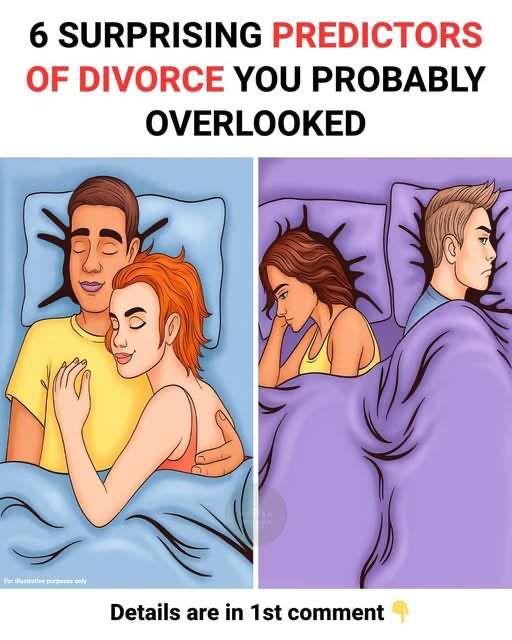
Most people think they know what causes divorce. Infidelity. Money fights. Constant arguing. Growing apart.
Those factors matter—but research and real-world patterns show that many divorces are preceded by quieter, less obvious warning signs that couples routinely overlook. These predictors don’t look dramatic. They don’t feel urgent. And that’s exactly why they’re dangerous.
Here are some of the most surprising predictors of divorce—and why they’re so often missed.
1. Contempt (Not Conflict) Is the Biggest Red Flag
It’s not how much couples fight—it’s how they fight.
Disagreements are normal. Even frequent ones don’t necessarily predict divorce. What does is contempt: sarcasm, eye-rolling, mockery, dismissive tones, or treating a partner as intellectually or morally inferior.
Contempt communicates one core message: “I don’t respect you.”
Once respect erodes, repair becomes extremely difficult. Love can survive anger. It rarely survives humiliation.
Why it’s overlooked:
Contempt often masquerades as humor or “just being honest,” especially in long-term relationships where boundaries slowly loosen.
2. Emotional Withdrawal Is More Dangerous Than Anger
Many people assume yelling is worse than silence. In reality, emotional disengagement is often the final stage before divorce.
When one partner stops:
- Complaining
- Initiating conversations
- Expressing needs
- Reacting emotionally
…it often means they’ve already given up internally.
Anger signals hope for change. Withdrawal signals resignation.
Why it’s overlooked:
Calm can look like peace. Silence can look like maturity. But indifference is not stability—it’s emotional exit.
3. Unequal Mental Load (Not Just Chores)
It’s not just about who does the dishes. It’s about who carries the invisible labor:
- Remembering appointments
- Tracking finances
- Planning meals
- Managing kids’ schedules
- Anticipating problems before they arise
When one partner consistently carries the mental load, resentment builds—even if chores appear evenly split.
Why it’s overlooked:
The mental load is invisible by nature. Couples argue about tasks while ignoring the cognitive burden underneath.
4. Lack of Small Affection (Not Lack of Sex)
Sex frequency matters less than everyday physical and emotional connection.
Predictive signs include:
- Rare hugs
- No casual touch
- Minimal eye contact
- No affectionate check-ins
Affection is the glue that maintains safety. When it disappears, partners begin to feel like roommates—or strangers.
Why it’s overlooked:
Couples often blame stress, kids, or schedules without realizing affection is the buffer against those pressures.
5. Feeling Unseen (Even If You’re “Supported”)
A partner can be supportive in practical ways and still emotionally miss you entirely.
Divorce risk increases when one or both partners feel:
- Their inner world doesn’t matter
- Their feelings are minimized
- Their growth is ignored
- They are known only for their role
People don’t leave because they aren’t helped. They leave because they aren’t recognized.
Why it’s overlooked:
Support is measurable. Feeling seen is not—and couples often confuse the two.
6. Different Conflict Styles That Never Adapt
Some people process by talking. Others process by withdrawing. Neither is wrong—but rigid incompatibility becomes toxic when couples don’t adapt.
Common destructive pairings:
- Pursuer vs. Avoider
- Analyzer vs. Emotional Reactor
- Fixer vs. Vent-er
If partners never learn to bridge these styles, every disagreement becomes a replay of the same unresolved dynamic.
Why it’s overlooked:
Early in relationships, differences feel manageable. Over time, repetition turns irritation into despair.
7. Scorekeeping Instead of Team Thinking
When couples mentally track:
- Who gives more
- Who sacrifices more
- Who “owes” whom
…the relationship becomes transactional.
Marriage can’t survive when partners stop asking “How do we win together?” and start asking “Who’s winning right now?”
Why it’s overlooked:
Scorekeeping often feels justified—especially when one partner genuinely feels overextended.
8. Avoiding Hard Conversations for Too Long
Couples often pride themselves on being “low drama.” But conflict avoidance is not the same as harmony.
Unspoken issues don’t disappear—they compound.
Avoidance predicts divorce when:
- Problems are delayed indefinitely
- Resentment accumulates quietly
- One partner feels unsafe bringing things up
Eventually, the emotional debt comes due—often all at once.
Why it’s overlooked:
Peace feels good in the moment. The cost isn’t immediate.
9. Different Growth Speeds (Not Different Values)
People change. Healthy marriages grow together—or consciously realign.
Divorce risk rises when:
- One partner evolves emotionally or intellectually
- The other remains static or resists change
- Growth becomes threatening instead of shared
It’s not about drifting apart. It’s about failing to renegotiate the relationship as both people evolve.
Why it’s overlooked:
Early compatibility masks future divergence. Couples assume alignment is permanent.
10. Chronic Loneliness Inside the Relationship
One of the strongest predictors of divorce is feeling alone while married.
This includes:
- Feeling unsupported emotionally
- Feeling misunderstood
- Feeling like your partner is “elsewhere”
- Feeling safer confiding in others
Loneliness inside a relationship hurts more than loneliness outside one.
Why it’s overlooked:
From the outside, the marriage may look functional—even successful.
The Quiet Truth About Divorce Predictors
Divorce rarely begins with a crisis.
It begins with patterns.
Small dismissals. Unchecked assumptions. Unspoken needs. Emotional erosion that feels tolerable—until it isn’t.
Most couples don’t fail because they didn’t love each other.
They fail because they stopped attending to the relationship.
The Bottom Line
The most dangerous predictors of divorce are not explosive—they’re subtle.
They hide in routines.
They wear the mask of normalcy.
They feel survivable—until they accumulate.
The good news? Awareness changes outcomes.
Many of these predictors are reversible when recognized early. But they require honesty, curiosity, and the willingness to confront discomfort before it hardens into distance.
Divorce is often less about one big mistake—and more about many small moments that went unaddressed.
And those moments are easier to change than most people think.