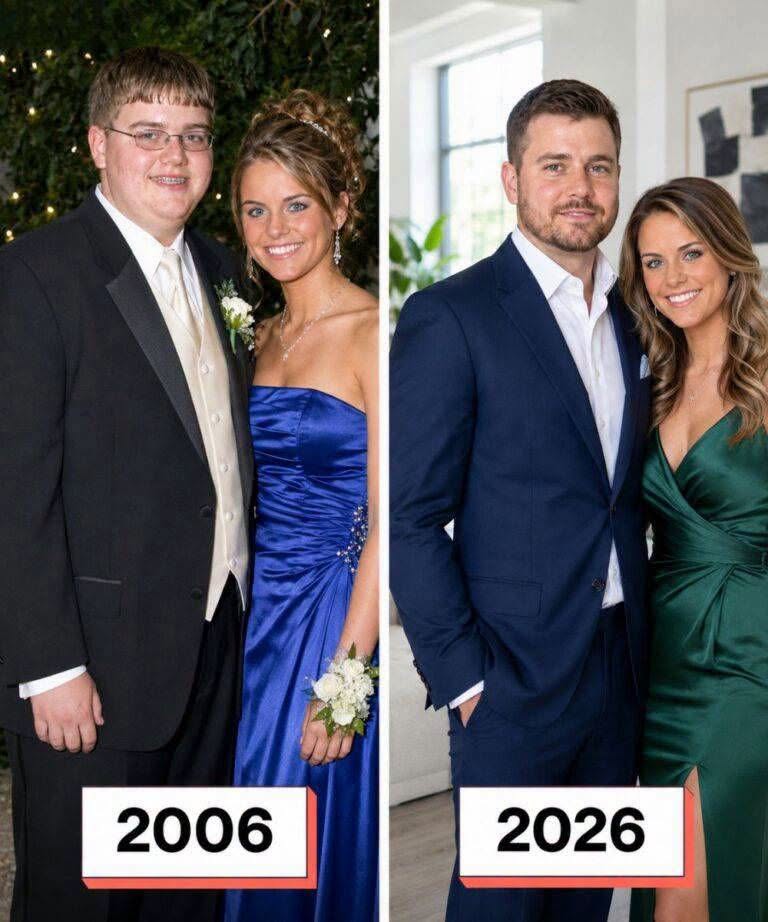
“The Most Beautiful Girl in School Asked Me to Prom While Everyone Else Laughed at My Weight. Twenty Years Later, She Didn’t Recognize Me—and I Used That Moment to Do Something She Never Expected.”
High school can be an unforgettable chapter in a person’s life. For some, it is filled with friendships, victories, and cherished memories. For others, it becomes a time marked by loneliness, insecurity, and painful experiences that linger for years. This is a fictional story about resilience, kindness, and discovering that the greatest form of success isn’t revenge—it’s growth.
At sixteen, I was known as “the big kid.”
Not by teachers. Not by my parents. But by almost everyone else.
I weighed over 300 pounds, struggled to keep up in gym class, and dreaded walking through crowded hallways because I knew what was coming.
The whispers.
The laughter.
The jokes that people thought I couldn’t hear.
Every lunch period felt like an endurance test. Sometimes students would imitate the way I walked. Other times they’d move their backpacks off the bench dramatically as if I might break it by sitting down.
I laughed along whenever I could.
It was easier than admitting how much it hurt.
One Friday afternoon, only a month before prom, I was cleaning out my locker when someone tapped me on the shoulder.
I turned around.
Standing there was Emily.
She was the most admired girl in school.
She wasn’t just beautiful—she was captain of the debate team, volunteered at the animal shelter, earned excellent grades, and somehow treated everyone with genuine respect.
I assumed she needed directions or had mistaken me for someone else.
Instead, she smiled.
“Would you go to prom with me?”
I stared at her.
Surely this was a prank.
Several students had gathered nearby.
I could already hear muffled laughter.
My face burned with embarrassment.
“Very funny,” I muttered.
She frowned.
“I’m serious.”
The hallway became strangely quiet.
“I’d really like to go with you.”
I looked around.
Some students rolled their eyes.
Others looked confused.
One whispered, “Why him?”
Emily ignored every comment.
She waited patiently.
Finally, I nodded.
“I’d love to.”
That night became one of the happiest evenings of my teenage years.
She treated me like everyone deserves to be treated—with dignity.
We danced.
We laughed.
We took awkward photos.
For a few hours, I forgot what it felt like to be the target of every joke.
When people whispered behind our backs, she simply smiled and kept talking to me as though no one else existed.
Years later, I would realize she had given me something far more valuable than a date.
She had restored a piece of my confidence.
After graduation, life pulled us in different directions.
I rarely saw anyone from high school again.
The years weren’t easy.
I struggled with my health.
Climbing stairs left me breathless.
My doctor warned me that if I didn’t make serious changes, I could face life-threatening complications before I turned forty.
That conversation changed everything.
I didn’t transform overnight.
There were setbacks.
Weeks when I wanted to quit.
Months when the scale barely moved.
But I kept going.
One healthier meal became two.
A ten-minute walk became thirty.
Thirty became an hour.
I learned about nutrition instead of chasing miracle diets.
I focused on consistency rather than perfection.
Five years later, I had lost more than 150 pounds.
Even more importantly, I had gained confidence, discipline, and a healthier relationship with myself.
I eventually started a small fitness coaching business focused on helping beginners who felt intimidated by traditional gyms.
Many of my clients had experienced bullying similar to mine.
I understood their fears because I had lived them.
Twenty years passed.
One autumn afternoon, I attended a charity fundraiser hosted by a local hospital.
As guests mingled around the reception hall, someone approached me.
“Excuse me,” a woman said.
“You look familiar.”
I turned around.
It was Emily.
Time had changed us both.
She looked thoughtful, confident, and warm—just as I remembered.
She studied my face for several seconds.
“I’m sorry,” she laughed.
“Have we met?”
For a brief moment, dozens of memories rushed back.
The cafeteria.
The locker hallway.
The laughter.
The prom.
She genuinely didn’t recognize me.
I smiled.
“We went to high school together.”
She tilted her head.
“I’m embarrassed.”
“I still can’t place you.”
“I was your prom date.”
Her eyes widened.
“No…”
She covered her mouth.
“Oh my goodness.”
Her expression shifted from confusion to complete disbelief.
“You’re…”
She finally said my name.
I nodded.
She laughed so hard that nearby guests turned to look.
“I cannot believe this!”
“You’ve completely changed!”
We spent nearly an hour catching up.
She told me about her career.
I shared my journey.
Eventually she became quiet.
“You know,” she said softly, “people gave me a hard time for asking you to prom.”
“I know.”
“They said I was making a mistake.”
“I remember.”
She smiled.
“I never cared.”
Then she asked something unexpected.
“Can I tell you why I invited you?”
I nodded.
She took a deep breath.
“Everyone noticed your weight.”
“I noticed something else.”
“What?”
“You were always kind.”
“You helped teachers carry supplies.”
“You tutored students who were struggling.”
“You thanked cafeteria workers.”
“You smiled at people who ignored you.”
“I thought…”
She paused.
“…if more people looked beyond appearances, they’d see what I saw.”
For a moment, neither of us spoke.
Finally I smiled.
“I’ve spent twenty years wondering why.”
She laughed.
“Now you know.”
As the evening ended, she asked if I’d be willing to speak at a youth leadership event she organized each year.
The audience included teenagers dealing with bullying, self-esteem, and mental health challenges.
I accepted immediately.
A month later, I stood before hundreds of students.
I shared my story.
Not about losing weight.
Not about business success.
Not about changing my appearance.
I spoke about kindness.
About resilience.
About refusing to let other people’s opinions define your worth.
Then I pointed toward Emily in the front row.
“Twenty years ago,” I told the audience, “one person chose kindness when everyone else chose laughter.”
“She probably forgot how much that mattered.”
“But I never did.”
The room fell silent.
Many students wiped away tears.
After the presentation ended, dozens stayed behind to share their own stories.
Some had been bullied.
Others admitted they had bullied classmates and regretted it.
Teachers thanked us for starting conversations that rarely happened openly.
As everyone left, Emily smiled.
“So…”
“I guess you surprised me today.”
I laughed.
“I thought I was the one surprising you.”
She shook her head.
“No.”
“The surprise wasn’t that you changed.”
“It was seeing that you never let bitterness define you.”
Driving home that evening, I realized something important.
For years, I had imagined meeting the people who laughed at me.
I pictured proving them wrong.
Showing them how successful I’d become.
Making them regret the way they treated me.
But when the moment finally arrived with the one person who had shown me kindness, I understood something far more meaningful.
The greatest victory isn’t making people jealous.
It isn’t seeking revenge.
It isn’t hearing, “Look how much you’ve changed.”
The greatest victory is becoming someone who carries forward the kindness they once received.
Because appearances fade.
Popularity fades.
Youth fades.
But compassion has a way of changing lives long after high school is over—and sometimes, twenty years later, it becomes the memory that matters most.