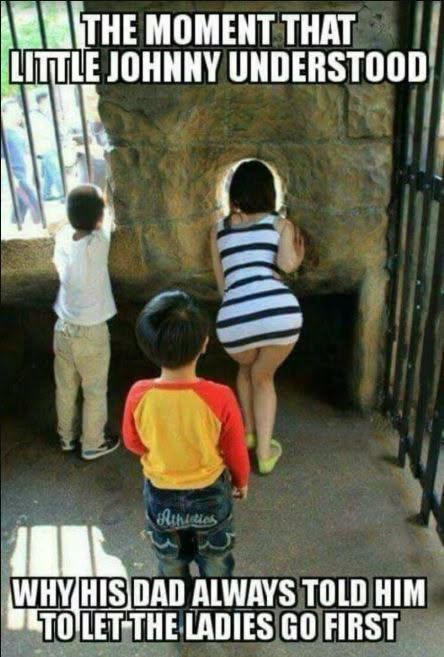
The Moment Little Johnny Understood Why His Dad Always Told Him to Let the Ladies Go First
Little Johnny had heard the same advice from his father for as long as he could remember.
“Always let the ladies go first,” his dad would say whenever they approached a doorway, a line at the grocery store, or the entrance to a restaurant. “It’s a simple way to show respect.”
Johnny didn’t always understand why. To him, it seemed like a small rule that adults followed for no particular reason. Sometimes he even wondered if it was just one of those traditions that people repeated without thinking about it.
One sunny Saturday morning, Johnny and his father headed downtown to run a few errands. They planned to stop by the library, pick up groceries, and visit Johnny’s grandmother before returning home. It seemed like an ordinary day, but it would soon become one Johnny would never forget.
Their first stop was the local bakery. As they reached the entrance, another customer—a woman carrying several shopping bags—approached the door at the same time.
Johnny instinctively reached for the handle.
His father smiled.
“Remember what I always tell you?”
Johnny nodded and stepped aside, holding the door open.
The woman smiled warmly.
“Thank you, young man. That’s very kind.”
Johnny smiled back, feeling surprisingly proud.
As they continued through town, similar moments happened again and again. At the bookstore, Johnny waited while an elderly woman with a cane slowly entered ahead of him. At the grocery store, he stepped aside so a mother pushing a stroller could easily pass through the automatic doors.
Each time, someone thanked him.
Each time, his father quietly smiled.
Finally, Johnny couldn’t contain his curiosity any longer.
“Dad,” he asked, “is letting ladies go first just about being polite?”
His father thought for a moment before answering.
“It’s about respect,” he said. “Not because women are less capable, but because kindness makes the world a little easier for everyone. And sometimes the person you’re helping may be carrying more than you realize.”
Johnny wasn’t entirely sure what he meant.
A few minutes later, they arrived at a busy intersection. As the traffic light changed, several pedestrians prepared to cross.
Among them was an elderly woman carrying two heavy grocery bags.
Johnny noticed she was struggling.
Without waiting to be asked, he hurried over.
“May I help you carry those?”
She looked surprised.
“That would be wonderful.”
Together they crossed the street.
When they reached the other side, she smiled with grateful eyes.
“You remind me of my grandson,” she said.
Johnny felt his cheeks turn red.
“It wasn’t much.”
“Oh,” she replied gently, “sometimes the smallest kindness means the most.”
As they walked away, Johnny looked up at his father.
“I think I’m starting to understand.”
His father nodded.
“Good manners aren’t about following old rules. They’re about noticing other people.”
That afternoon, they visited Johnny’s grandmother.
As always, she greeted them with warm hugs and fresh cookies.
Johnny eagerly told her about helping the elderly woman.
His grandmother listened carefully before saying, “Kindness has a funny way of spreading. When someone receives kindness, they’re often inspired to pass it on.”
Later that evening, something unexpected happened.
Johnny accidentally dropped several books while leaving the library.
Before he could bend down, two strangers quickly stopped to help gather them.
“Here you go,” one said with a smile.
Johnny thanked them.
Walking home, he realized something.
Earlier that day he had helped someone.
Now complete strangers had helped him.
Maybe kindness really did travel from person to person.
Over the following weeks, Johnny began paying closer attention to the people around him.
He noticed classmates carrying heavy backpacks.
He held doors for teachers, parents, and neighbors—not just women, but anyone whose hands were full or who could use a little assistance.
He offered his seat on the bus to older passengers.
He waited patiently instead of rushing ahead.
None of these actions took very long.
Yet each one seemed to make someone’s day just a little brighter.
One evening, his father asked, “Do you know why I kept reminding you all those years?”
Johnny smiled.
“Because opening a door isn’t really about the door.”
His father laughed.
“Exactly.”
“It’s about showing people they matter.”
His dad placed a hand on Johnny’s shoulder.
“You’ve learned the lesson.”
Years later, long after Johnny had grown into an adult, he still remembered that Saturday.
Not because he had held a door open.
Not because someone had thanked him.
But because he had discovered something much bigger.
Respect isn’t measured by grand speeches or expensive gifts.
It lives in everyday choices—offering a helping hand, showing patience, listening carefully, and treating others with dignity.
Whether it’s letting someone go first, carrying a heavy bag, or simply sharing a smile, these small gestures remind people that they are seen and appreciated.
And perhaps that was the lesson his father had hoped Johnny would understand all along.
Sometimes the smallest acts of courtesy open doors far greater than the ones standing in front of us.