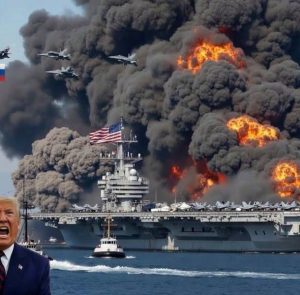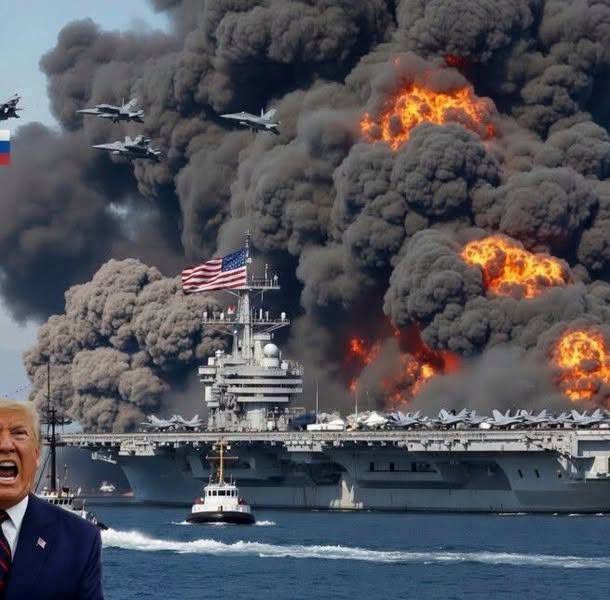
Russian Su-57 Pilot “Destroys” U.S. Aircraft Carrier Carrying 700 Tanks? What We Actually Know
A dramatic headline claiming that a Russian Su-57 pilot destroyed a U.S. aircraft carrier allegedly carrying 700 tanks has spread rapidly across social media, generating thousands of reactions and raising questions about a possible confrontation between two of the world’s most powerful militaries.
The headline is striking.
It sounds like the opening scene of a major military conflict: a Russian fifth-generation fighter suddenly appearing over the ocean, penetrating the defenses of a heavily protected American naval vessel, and delivering a devastating attack that destroys the ship and its enormous cargo.
But there is a major problem.
There is currently no credible independent confirmation that such an attack actually happened.
The claim appears in multiple social-media posts, including Facebook posts carrying virtually identical wording. A website that published the story also acknowledged that the reports were unconfirmed and that no official confirmation had been released.
That distinction is extremely important.
Why the Story Is So Dramatic
The Su-57 is Russia’s most advanced operational fighter aircraft and is generally described as a fifth-generation multirole combat aircraft.
It was designed with stealth characteristics, advanced sensors, high maneuverability and the ability to conduct both air-to-air and air-to-surface missions.
That makes the aircraft a natural subject for sensational military stories.
A headline involving a Su-57 attacking a U.S. carrier immediately creates an image of a high-technology confrontation between Washington and Moscow.
But advanced aircraft do not operate in isolation.
A U.S. aircraft carrier normally operates as part of a carrier strike group, supported by other warships, aircraft, radar systems and defensive weapons. Any attempt to attack such a formation would represent an extraordinarily complex military operation.
That is one reason extraordinary claims require extraordinary evidence.
The “700 Tanks” Question
Another unusual part of the headline is the claim that the American carrier was transporting 700 tanks.
Aircraft carriers are not conventional tank transport ships.
Their primary purpose is to operate aircraft, helicopters and associated personnel and equipment.
The U.S. military does operate large amphibious assault ships, transport vessels and other logistical ships capable of carrying military vehicles. These vessels can transport armored vehicles, equipment and troops during major deployments.
But describing an aircraft carrier as carrying 700 tanks immediately raises questions about whether the original story is mixing different types of military vessels.
This does not prove that no military ship could be carrying tanks.
It simply means that the headline’s wording should be treated carefully.
What Has Actually Been Reported?
The claim appears to have spread through social-media accounts using urgent language such as “13 minutes ago” and presenting the alleged attack as an immediate breaking-news event.
Search results show several Facebook posts repeating essentially the same headline.
A separate article published on August 19 described the incident as an allegation and specifically stated that there had been no official confirmation at the time.
That is very different from an announcement by the U.S. Department of Defense, the Russian Ministry of Defense, NATO, or a major international news organization independently confirming the destruction of an American warship.
Until such evidence appears, the story should remain classified as unverified.
Why Verification Matters
Military misinformation can spread extraordinarily quickly.
A dramatic photograph, video clip or headline can be copied thousands of times within minutes. Once a story begins circulating, people may assume that repeated posts automatically mean the information has been confirmed.
They do not.
In fact, repetition can sometimes make an unverified claim appear more credible than it actually is.
This is particularly dangerous with stories involving the United States and Russia.
A confirmed attack by Russian forces against a U.S. Navy carrier would represent an enormous geopolitical development. It could trigger an international crisis and potentially lead to military retaliation.
Such an event would not normally remain confined to obscure social-media posts.
Major governments, defense organizations, intelligence agencies and international newsrooms would be expected to react.
The Su-57’s Real Significance
Even though the specific carrier-destruction claim is unconfirmed, the Su-57 itself is a real and important Russian military aircraft.
The aircraft represents Russia’s effort to maintain a high-end fighter capability comparable in broad technological ambition to other modern fifth-generation aircraft.
However, the Su-57 exists in relatively limited numbers compared with the huge fleets of more established fighter aircraft. Recent reporting on Russian military production indicates that only small numbers of Su-57s were delivered during 2025.
That makes every operational aircraft valuable.
A Su-57 pilot conducting a real combat mission against a major naval formation would therefore be participating in an extremely significant operation.
But that does not establish that the alleged operation occurred.
What Would a Real Carrier Attack Look Like?
An actual attack on a U.S. carrier would involve much more than one fighter simply flying toward the ship.
Modern carrier groups are designed around layered defense.
Aircraft provide air cover.
Surface warships provide radar and missile defense.
Electronic warfare systems attempt to disrupt enemy sensors and communications.
Long-range surveillance systems search for incoming threats.
The carrier itself has defensive weapons and is surrounded by escort ships specifically intended to help protect it.
Consequently, successfully striking a carrier is one of the most difficult missions imaginable.
That does not mean carriers are invulnerable.
No military platform is.
But it does mean that a claim describing a lone fighter suddenly destroying a major American carrier should immediately prompt questions about the weapon used, the location, supporting aircraft, defensive response, satellite imagery, photographs, official statements and independent verification.
Could the Situation Become Real?
The possibility of future military confrontation between major powers is a serious subject, but speculation should not be confused with news.
Russia and the United States possess enormous military capabilities, including advanced aircraft, missiles, submarines, naval forces and nuclear weapons.
A direct attack between their forces would therefore carry consequences far beyond the battlefield.
For that reason, governments generally seek to avoid uncontrolled escalation even when their forces operate in the same regions or conduct opposing missions.
A fabricated or exaggerated report can nevertheless create fear and confusion.
It can also be used as propaganda.
The Bottom Line
The headline claiming that a Russian Su-57 pilot destroyed a U.S. aircraft carrier carrying 700 tanks is highly dramatic, but the available evidence does not establish that the event actually happened.
The claim is circulating on social media, and at least one website presenting the story explicitly described it as unconfirmed.
There is currently no reliable evidence presented in the sources reviewed showing that a U.S. aircraft carrier was destroyed by a Russian Su-57.
The unusual reference to an aircraft carrier carrying 700 tanks also raises additional questions about the accuracy of the story.
For readers, the safest conclusion is simple:
Treat the headline as an unverified claim, not confirmed breaking news.
If credible evidence eventually emerges—including official military statements, independently verified imagery or reporting from multiple reputable international news organizations—the story could be reassessed.
Until then, the most responsible approach is to separate the dramatic headline from the facts.
The Su-57 is real.
U.S. aircraft carriers are real.
Russia and the United States possess formidable military capabilities.
But there is currently no credible confirmation that a Russian Su-57 destroyed an American aircraft carrier carrying 700 tanks.
In an age when sensational military headlines can travel around the world in seconds, sometimes the most important question is not “What happened?”
It is:
“How do we know?”