What Experts Base These Predictions On
When analysts talk about potential targets in a global nuclear conflict, they generally distinguish between two kinds of strategies:
-
Counter‑force strikes – aimed at military assets, nuclear command centers, and facilities that enable retaliation.
-
Counter‑value strikes – aimed at major population centers, economic hubs, or symbolic capitals to create maximum psychological and societal shock.
In a theoretical World War III scenario involving major nuclear powers, both types of targets would likely be hit. Cities near critical military infrastructure could be first on the list, while large metropolitan areas and strategic economic hubs might follow.
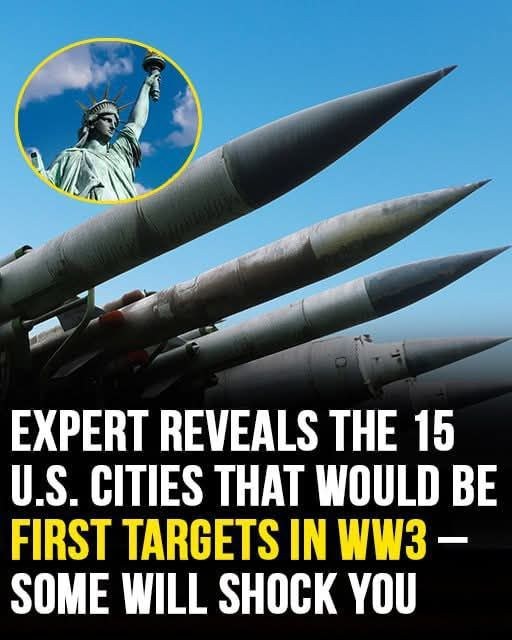
Below are 15 U.S. cities that experts say could be among the earliest targets if such an unprecedented global conflict erupted.
1. Great Falls, Montana
Though a small city, Great Falls appears on many expert lists because of its proximity to Malmstrom Air Force Base, which controls hundreds of U.S. nuclear missile silos buried throughout rural Montana. An adversary seeking to neutralize U.S. nuclear capability might target nearby infrastructure — and that could tragically extend to the town itself.
Why It’s a Target
-
Close to ICBM silos
-
Part of U.S. nuclear deterrent infrastructure
2. Cheyenne, Wyoming
Another smaller city that would suffer an outsized risk is Cheyenne, home to Francis E. Warren Air Force Base. This base plays a key role in U.S. missile defense and nuclear command systems, making the surrounding area a likely strategic objective.
Why It’s a Target
-
Nuclear missile command operations nearby
-
Strategic launch command infrastructure
3. Ogden & Clearfield, Utah
Ogden and Clearfield are two neighboring cities near Hill Air Force Base, one of the U.S. Air Force’s major maintenance and weapons hubs. A strike here would degrade America’s ability to maintain and deploy strategic assets.
Why It’s a Target
-
Nuclear weapons assembly and maintenance center nearby
-
Significant military logistical importance
4. Shreveport, Louisiana
Shreveport is home to Barksdale Air Force Base, a key bomber base housing B‑52 strategic bombers that could deliver nuclear payloads. That makes the city a logical target in any campaign to cripple U.S. strike capabilities.
Why It’s a Target
-
Long‑range bomber base with nuclear strike capability
5. Honolulu, Hawaii
Often associated first with Pearl Harbor, Honolulu remains a significant military hub in the Pacific, with major naval and air force facilities. Its location makes it both operationally important and historically symbolic.
Why It’s a Target
-
Strategic Pacific military command and naval presence
-
Symbolic significance
6. Omaha, Nebraska
Just outside Omaha lies Offutt Air Force Base, historically central to U.S. strategic command and airborne nuclear operations. In a global conflict, hitting command centers quickly is often a priority.
Why It’s a Target
-
Longstanding nuclear command infrastructure
7. Colorado Springs, Colorado
Colorado Springs hosts the well‑known NORAD (North American Aerospace Defense Command) and associated defense installations that monitor and defend U.S. and Canadian airspace. Disabling such early warning systems would be a key objective in a nuclear exchange.
Why It’s a Target
-
NORAD operations and aerospace defense assets
8. Albuquerque, New Mexico
Kirtland Air Force Base near Albuquerque handles a large portion of the U.S. nuclear weapons stockpile, making the city a potential counter‑force target.
Why It’s a Target
-
Nuclear weapons storage and arsenal support
9. Washington, D.C.
The nation’s capital is an obvious high‑value target. Beyond symbolic significance, it houses the executive branch, Pentagon leadership, and core political decision‑making infrastructure — making it a first priority in a decapitation strategy.
Why It’s a Target
-
Political and military command center
-
National leadership presence
10. Seattle, Washington
Seattle sits near Naval Base Kitsap, a major submarine base that houses ballistic‑missile submarines — the sea‑based leg of the U.S. nuclear triad. It’s also a significant commercial port and tech hub.
Why It’s a Target
-
Submarine nuclear force nearby
-
Strategic commercial and industrial importance
Symbolic and High‑Impact Urban Targets
Large metropolitan cities often appear next in expert projections, not for immediate military infrastructure, but because of their economic, technological, and cultural significance.
11. San Francisco, California
San Francisco isn’t known for nearby nuclear bases, but it is a critical economic and technology hub on the West Coast. In a prolonged global war, hitting major economic engines can have profound ripple effects on logistics and morale.
Why It’s a Target
-
Major financial and technology center
12. Houston, Texas
Houston’s role as a global energy center — especially oil and gas — makes it strategically important. Attacks could disrupt energy production and send shocks through global markets.
Why It’s a Target
-
Energy infrastructure
-
Major urban center
13. Chicago, Illinois
Chicago’s monumental size and central location make it a hub for transportation, industry, and population. An attack here would be devastating on both human and economic levels.
Why It’s a Target
-
Major economic and transportation hub
14. Los Angeles, California
Los Angeles is another massive urban and cultural center, with major ports, media infrastructure, and industry. Its destruction would have enormous psychological and economic consequences.
Why It’s a Target
-
Large population
-
Economic and cultural importance
15. New York City, New York
Often described as the ultimate symbolic and economic target, New York City combines immense population, global finance, media, and infrastructure. It’s frequently listed as the highest‑impact city in strategic assessments.
Why It’s a Target
-
Largest U.S. city
-
Wall Street and global finance hub
-
Transit and population density
What This List Really Means
It’s important to stress that these assessments are hypothetical and strategic projections — not predictions that such a war will happen. Military strategists often think in terms of “counter‑force” versus “counter‑value” targets, meaning that early attacks might be aimed at infrastructure before population centers.
This kind of list is primarily used to understand:
-
Deterrence strategy: How nations might think about prioritizing targets.
-
Civil defense planning: What regions might need focused preparedness.
-
Diplomatic urgency: Why avoiding escalation remains critical.
Many analysts warn that a large‑scale nuclear exchange would be catastrophic not just for target cities, but globally — with fallout, climate impacts, and disruption far beyond the initial detonations.
Final Takeaway
Experts who study nuclear strategy generally agree that in a hypothetical World War III involving major nuclear powers, targets would include not just obvious population centers but also military command sites, missile bases, early warning installations, and strategic economic hubs. The list above blends both dimensions — cities that might be hit for their role in national defense infrastructure as well as major metropolitan areas whose destruction would cripple economic and societal structures.
It’s a sobering exercise that underscores how critical diplomatic efforts and conflict‑deescalation remain for global security.