Exploring the 2019 Math Puzzle That Sparked Global Debate on Arithmetic Interpretation
In 2019, a seemingly simple arithmetic problem became one of the internet’s most widely discussed math puzzles. The expression was short enough to fit into a single line, yet it generated enormous disagreement among people who were convinced that their answer was obviously correct.
The puzzle was:
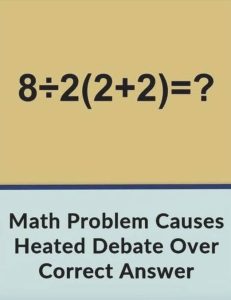
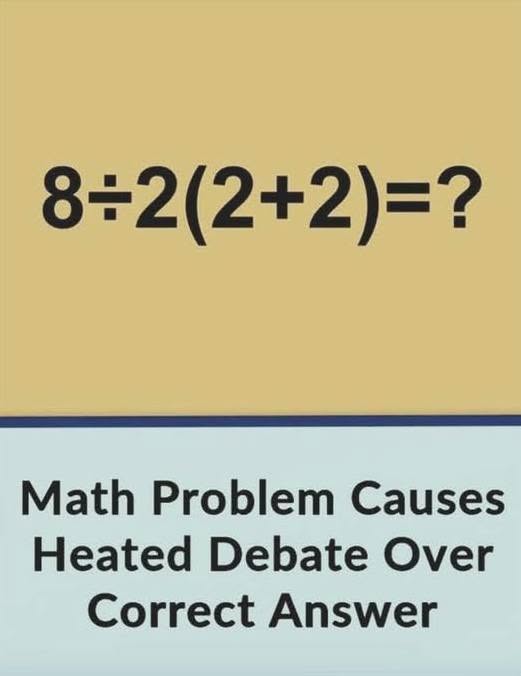
8 ÷ 2(2 + 2)
At first glance, it looks like a problem that should take only a few seconds to solve. But when people posted their answers online, two competing results quickly emerged: 1 and 16.
How could a basic arithmetic expression produce two dramatically different answers?
The controversy was not really about difficult mathematics. Instead, it exposed something much more interesting: the way people interpret mathematical notation, the importance of conventions, and the limitations of expressions that are written ambiguously.
The first step: simplify the parentheses
The expression begins with a familiar operation:
8 ÷ 2(2 + 2)
Inside the parentheses is:
2 + 2 = 4
So the expression becomes:
8 ÷ 2(4)
At this point, the disagreement begins.
Some people interpret the multiplication immediately following the 2 as a special combined quantity:
2(4) = 8
They then read the expression as:
8 ÷ 8 = 1
This produces the answer 1.
Other people follow the conventional order of operations and treat division and multiplication as operations of equal priority. They then perform them from left to right:
8 ÷ 2 × 4
First:
8 ÷ 2 = 4
Then:
4 × 4 = 16
This produces 16.
So which answer is correct?
The role of PEMDAS
The debate is often described as a disagreement about PEMDAS.
PEMDAS is a common acronym used in the United States to remember the conventional order of operations:
P — Parentheses
E — Exponents
M — Multiplication
D — Division
A — Addition
S — Subtraction
However, there is an important detail that is frequently misunderstood.
Multiplication does not universally come before division simply because the letter M appears before D in the acronym.
Multiplication and division have the same priority.
When multiplication and division appear at the same level, they are generally evaluated from left to right.
The same principle applies to addition and subtraction.
Therefore, after simplifying the parentheses, the expression can be interpreted as:
8 ÷ 2 × 4
Following left-to-right evaluation gives:
4 × 4 = 16
Under that conventional reading, the answer is 16.
Why did so many people answer 1?
The answer 1 is not random.
People who obtain 1 are often interpreting the notation differently. They see:
2(2 + 2)
as a tightly connected multiplication group.
In ordinary mathematical writing, juxtaposition—placing numbers or variables next to parentheses—does commonly indicate multiplication. For example:
3(x + 1)
is normally understood as a single multiplication structure.
Because of that convention, some readers naturally interpret:
8 ÷ 2(2 + 2)
as though the denominator were:
2(2 + 2)
That would mean:
8 ÷ [2(2 + 2)]
Then:
2 + 2 = 4
and:
2 × 4 = 8
so:
8 ÷ 8 = 1
The problem is that the original expression does not explicitly place the entire quantity 2(2 + 2) inside a denominator.
That is precisely why the notation became controversial.
The real issue: ambiguity
The most important lesson from the puzzle is not whether someone is “bad at math.”
The deeper issue is ambiguous notation.
Mathematics depends heavily on precise communication. When an expression can reasonably be interpreted in multiple ways, the best solution is often to rewrite it.
For example, if the intended answer is 1, a clearer expression would be:
8 ÷ [2(2 + 2)]
There is no confusion.
If the intended answer is 16, a clearer version would be:
(8 ÷ 2)(2 + 2)
Again, the intended structure is obvious.
This is why professional mathematicians generally try to avoid expressions that depend on readers guessing how the author intended the grouping.
Why calculators can make the debate worse
Another fascinating part of the controversy involved calculators.
Different calculators, websites, programming systems, and apps may process mathematical input differently depending on how the expression is entered and what conventions they use.
For example, typing the expression into a basic calculator may require entering individual operations sequentially. A scientific calculator may parse the expression according to a particular mathematical grammar. Computer algebra systems can have their own rules for implicit multiplication.
As a result, people sometimes posted screenshots showing different calculator answers and assumed that one device must be “wrong.”
But a calculator can only follow the rules programmed into it.
If the input itself is ambiguous, the machine may not resolve the ambiguity in the same way a human reader expects.
The internet turns a math problem into a cultural argument
What made the 2019 puzzle especially fascinating was the intensity of the online debate.
People did not merely exchange solutions.
They defended their answers passionately.
Some argued that anyone answering 16 did not understand PEMDAS. Others insisted that people answering 1 were incorrectly giving multiplication a higher priority than division.
The argument quickly spread beyond mathematics.
It became an example of how two people can look at exactly the same information and reach different conclusions because they apply different assumptions.
That makes the puzzle surprisingly relevant outside mathematics.
The same phenomenon occurs in contracts, programming languages, scientific notation, instructions, and everyday communication.
Mathematics requires conventions
There is another important lesson here.
Mathematical notation is not simply a collection of symbols. It is a language with conventions.
For example, parentheses tell us what belongs together. Fraction bars can make grouping clearer. Exponents establish relationships between quantities. Multiplication symbols can sometimes be omitted.
Experienced mathematicians rely on these conventions constantly.
But when notation becomes compressed, ambiguity can appear.
Consider the difference between:
8 ÷ 2 × 4
and
8 ÷ (2 × 4)
The first gives:
16
The second gives:
1
The numbers are identical.
The only difference is the grouping.
That tiny difference completely changes the result.
What the puzzle teaches students
For students, this controversy offers a useful lesson about order of operations.
Instead of memorizing PEMDAS as a rigid sequence, it is better to understand the underlying structure.
Parentheses and other