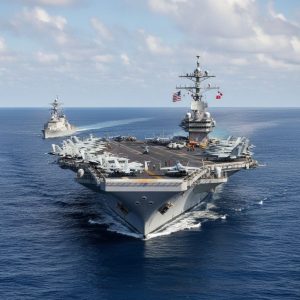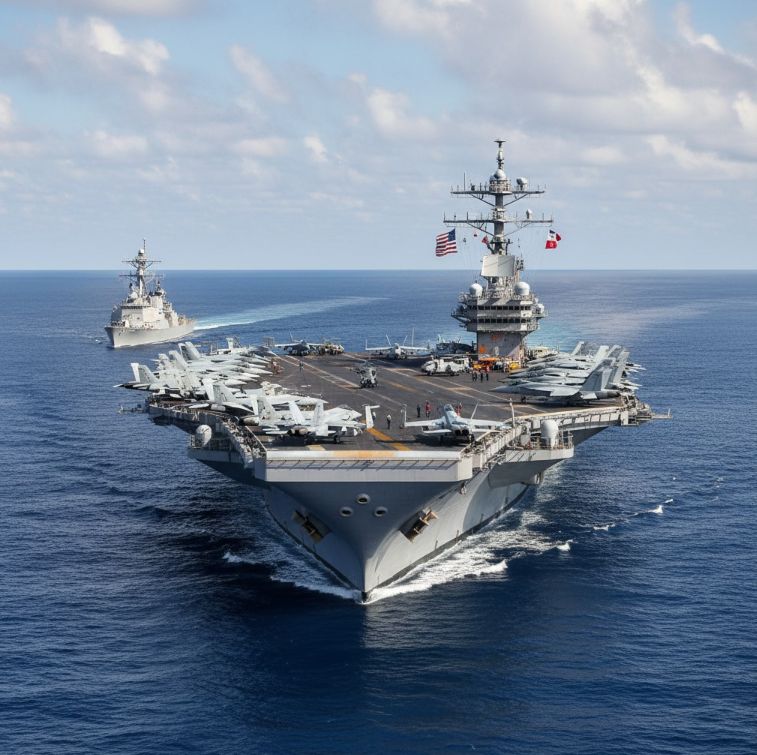
“5 minutes ago: Russian Sukhoi Su-57 pilot destroys U.S. aircraft carrier carrying 600 fighter jets.”
This kind of headline is engineered to feel immediate, dramatic, and believable—but when you break it down, it doesn’t hold up to reality. In fact, nearly every part of the claim contradicts how modern military systems actually work.
Start with the aircraft mentioned: the Sukhoi Su-57. This is Russia’s most advanced stealth fighter, designed for air superiority and strike missions. While it incorporates modern radar-evading features and advanced avionics, it is not a weapon capable of single-handedly destroying one of the most protected military assets on Earth. Even the most capable aircraft rely on coordinated operations—support from other aircraft, electronic warfare systems, satellites, and intelligence networks—to carry out complex missions.
Now consider the target: a U.S. aircraft carrier operated by the United States Navy. These carriers are not isolated ships; they are the centerpiece of a carrier strike group, which is essentially a floating fortress. Surrounding a carrier are multiple layers of defense: guided missile cruisers, destroyers equipped with advanced radar and interception systems, submarines operating below the surface, and fighter jets patrolling the skies above.
These defenses are specifically designed to detect and neutralize threats long before they get close. Enemy aircraft would be tracked from hundreds of miles away, intercepted by carrier-based fighters, and targeted by long-range missile systems. For a single jet—even a stealth one—to penetrate all these layers, deliver a decisive strike, and escape or succeed would require a breakdown of multiple independent defense systems simultaneously. That is not how modern naval warfare functions.
Then there’s the claim about “600 fighter jets.” This is where the story becomes even more detached from reality. No aircraft carrier in the world carries anywhere near that number of aircraft. Even the largest carriers—such as those in the U.S. fleet—typically carry around 60 to 75 total aircraft, including fighters, helicopters, and support planes. The idea of 600 fighter jets on a single ship is not just exaggerated; it is physically impossible given the size, deck space, and operational constraints of naval aviation.
Beyond the technical inconsistencies, think about the global implications. If a U.S. aircraft carrier were actually destroyed—especially by a Russian military asset—it would be one of the most consequential military events in modern history. It would represent a direct and severe escalation between two nuclear-armed powers. The consequences would be immediate and impossible to miss:
Governments around the world would issue emergency statements within minutes. Military forces would shift to high alert. News coverage would dominate every major outlet globally. Financial markets would react sharply, and international organizations would call for urgent responses.
None of that is happening.
Real-world events of this magnitude cannot remain confined to vague, viral posts. They generate overwhelming, consistent, and detailed reporting almost instantly. The absence of that reporting is a strong indicator that the claim is false.
So what explains messages like this?
They follow a familiar pattern of viral misinformation:
- Extreme urgency (“5 minutes ago”)
- High-stakes conflict involving major powers
- Dramatic, almost cinematic outcomes
- Lack of verifiable details (no ship name, no location, no official source)
Sometimes these stories are inspired by video game footage or simulations. Other times they are entirely fabricated to attract attention and provoke emotional reactions. In both cases, the goal is engagement—not accuracy.
There’s also a psychological factor. When people see a headline involving advanced weapons, global powers, and catastrophic outcomes, it triggers a sense of urgency and concern. That emotional response can make the claim feel more believable, even if the details don’t add up. In a world where information spreads instantly, that initial reaction is often enough to drive sharing before verification.
But critical thinking changes the outcome.
Ask simple questions:
Does the claim match known capabilities?
Are the numbers realistic?
Is there confirmation from reliable sources?
Here, the answers are clear. The capabilities don’t align, the numbers are impossible, and there is no credible confirmation.
That doesn’t mean global tensions aren’t real. Military forces continue to operate in complex and sometimes tense environments. Advanced aircraft like the Su-57 exist, and aircraft carriers remain central to naval strategy. But the scenario described—a single jet destroying a carrier loaded with hundreds of aircraft in a sudden, unreported event—is not grounded in reality.
It’s important to separate possibility from plausibility. While many things are theoretically possible in isolation, real-world events are constrained by technology, logistics, and systems designed to prevent exactly this kind of outcome.
In this case, the claim collapses under those constraints.
To be absolutely clear:
There is no verified report of a Russian Su-57 destroying a U.S. aircraft carrier.
The detail about “600 fighter jets” is factually incorrect.
And the overall scenario is not consistent with how modern military operations work.
In an age where headlines can be created and spread in seconds, the ability to pause, question, and analyze is more valuable than ever. Not every urgent message reflects reality—but every moment of critical thinking brings you closer to the truth.