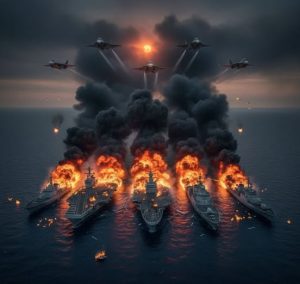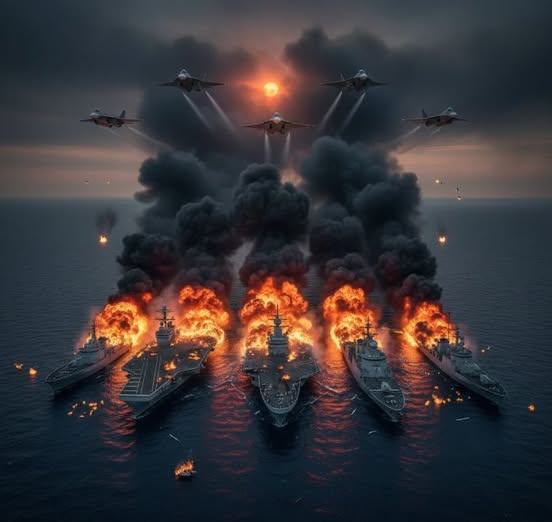
“1 minute ago: Russian Sukhoi pilots brutally destroy U.S. aircraft carrier in the Black Sea… See more” — this is another dramatic, fast-moving headline that sounds alarming, but it breaks down quickly when you look at the facts.
First and most important: there is no verified report of any U.S. aircraft carrier being destroyed in the Black Sea. An event like that would be one of the most significant military incidents in modern history. It would instantly dominate global news, trigger emergency responses from governments, and likely mark a major escalation between nuclear-armed powers. None of that is happening.
Now let’s examine the details of the claim itself.
The headline mentions “Russian Sukhoi pilots,” likely referring to aircraft such as the Sukhoi Su-57 or other Sukhoi models. While these are capable military aircraft, they are not designed to single-handedly destroy one of the most heavily defended naval assets in the world. Modern warfare relies on coordinated operations involving multiple units, not lone pilots carrying out massive, decisive strikes against fortified targets.
Next, consider the location: the Black Sea. This is where the claim becomes even more unrealistic. Aircraft carriers operated by the United States Navy do not operate in the Black Sea. There are strict international agreements—particularly the Montreux Convention—that limit the passage of large warships, especially aircraft carriers, through the Turkish Straits into the Black Sea. As a result, U.S. carriers are not deployed there.
That means the core scenario being described—Russian pilots attacking and destroying a U.S. aircraft carrier in that specific region—is based on a situation that doesn’t exist in the first place.
Even beyond that, think about how a real attack on a U.S. carrier would unfold. These ships are not alone. They are protected by a carrier strike group with multiple layers of defense: radar systems that detect threats at long range, escort ships equipped with missile defense systems, submarines providing stealth protection, and fighter jets patrolling the airspace.
For an attack to succeed, all of those systems would have to fail simultaneously. The attacking aircraft would need to evade detection, bypass interception, deliver a decisive strike, and do so without triggering an immediate and massive response. That’s not how modern naval operations work.
There’s also the issue of how information spreads. If a U.S. aircraft carrier were destroyed—even damaged significantly—it would be impossible to hide. Within minutes, there would be:
- Official statements from defense departments
- Continuous coverage across major news networks
- Satellite imagery and analysis
- Global political reactions
Instead, what you’re seeing is a vague, incomplete message ending in “see more.” That’s a hallmark of viral misinformation. It creates urgency without providing facts, encouraging people to click or share before verifying.
This type of content often follows a predictable pattern:
- It uses phrases like “1 minute ago” or “just now” to create immediacy
- It involves major global powers to increase emotional impact
- It includes dramatic language like “brutally destroy”
- It avoids specific, verifiable details
Sometimes these stories are based on fictional scenarios, simulations, or even footage from military-themed video games. Other times, they are entirely fabricated. Either way, they are not reliable sources of information.
It’s also important to understand why these posts spread so quickly. In times of global tension, people are more sensitive to news about conflict. A dramatic headline can trigger fear or curiosity, making it more likely to be shared. Social media algorithms often amplify content that gets strong reactions, regardless of whether it’s accurate.
But reacting quickly isn’t the same as reacting accurately.
When you encounter a claim like this, a few simple checks can help:
- Does it name a specific ship or provide verifiable details?
- Are multiple trusted sources reporting the same event?
- Does the scenario make sense given known military rules and geography?
In this case, the answer to all of those questions is no.
The reality is that while global military tensions can be serious, not every alarming headline reflects a real event. The idea of Russian Sukhoi pilots destroying a U.S. aircraft carrier in the Black Sea is not supported by facts, not consistent with international agreements, and not reported by any credible source.
To be clear:
There is no confirmed attack,
No U.S. carrier in that location,
And no evidence supporting the claim.
In a fast-moving information environment, the most powerful tool you have is the ability to pause and think critically. Not everything labeled “breaking news” is real—but taking a moment to question it can make all the difference.