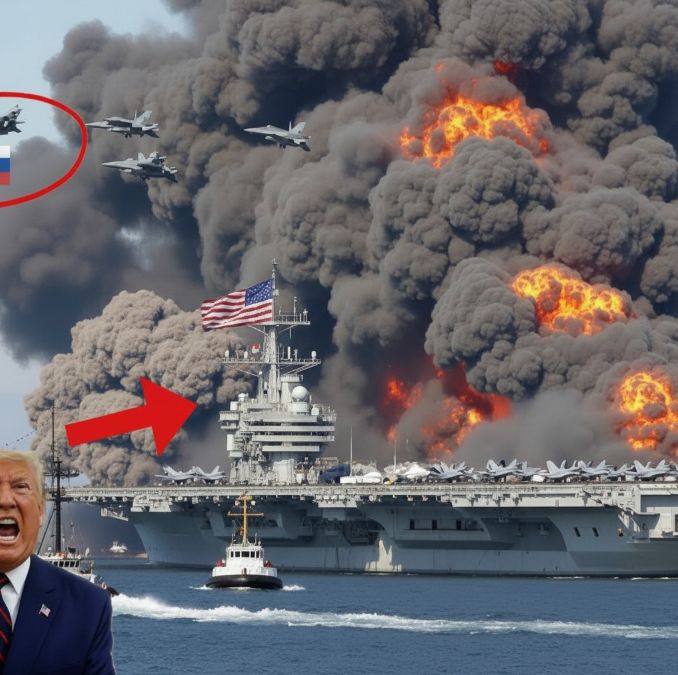
A headline like: “13 minutes ago: Russian Su-57 pilot destroys U.S. aircraft carrier carrying 700 tanks” is designed to feel urgent and shocking—but it falls apart immediately when compared with real-world facts, military capabilities, and basic logistics.
Let’s break it down carefully.
First, the aircraft mentioned—the Sukhoi Su-57—is a real Russian stealth fighter. It is advanced in design, with modern avionics and air-to-air and air-to-ground capabilities. However, it is still a single tactical aircraft, not a strategic super-weapon capable of independently destroying a heavily defended naval fleet. Modern warfare does not work as “one pilot destroys an entire carrier group.” Military operations require coordinated strikes, electronic warfare support, missile systems, and multi-platform coordination.
Now consider the target: a U.S. aircraft carrier operated by the United States Navy. Aircraft carriers are among the most heavily protected military assets in existence. They do not operate alone. A carrier is always part of a carrier strike group, which includes destroyers, cruisers, submarines, early-warning aircraft, and layered missile defense systems.
These systems are designed specifically to prevent exactly what the headline describes. Enemy aircraft would be detected far beyond visual range, tracked continuously, and intercepted long before reaching strike distance. Even if one aircraft attempted an attack, it would have to survive multiple layers of radar detection, electronic warfare disruption, and missile interception.
Now let’s address one of the most unrealistic parts of the claim: the idea that a carrier is “carrying 700 tanks.”
This is physically impossible.
Modern aircraft carriers are designed to carry aircraft, not armored ground vehicles like tanks. Tanks are transported by dedicated cargo ships or landing vessels, not aircraft carriers. Even large naval vessels simply do not have the structural capacity, weight allowance, or storage configuration to transport hundreds of tanks.
To put it simply:
- Aircraft carriers carry fighter jets, helicopters, and support aircraft
- Tanks are transported by specialized transport ships
- The two systems are completely different in design and purpose
So the claim immediately breaks down on logistics alone.
Now consider the implication of the headline: that a single Su-57 pilot destroyed this entire carrier and its cargo “13 minutes ago.” If such an event actually occurred, it would be one of the most significant military disasters in modern history. It would trigger immediate global consequences:
- Emergency statements from governments worldwide
- Continuous coverage by all major international news outlets
- Immediate military alerts and strategic responses
- Satellite confirmation and independent verification
- Economic shockwaves in global markets
None of that is happening.
Real-world military events of this scale cannot remain hidden or vague. They are tracked, reported, and analyzed in real time by governments, journalists, and independent observers.
So why do these kinds of headlines appear?
They are part of a pattern of viral misinformation that uses:
- Extreme urgency (“13 minutes ago”)
- High-profile military equipment
- Impossible scenarios
- Emotional or catastrophic language
- Lack of verifiable details
The goal is not to inform—it is to capture attention and encourage sharing.
Sometimes these posts are inspired by video game footage or military simulations. Other times, they are completely fabricated stories designed for engagement. Either way, they are not based on real events.
It’s also important to understand how modern military technology actually works. Even advanced aircraft like the Su-57 operate within a networked battlefield environment. Success in modern warfare depends on coordination between air, sea, space, and cyber capabilities. No single aircraft operates alone against an entire naval group.
Aircraft carriers, on the other hand, represent entire floating military bases. They are not only heavily defended but also supported by intelligence networks, satellite surveillance, and allied coordination. Their survival depends on redundancy, detection systems, and layered defense strategies.
Because of this, the scenario described in the headline is not just unlikely—it is incompatible with how modern military systems function.
There is also the issue of scale. The claim involves “700 tanks,” which exceeds even the cargo capacity of the largest military transport ships, let alone an aircraft carrier. Transporting that many armored vehicles would require a massive logistical operation involving multiple specialized vessels, not a single carrier.
In reality, no credible military source reports anything resembling this event. There are no verified losses, no official statements, and no independent confirmation.
To be absolutely clear:
- There is no evidence a U.S. aircraft carrier was destroyed
- There is no evidence of a Su-57 carrying out such an attack
- The claim about “700 tanks” is logistically impossible
- The entire scenario is not consistent with real-world military operations
What this shows is how easily dramatic narratives can spread when they combine real military names with fictional scenarios. The presence of real elements (like the Su-57 or U.S. Navy) can make a false story feel believable, even when the details are physically impossible.
In situations like this, the most important tool is critical thinking. Asking simple questions—Does this make sense? Could this physically happen? Is it being reported by credible sources?—quickly reveals the truth.
And in this case, the answer is clear: the headline is not describing a real event. It is misinformation built for shock value, not reality.